
 Worksheets
Where People Live and Why
Total questions: 19
Worksheet time: 11mins
Name
Class
Date
1.

The number of people in a certain space such as a mile or kilometer is...
a)
population
b)
population density
c)
population distribution
2.

The total number of people divided by square miles is the formula for...
a)
population distribution
b)
population density
3.

One important feature of the world's population with the most significant future implications is that:
a)
the natural increase rate is larger every year.
b)
there are fewer people in the world now than at the peak of the 20th century.
c)
people are uniformly distributed across Earth.
d)
the most rapid growth is occurring in the less developed countries.
4.

The most populous country in the world is:
a)
China.
b)
India.
c)
Russia.
d)
Indonesia.
5.

Two-thirds of the world's population is clustered in 4 regions. Which of the following is NOT one of these 4 regions?
a)
South Asia
b)
Southeast Asia
c)
Europe
d)
Sub-Saharan Africa
6.

Human beings avoid all but which of these regions?
a)
Warm lands
b)
Dry lands
c)
High lands
d)
Wet lands
7.

Physiological density is the number of:
a)
acres of farmland.
b)
people per area suitable for agriculture.
c)
farmers per area of farmland.
d)
farm animals per area suitable for agriculture.
8.

A country with a large amount of arable land and a small number of farmers will have:
a)
high agricultural density.
b)
low agricultural density.
c)
high arithmetic density.
d)
low physiological density.
9.

Land suited for agriculture is called:
a)
arid land.
b)
arable land.
c)
population density.
d)
cultural landscape.
10.
The number of persons in a certain area. This is measured as persons per square mile.
a)
death rate
b)
birth rate
c)
population density
d)
emigrate
11.

What type of population growth does this graph represent?
a)
Abiotic growth
b)
Logistic growth
c)
Maximum growth
d)
Exponential growth
12.
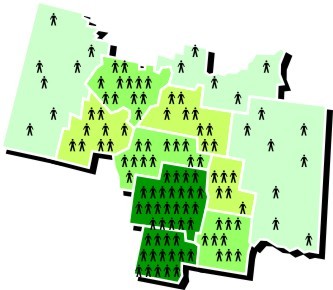
The average number of people per square mile
a)
population distribution
b)
population density
c)
urbanization
d)
population rate
13.

The number of deaths compared to the total number of people in a population
a)
death rate
b)
doubling time
c)
population decline
d)
birth rate
14.
Population distribution refers to how...
a)
People live in different areas.
b)
People emigrate in an area.
c)
People are located within an area.
d)
People are living in an area.
15.
What is life expectancy?
a)
The number of years needed for one to reach 60 years.
b)
The number of years that a person is expected to live on his/her own.
c)
The number of years that a person is expected to live.
d)
What one expects to face in life.
16.
What is population density?
a)
The number of people living across Europe.
b)
The number of plants occupying an area.
c)
The number of people living in an area.
d)
The number of insects in an ecosystem.
17.
The equation: (number of people)
÷ (land area) =
÷ (land area) =
a)
Population
b)
Population distribution
c)
birth rate
d)
Population Density
18.
The birth and death rate are per ________ people
a)
5,000
b)
1,000
c)
1
d)
1,000,000,000
19.
What does it mean that a pyramid graph is wider at the base?
a)
The population is decreasing
b)
The population is getting older
c)
The population is increasing
100 %

