
 Worksheets
Forces and Momentum
Total questions: 48
Worksheet time: 57mins
Name
Class
Date
1.
The ability to resist a change in motion is known as...
a)
Impulse
b)
Inertia
c)
Mass
d)
Force
2.
The units for force are...?
a)
Newton
b)
kg x m/sec
c)
Impulse
d)
kg / m / s / s
3.
An object in motion will remain in motion.
a)
1st Law
b)
2nd Law
c)
3rd Law
d)
Conservation of Momentum
4.
If I push you, then you also will push me.
a)
1st Law
b)
2nd Law
c)
3rd Law
d)
Conservation of Momentum
5.
The momentum before and after a collision is the same.
a)
1st Law
b)
2nd Law
c)
3rd Law
d)
Conservation of Momentum
6.
Two objects of equal mass are given a push. Object 1 accelerates faster than object 2. What can be said about the forces causing the motion.
a)
The force on object 1 was greater than the force on object 2.
b)
The forces were equal on both objects
c)
The force on object 2 was greater than the force on object 1.
d)
The forces were equal, but the momentum was larger for object 1.
7.
Coins are stacked on top of an index card which is placed over a cup. The index card is flicked and the coins...
a)
fall straight down due to 1st Law
b)
fly off due to 2nd Law.
c)
fly toward the flick due to 3rd Law
d)
The coins absorbe the momentum of the flick and fly off at an increased speed.
8.
kg x m / sec. These are the units for...
a)
momentum
b)
force
c)
acceleration
d)
velocity
9.
Which of the following is NOT a Vector.
a)
Force
b)
Momentum
c)
Acceleration
d)
Speed
10.
A red car is sitting still and gets hit by a blue car of equal mass going at a speed of 30 m/s. After the collision, which car has the greater change in velocity?
a)
red car
b)
blue car
c)
they will be equal
d)
It could be either depending on the type of collision.
11.
A blue car of greater mass collides head on with a red car of less mass. The two cars were initially traveling at the same speed before impact and stuck together after the collision. Which scenario explains what would happen afterwards.
a)
The red and blue car would continue at the same speed in the direction of the blue car initially but at a slower speed.
b)
The red and blue car would continue at the same speed in the direction of the red car initially but at a slower speed.
c)
The red and blue car would continue at the same speed in the direction of the blue car initially but at a faster speed.
d)
The red and blue car would continue at the same speed in the direction of the red car initially but at a faster speed.
12.
A 15 N force is applied to a box. The box then accelerates at a rate of 3 m/s/s. What would the mass of the box be?
a)
5 kg
b)
12 kg
c)
45 kg
d)
18 kg
13.
A man fires a gun and it knocks him over.
a)
1st Law
b)
2nd Law
c)
3rd Law
d)
4th Law
14.
A 3 kg car traveling at 5 mph collides with a 2 kg car at rest and they stick together. What will the speed of the cars be together afterwards?
a)
3 mph
b)
15 mph
c)
5 mph
d)
25 mph
15.
If an object has more mass, then ___ force will be required to accelerate it.
a)
More
b)
Less
c)
Same
16.
In order for an object to experience a change in motion, what must happen?
a)
An unbalanced external force must be applied to it.
b)
A velocity must be present
c)
An internal force must be applied.
d)
An object must move at a constant velocity.
17.
Objects that are moving with balanced forces upon them will travel ...
a)
in a straight path
b)
travel the path of least resistance.
c)
travel towards the greater force presence.
d)
stop moving until a force is applied.
18.
F = m x a
a)
1st Law
b)
2nd Law
c)
3rd Law
d)
4th Law
19.
If the time interval that a force interacts with an object decreases to stop the objects motion, the _____ the force will need to be.
a)
greater
b)
lesser
c)
the force will be the same regardless.
20.
Foundation for the Law of Conservation of Momentum
a)
1st Law
b)
2nd Law
c)
3rd Law
d)
4th Law
21.
Originally by Galileo
a)
1st Law
b)
2nd Law
c)
3rd Law
d)
4th Law
22.
Forces always come in ....
a)
pairs
b)
sets of 3
c)
as waves
d)
individual amounts
23.
'p' before equals 'p' after.
a)
1st Law
b)
2nd Law
c)
3rd Law
d)
Law of Conservation of Momentum
24.
Which type of collision (assuming same mass and speeds) has the lowest change in momentum.
a)
A collision where a car bounces
b)
A collision where the cars stick
25.
What is Newton's First Law known as? The Law of
a)
Friction
b)
Mass
c)
Inertia
d)
Gravity
26.
What is Newton's First Law
a)
F=ma
b)
Every action has an equal and opposite reaction
c)
An object at rest stays at rest, an object in motion stays in motion.
d)
Friction
27.
What Unit do we Measure Force in?
a)
Newtons
b)
Joules
c)
grams
d)
pounds
28.
As the acceleration of an object increases, what happens to the force of the object?
a)
force increases
b)
force decreases
c)
force remain the same
d)
mass increases
29.

Will it take more force to push an empty shopping cart or a shopping cart that is full?
a)
The empty shopping cart
b)
The full shopping cart
c)
They will take the same amount of force
30.
When a heavy football player and a light one run into each other, who exerts more force?
a)
The heavy one
b)
The light one
c)
They are equal
d)
there is no such thing as force
31.
According to Newton's 3rd Law, reactions always go in the ___ direction of the action.
a)
same
b)
opposite
32.
You push on a tree with 20 N of force. If the tree doesn't move, the tree is pushing back on you with _____of force.
a)
20N
b)
40N
c)
10N
d)
70N
33.
A biker with a mass of 75 kg moves along the path with a constant velocity of 5 m/s. What is the biker's momentum?
a)
25 m/s
b)
375 m/s
c)
25 kg m/s
d)
375 kg m/s
34.
A runner has a momentum of 670 kg m/s and is travelling at a velocity of 9 m/s. What is his mass?
a)
6030 kg
b)
0.0134 kg
c)
74.4 kg
d)
80 kg
35.
The units for Impulse are kg x m/s and/or
a)
N/s
b)
N.s
c)
N
d)
m/s
36.
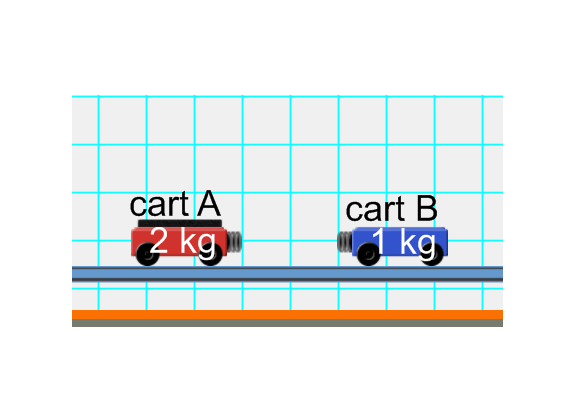
Cart A is pulled with a 2 Newton force for 2 seconds, and Cart B is pulled with a 1 Newton force for 3 seconds. Which cart experiences the greatest impulse?
a)
Cart B
b)
Cart A
c)
they are the same
37.
Softer landings tend to
a)
increase impact force
b)
increase force
c)
increase collision time
d)
increase change in momentum
38.
The purpose of crumble zones on a car is to
a)
decrease time of impact.
b)
increase force of impact.
c)
increase the time of impact.
d)
decrease the impulse during impact.
39.
A 0.250 kg cart moving at 0.400 m/s has how much momentum?
a)
0.1 kg-m/s
b)
1 kg-m/s
c)
10 kg-m/s
d)
100 kg-m/s
40.
Newton's 2nd Law can be rearranged to say...
a)
the impulse on an object is equal to the change in momentum it causes
b)
the force on a moving object is equal to the magnitude of the impulse.
c)
the impulse on an object is greater than the change in momentum it causes
d)
the impulse on an object is less than the change in momentum it causes
41.
If an air bag changes a 60 kg person's speed from 40.0 m/s to 0.0 m/s, what impulse must act on the person?
a)
2400 kg.m/s
b)
1.5 kg.m/s
c)
0.67 kg.m/s
d)
1500 kg.m/s
42.
The momentum of an object depends upon the object's ___________&_____________.
a)
size and shape
b)
mass and speed
c)
mass and veloctiy
d)
mass and energy
43.
Momentum is conserved in this type of collision
a)
elastic
b)
inelastic
c)
momentum is conserved in both types of collisions
44.
A 2 kg cart has a momentum of 16 kg m/s. What is its velocity?
a)
8 m/s
b)
32 m/s
c)
0.125 m/s
d)
18 m/s
45.
Paul is riding a motorbike while wearing a helmet with a face shield. A beetle hits Paul's face shield while Paul is moving at 30 mph. Which undergoes the greater change in momentum?
a)
Paul
b)
Beetle
c)
both are the same
46.
Paul is riding a motorbike while wearing a helmet with a face shield. A beetle hits Paul's face shield while Paul is moving at 30 mph. Which undergoes the greater acceleration?
a)
Paul
b)
Beetle
c)
both are the same
47.
In a physics experiment, two carts of mass 1.5 kg each are rolled towards each other. The orange cart has a velocity of 2 m/s and the blue cart has a velocity of -1m/s. The carts stick together when they collide. Calculate their final speed.
a)
0.5 m/s
b)
1.0 m/s
c)
0.33 m/s
d)
0.67 m/s
48.
A 0.5 kg ball moving at 5 m/s strikes a wall and rebounds in the opposite direction with a speed of 2 m/s. The time the ball is in contact with the ball is 0.01 s. Calculate the force acting on the ball by the wall during the collision. F = ______ N (magnitude only)
a)
0.14
b)
150
c)
350
d)
500
100 %

