wayground logo

Free Printable Worksheets

Font size

S
M
L
XL
Worksheets

Motion Review

Total questions: 44

Worksheet time: 35mins

Name
Class
Date
1.

A push or pull that can change the position or motion of an object/material is --

a)

magnetism

b)

motion

c)

force

2.

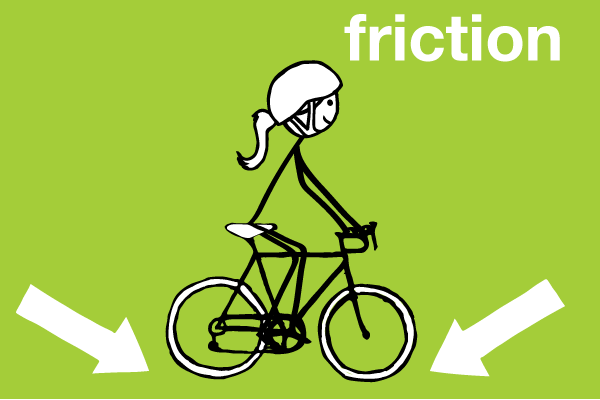
Friction is the _________

a)

force of attraction that causes a magnetic material to move

b)

force that acts in an opposite directions to movement

c)

act of applying force in order to move something away

3.

Two students were pulling on the rope below with the same amount of force. The man increased the amount of force he was using by 2 N and the woman increased the amount of force she was using by 4 N. Which BEST describes the motion that resulted after they increased force?

a)

The both moved farther from one another

b)

The man moved towards the woman

c)

The woman moved towards the man

d)

They both moved farther from one another

4.

As two objects get closer together, what happens to the force of gravity between them?

a)

The force of gravity increases

b)

The force of gravity decreases

c)

The force of gravity stays the same, since their masses are constant

d)

Not enough information

5.

As an astronaut travels far away from Earth, his weight

a)

increases because gravity increases.

b)

decreases because her mass decreases.

c)

remains the same because her mass remains the same.

d)

decreases because gravity decreases.
6.
A ball on a string is travelling in circular motion. Which vector represents the centripetal force?
a)
The green vector because it points towards the center of the circular path
b)
The blue vector because it shows the direction of the object's inertia
c)
The green vector because it shows the path of the ball
d)
The blue vector because this is the way the ball will move when it is released.
7.
Centripetal acceleration always points
a)
in the direction of the object's motion
b)
in the opposite direction of the object's motion
c)
towards the center of the circle
d)
towards the outside of the circle
8.
Why do we need friction?
a)
It helps objects go faster. 
b)
It helps objects go up higher.
c)
It helps make objects go slower or stop.
9.
What does a curved line on a distance-time graph show?
a)
That the speed is changing. 
b)
That the object is not moving. 
c)
That the object is constant. 
10.
What are EQUAL forces acting on an object in opposite directions that do not change the object's motion?
a)
Friction
b)
Weight
c)
Balanced Forces
d)
Unbalanced Forces
11.
What are UNEQUAL forces acting on an object in opposite directions that cause motion?
a)
Balanced Forces
b)
Unbalanced Forces
c)
Gravity
12.
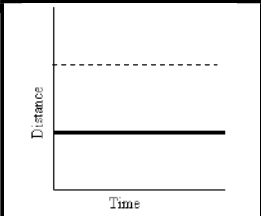
What does this graph represent?
a)
Constant speed
b)
Acceleration
c)
Not moving
13.
It's field day and two classes are playing tug-of-war. One side has 4 people and the other side has 8 people. What is this an example of?
a)
balanced forces
b)
unbalanced forces
14.
This is an example of _____ because the object WILL move. 
a)
Unbalanced Forces
b)
Balanced Forces
c)
Neither
15.
The term for when an object speeds up, slows down, or changes direction
a)
Speed
b)
Velocity
c)
Acceleration
d)
Newtons
16.
How much force is required to accelerate 10 kg at a rate of 100 m/s2?
a)
1,000kg
b)
10N
c)
10kg
d)
1,000N
17.
What is the acceleration of a 50 kg object pushed with a force of 2,500 newtons?
a)
75,000N
b)
50N
c)
2500N
d)
50m/s2
18.
18 km/s in a northerly direction is an example of
a)
velocity
b)
Speed
c)
acceleration
d)
momentum
19.
The net force of the following diagram is
a)
20 N
b)
Moving to the left
c)
Balanced forces
d)
160 N
20.
Which graph best represents a graph of a car travelling down a freeway at a CONSTANT speed?
a)
A
b)
B
c)
C
d)
D
21.
If a 100 N force acts on a 50 kg car, what will the acceleration be? ( F= m x a)
a)
500m/s2
b)
2m/s2
c)
50m/s2
d)
150 m/s2
22.
The snail is traveling at 5 cm/hr. This is an example of
a)
speed
b)
forces
c)
acceleration
d)
velocity
23.
What is the speed of the object represented by the graph?
a)
0.5 m/s
b)
2 m/s
c)
5 m/s
d)
4 m/s
24.
a change in position is defined as
a)
force
b)
motion
c)
speed
d)
acceleration
25.
How are speed and velocity different?
a)
Speed includes direction
b)
Speed indicates momentum
c)
Velocity includes Momentum
d)
Velocity includes direction
26.
A cup is sitting on a table. Which statement best describes the relationship between the cup and the table? 
a)
The cup is accelerating faster than  the table
b)
The cup is pushing on the table 
c)
The cup is doing work on the table 
d)
The forces on the cup are unbalanced 
27.
Which is an example of Newton's third law about action and reaction forces? 
a)
A rocket takes off from the ground
b)
A book slides forward when the car stops
c)
A heavier ball falls at the same speed as a lighter ball 
d)
A vehicle will slow down as it curves
28.
With unbalanced forces, the object will move in the direction of the _______ force.
a)
larger 
b)
smaller 
c)
equal 
29.
A magician pulls a tablecloth out from under dishes and glasses on a table without disturbing them.
a)
Newton's 1st Law
b)
Newton's 2nd Law
c)
Newton's 3rd Law
30.
Pushing a child on a swing is easier than pushing an adult on the same swing, because the adult has more mass and requires more force to accelerate.
a)
Newton's 1st Law
b)
Newton's 2nd Law
c)
Newton's 3rd Law
31.

A force of 25 N is pushing down on an object, while a force of 50 N is pushing up on the object.


What is the net force acting on the object and which direction will it move?

a)

75 N, up

b)

75 N, down

c)

25 N, up

d)

25 N, down

32.

During which interval(s) is this object as rest? (You *may* select more than one answer.)

a)

0 and 10 seconds

b)

10 and 20 seconds

c)

20 and 30 seconds

d)

30 and 40 seconds

33.

During which interval is this object accelerating the fastest?

a)

0 and 10 seconds

b)

10 and 20 seconds

c)

20 and 30 seconds

d)

30 and 40 seconds

34.

Which law states that for every action there is an equal and opposite reaction?

a)

1st Law

b)

2nd Law

c)

3rd Law

35.

Which law states that the acceleration of an object depends on the force exerted on it and its mass?

a)

1st Law

b)

2nd Law

c)

3rd Law

36.

Which law states that an object at rest stays at rest and an object in motion stays in motion unless an unbalanced force acts on it?

a)

1st Law

b)

2nd Law

c)

3rd Law

37.
Which has more momentum: a car stopped at a red light or a bike moving at 15 mph?
a)
car
b)
bike
c)
they are equal
d)
cannot determine using the info provided
38.

Which of the following has the MOST momentum?

a)

rolling ping-pong ball

b)

rolling bowling ball

c)

rolling soccer ball

d)

rolling basketball

39.

The state that exists when the only force acting on an object is gravity is called

a)

free fall

b)

inertia

c)

acceleration

d)

momentum

40.

Satellites in orbit around the Earth travel in almost circular path because Earth is

a)

centripetal

b)

free falling

c)

curved

d)

massive

41.

The force that causes an object to move in a circle is called centripetal force?

a)

True

b)

False

42.

Any object that travels around another object in space is a satellite.

a)

True

b)

False

43.

What is the ONLY force acting on free fall

a)

friction

b)

gravity

c)

centripetal

d)

centrifugal

44.

An object in free fall

a)

ignores air resistance.

b)

undergoes a downward acceleration.

c)

has an acceleration of -9.8 m/s2.

d)

all of these.