
 Worksheets
Chemical Bonding and Equations Review
Total questions: 30
Worksheet time: 32mins
Name
Class
Date
1.

A chemical bond is a ______________ that holds atoms together.
a)
force
b)
negative
c)
positive
d)
compound
2.

What usually forms the positive ion? (Loses electrons)
a)
Metals
b)
Nonmetals
3.

What two types of atoms make a covalent bond?
a)
2 Nonmetals
b)
1 Nonmetal and 1 Metal
c)
2 Metals
d)
2 Noble Gases
4.

What is the number of valence electrons for Oxygen (group 16)?
a)
8
b)
6
c)
2
d)
1
5.
What will happen when a polar and a nonpolar substance is in the same container?
a)
They will dissolve
b)
They will mix evenly
c)
They will not mix
d)
They will attract each other
6.

How many valence electrons in this structure?
a)
6
b)
5
c)
4
d)
7
7.
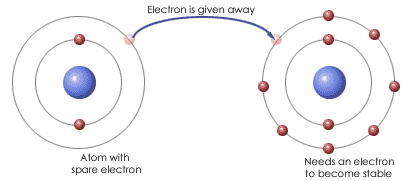
What is a bond that forms when valence electrons are transferred from one atom to another?
a)
ionic bond
b)
covalent bond
c)
crystal bond
d)
atom bond
8.

What type of compound is CaF2?
a)
covalent
b)
ionic
c)
polar
d)
metallic
9.

Ionic or covalent?
NH3
NH3
a)
Ionic
b)
Covalent
10.

When a metal reacts with a nonmetal, it makes
a)
an ionic bond
b)
a covalent bond
c)
a low melting point
d)
water molecules
11.

This type of model shows only the valence electrons of an element?
a)
Bohr diagram
b)
Childers model
c)
Electron Dot Diagram
d)
What is a valence electron again?
12.

In a covalent bond, one or more electrons are?
a)
shared
b)
lost
c)
gained
d)
transferred
13.

What group of elements has a full outer shell and doesn't usually form bonds?
a)
halogens
b)
noble gases
c)
alkali metals
d)
alkaline earth metals
14.

Which types of bonds usually form solid crystals?
a)
Ionic
b)
Covalent
c)
Metallic
d)
Bohr Model
15.

Why don't noble gases normally form chemical bonds?
a)
They have only 2 valence electrons
b)
Their outer level electrons are empty
c)
They have 8 neutrons
d)
They have a full outer shell
16.

What are the electrons in the outer most level called?
a)
Outer level electrons
b)
Protons
c)
Neutrons
d)
Valence Electrons
17.

What is a charged atom called? (can be positive or negative)
a)
ion
b)
ide
c)
bond
18.

How many atoms of carbon are used to make a molecule of sugar, C12H22O11?
a)
12
b)
22
c)
11
d)
Sugar is not a molecule
19.
Predict the bond that will form between Na (metal) and Cl (nonmetal).
a)
Ionic
b)
Covalent
c)
Metallic
20.

Predict the bond that will form between H (nonmetal) and O (nonmetal)
a)
Ionic
b)
Covalent
c)
Metallic
21.
What elements generally make an ionic bond?
a)
metal and nonmetal
b)
2 nonmetals
c)
2 metals
d)
none of the above
22.
Which is the correct formula for:
three hydrogen (H)
one sulfur (S)
four oxygen (O)
three hydrogen (H)
one sulfur (S)
four oxygen (O)
a)
H3SO4
b)
HSO4
c)
H4S3O
d)
H2O
23.

The red numbers in the image below represent ________
a)
subscripts
b)
coefficients
c)
small numbers
d)
None of the answers are correct
24.

The blue numbers in the image below represent ________
a)
big numbers
b)
coefficients
c)
subscripts
d)
none of the answers are correct
25.
In the equation,
2Mg + O2 ---> 2MgO
which are the reactants?
a)
2Mg and O2
b)
2MgO
c)
2Mg and 2MgO
d)
O2 and 2MgO
26.
In a chemical reaction, everything to the right of the arrow is called ______________.
a)
Products
b)
Yields
c)
Molecules
d)
Reactants
27.
How many Aluminum are in Al2O3?
a)
3
b)
2
c)
5
28.
Balance this equation...
H2 + Cl2 --> HCl
H2 + Cl2 --> HCl
a)
It is balanced
b)
3H2 + Cl2 --> 6H2Cl
c)
H2 + Cl2 --> 2HCl
29.

How many Iron (Fe) atoms are in this chemical formula?
a)
2 iron atoms
b)
6 iron atoms
c)
5 iron atoms
d)
4 iron atoms
30.
The law of conservation of mass states that....
a)
Matter can be created
b)
Matter can be destroyed
c)
Matter can not be created or destroyed
100 %

