
 Worksheets
Space
Total questions: 22
Worksheet time: 18mins
Name
Class
Date
1.

Which causes the day-and-night cycle on earth?
a)
Earth moving around the sun
b)
The sun moving around the Earth
c)
Earth tilting on its axis
d)
Earth spinning on its axis
2.

What causes the different phases of the moon?
a)
Earth's shadow falling on the moon
b)
The change in the positions of Earth, the moon, and the sun
c)
The change in Earth's position in its orbit around the sun
d)
The moon's revolution around Earth
3.

When a planet spins on its axis, it is said to ___________________.
a)
orbit
b)
rotate
c)
revolve
d)
eclipse
4.

To "revolve" means to _________________
a)
rotate
b)
spin
c)
move
d)
orbit
5.
What galaxy do we live in?
a)
Black Hole
b)
Milky Way
c)
Milk Dud
d)
Three Musketeers
6.

What causes seasons?
a)
The distance of a planet from the sun
b)
The gravitational pull of the Earth and Moon
c)
The tilt and revolution of Earth around the sun
d)
Changing temperatures on Earth
7.

If it is winter in the Northern Hemisphere, what season is it in the Southern Hemisphere?
a)
Spring
b)
Fall
c)
Winter
d)
Summer
8.

What happens when the area you live in tilts away from the sun?
a)
It is summer
b)
It is spring
c)
It is fall
d)
It is winter
9.

How does tides form?
a)
by the earth going around the sun
b)
the earth going around the moon
c)
the sun going around the mars
d)
the moon going around the earth
10.

Which moon phase?
a)
Full moon
b)
waxing crescent
c)
waning crescent
d)
?????????
11.

The only planet that we know of which can sustain life is ____________.
a)
mars
b)
earth
c)
the moon
d)
jupiter
12.

What is the force present on Earth, but not in space, that makes it difficult for the heart to move blood throughout the body?
a)
energy
b)
friction
c)
gravity
d)
inertia
13.

Earth's rotation on its axis is what causes ______________________________.
a)
seasons
b)
moon phases
c)
day and night
d)
weather
14.

The Sun is a ____________.
a)
planet
b)
star
15.

Which of the following is a gas giant?
a)
Venus
b)
Jupiter
c)
Pluto
d)
Mercury
16.

What planet is it?
a)
Jupiter
b)
Saturn
c)
Uranus
d)
Venus
17.

The moon is a cold ball of rock that orbits the
a)
Sun
b)
Earth
c)
moon.
18.

True or False
The planets are not lined up in a perfectly straight line
The planets are not lined up in a perfectly straight line
a)
True
b)
False
19.

What is NOT a common characteristic of the outer planets?
a)
Gaseous
b)
Giant
c)
Rings
d)
Smaller than Earth
20.

Which planet rotates on its side?
a)
Jupiter
b)
Saturn
c)
Uranus
d)
Neptune
21.
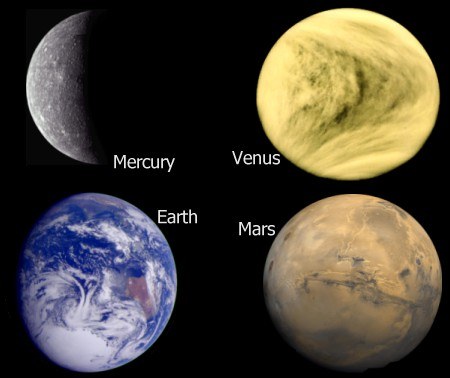
Earth and the other planets closest to the Sun are made mostly of _______
a)
gas
b)
metal
c)
water
d)
rock
22.

What type of eclipse is the picture showing?
a)
Solar
b)
Lunar
100 %

