
 Worksheets
Unit 2 Astronomy & Cosmology Learning Check Review
Total questions: 67
Worksheet time: 49mins
Name
Class
Date
1.

Where is the planet moving faster
a)
Position A to B
b)
Position B to C
c)
Position H to I
d)
Position I to J
2.
What is the correct order in the Universe Hierarchy?
a)
Sun→Earth→
Universe→
galaxy
Universe→
galaxy
b)
Universe→solar system→galaxy→Earth
c)
Universe→galaxy→
planetary system→
planet
planetary system→
planet
d)
planetary system→solar system→galaxy→
universe
universe
3.
Kepler's first law states that the orbits of the planets are oval in shape or
a)
ellipses
b)
perfect circles
4.
Kepler's second Law deals with
a)
the shape of the planets' orbits
b)
the speed/area the planet travels
c)
the length of time it takes the planet to orbit the sun
5.
Kepler's third law of planetary motion describes a relationship between the
a)
shape of orbit and location of Sun.
b)
orbital velocity and position in orbit
c)
distance from the Sun and length of year.
d)
path of epicycle and position.
6.
A force of attraction between objects that is due to their masses.
a)
Solar Flare
b)
Orbit
c)
Gravity
d)
Centripetal Force
7.
The process by which nuclei of small atoms combine to form a new, more massive nucleus; the process releases energy.
a)
Aphelion
b)
Prominence
c)
Parallax
d)
Nuclear Fusion
8.
The path that a body follows as it travels around another body.
a)
Solar System
b)
Prominence
c)
Orbit
d)
Geocentric
9.
The Sun is a _ star.
a)
White Dwarf
b)
Giant
c)
Nebula
d)
Main sequence
10.
This element is the last that a star can fuse before it completely dies.
a)
Iron
b)
Carbon
c)
Helion
d)
Oxygen
11.
Almost all other galaxies are...
a)
moving away from our galaxy.
b)
moving towards our galaxy.
c)
staying in the same place.
d)
moving in random directions.
12.
The process that produces energy in a star is
a)
Fusion
b)
Photosynthesis
c)
Entropy
d)
Politics
13.
In the first moments, the universe was
a)
hot and big
b)
cold and big
c)
hot and small
d)
cold and small
14.
Over time the universe is
a)
expanding
b)
shrinking
c)
staying the same size
d)
unobservable
15.
According to Kepler's First Law, all orbits are in the shape of
a)
an ellipse
b)
a circle
c)
a parabola
d)
a tangent
16.
The closest point a planet is to the sun is called
a)
eccentricity
b)
semi-major axis
c)
aphelion
d)
perihelion
17.
A planet moves slowest at
a)
eccentricity
b)
semi-major axis
c)
aphelion
d)
perihelion
18.
According to Kepler's Third Law the fastest planets have orbits
a)
close to the Sun
b)
far from the Sun
c)
anywhere in the solar system
d)
that do through Disneyland!
19.

If "t" is the same, what is true of the area of A and B?
a)
the same
b)
A is larger
c)
B is larger
d)
impossible to tell
20.
All wavelengths of light combined is the
a)
main sequence
b)
HR diagram
c)
neutrinos
d)
electromagnetic spectrum
21.
The first stage in a star's life is
a)
Giant
b)
Supernova
c)
Nebula
d)
White Dwarf
22.

In the diagram, point A represents the
a)
Perihelion
b)
Aphelion
c)
Ellipse
d)
Focus
23.

In the diagram, the Sun represents
a)
one focus
b)
the eccentricity
c)
the aphelion
d)
the perihelion
24.
The explosive death of a star is a
a)
supernova
b)
nebula
c)
main sequence
d)
giant
25.
Gravity pulls gases and dust particles in space toward one another, squeezing them into a smaller and smaller space. The temperature at the center rises high enough for nuclear fusion of hydrogen to begin.
What stage in a stars life cycle is this describing?
What stage in a stars life cycle is this describing?
a)
The birth of a star
b)
The death of a star
c)
Black Hole
d)
Stellar Nebula
26.
What determines the color of a star?
a)
It's size
b)
It's temperature
c)
It's composition
d)
They are all the same color
27.
A star at the stage in its life cycle when it stops burning hydrogen, begins burning helium, and expands to a large, low-density star.
What stage in the life cycle does this describe?
What stage in the life cycle does this describe?
a)
Supernova
b)
Black Hole
c)
Main Sequence
d)
Red Giant or Red Supergiant
28.
In a large mass star, the temperature reaches more than 100 billion degrees. The repulsive forces between the iron nuclei explode the star’s mass into space in a ....
a)
Nebula
b)
Black Hole
c)
Supernova
d)
Neutron star
29.
A relatively small, dense star at the end of its life cycle, which generates little or no energy and has contracted to its densest state.
What stage in the life cycle does this describe?
What stage in the life cycle does this describe?
a)
Black Hole
b)
Nebula
c)
White Dwarf
d)
Red Giant
30.
A large cloud of gas and dust in outer space ejected by an aging star near the end of its life cycle.
What stage in the life cycle is this describing?
What stage in the life cycle is this describing?
a)
Main Sequence
b)
Planetary Nebula
c)
Black Hole
d)
Neutron Star
31.
At what stage in a stars life cycle are elements heavier than iron form?
a)
Red Giant
b)
Supernova
c)
Black Hole
d)
Main Sequence
32.

What stage of the life cycle of a star is this?
a)
Main Sequence
b)
Red Giant
c)
Black Hole
d)
Neutron star
33.
In the death of a large mass star gravitational collapse is so complete that no energy or matter can escape. This is called a...
a)
Neutron Star
b)
Black Hole
c)
Black Dwarf
d)
Supernova
34.

This is an image of the formation of a star, also known as a ....
a)
Main Sequence
b)
Planetary Nebula
c)
Supernova
d)
Stellar Nebula
35.
A light year is the
a)
distance that light travels in one year
b)
Speed at which light travels
c)
Distance between the sun and the earth.
d)
Distance at which light no longer exists.
36.
The average distance between the earth and the sun is the
a)
astronomical unit
b)
The alpha unit
c)
Light year
d)
Light second
37.
The galaxy that we live in is called the
a)
Galaxy
b)
Milky Way
c)
None of these names
d)
Aurora Borealis
38.
True or false: as you move along the spectrum, left to right, the wavelengths decrease in size (get smaller)
a)
true
b)
false
39.
A wave with a large wavelength will have a ______ frequency and _____ energy
a)
high, low
b)
high, high
c)
low, high
d)
low, low
40.
Select the correct order of waves on the EMS
a)
Radio, Micro, Infra, Visible, Ultra, X-ray, Gamma
b)
Gamma, X-ray, Ultra, Vis, Infra, Micro, Radio
c)
Vis, Micro, Infra, Ultra, X-ray, Gamma, Radio
d)
Micro, Radio, Vis, Infra, Ultra, X-ray, Gamma
41.
Which has the LONGEST wavelength and, therefore, the lowest frequency/energy
a)
Gamma Rays
b)
Radio Waves
c)
Visible Light
d)
Infrared rays
42.
Which has the SHORTEST wavelength and, therefore, the highest frequency/most energy
a)
Radio waves
b)
Ultraviolet Rays
c)
Gamma Rays
d)
X-rays
43.
Which section of the spectrum is the ONLY one we can see?
a)
X-rays
b)
Visible Light
c)
Gamma Rays
d)
Ultraviolet Rays
44.
Put the visible light colors in order from longest wavelength to shortest wavelength
a)
Violet, Indigo, Blue, Green, Orange, Yellow, Red
b)
Red, Yellow, Green, Orange, Violet, Blue, Indigo
c)
Red, Orange, Yellow, Green, Blue, Indigo, Violet
45.
The _______________ determines the color of visible light.
a)
wavelength
b)
speed
c)
amplitude
d)
light
46.
Which color has the highest frequency?
a)
red
b)
orange
c)
green
d)
blue
47.
Which color has the least amount of energy?
a)
red
b)
orange
c)
green
d)
blue
48.

High frequency waves have _________ wavelengths.
a)
varying
b)
long
c)
the same
d)
short
49.

The moon is a natural ______ of Earth.
a)
comet
b)
axis
c)
satellite
d)
space probe
50.
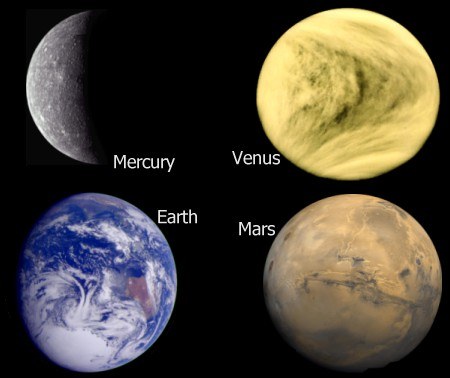
Earth and the other planets closest to the Sun are made mostly of _______
a)
gas
b)
metal
c)
water
d)
rock
51.

Earth's ________ on its axis causes day and night.
a)
rotation
b)
revolution
c)
phase
d)
comet
52.

One full orbit of an object around another object is called a ________.
a)
axis
b)
rotation
c)
revolution
d)
satellite
53.
One of the main differences between the outer and inner planets is __________.
a)
The inner planets all have water
b)
the inner planets are much bigger than the outer planets
c)
the outer planets are gas planets
d)
the outer planets have rings, and the inner planets don't
54.
Why does Earth have different seasons?
a)
because of the distance between Earth and the sun
b)
because of the speed of Earth as it rotates on its axis
c)
because of the amount of light blocked by the moon on its axis
d)
because of the tilt of Earth on its axis as it moves around the sun
55.
Day and night is caused by the _____________ of earth on its axis.
a)
revolution
b)
orbit
c)
rotation
56.
As the Earth travels around the sun, this tilt causes different areas of the Earth’s surface to get different amounts of daylight at different times of the year. The angle of the Sun’s rays to the surface also causes areas to have more or less of the Sun’s energy. This causes the ________.
a)
months
b)
day and night
c)
seasons
d)
years
57.
The pattern of stars in a constellation stays the same, but a planet can be seen in different locations at different times because _______________.
a)
Stars don't move; planets revolve and rotate
b)
Stars and planets revolve and rotate.
c)
Stars not planets move
d)
Planets don't move; Stars revolve and rotate.
58.
In what form does the Sun's energy travel to Earth?
a)
Heat
b)
Electrical energy
c)
Electromagnetic radiation
d)
Mechanical energy
59.
What is an exoplanet?
a)
A planet in our solar system
b)
A dead planet
c)
A star that does not have enough mass
d)
A planet outside of our solar system
60.
What is the name of the system with 3 exoplanets in the habitable zone?
a)
TRAPPIST-1
b)
TrES-2b
c)
GJ 504
d)
Kepler 10b
61.
If a star is being observed from Earth and it's light has shifted towards the blue side of the electromagnetic spectrum it would be...
a)
Moving towards the Earth
b)
Moving away from the Earth
c)
This is a trick question that cannot be answered
d)
It isn't a star, it is a very large blueberry.
62.
If a star is being observed from Earth and it's light has shifted towards the red side of the electromagnetic spectrum it would be...
a)
Moving towards the Earth
b)
Moving away from the Earth
c)
This is a trick question that cannot be answered
d)
It isn't a star, it is a very large blueberry.
63.
The vast majority of galaxies in our universe are moving away from us. We know this because we observe __________ in the galaxies absorption spectra.
a)
Redshift
b)
Blueshift
c)
Turbulance
d)
Superposition
64.

Which section of the spectrum is the ONLY one we can see?
a)
X-rays
b)
Visible Light
c)
Gamma Rays
d)
Ultraviolet Rays
65.

What do spectroscopes do?
a)
Collect light to identify elements
b)
Refract light
c)
Absorb light
d)
Transmit light
66.
Elements heavier than iron are formed in
a)
main sequence stars
b)
supernovae
c)
pulsars
d)
quasars
67.
The formation of light elements that took place during the big bang
a)
synthesis
b)
fusion
c)
nuclear fission
d)
nucleosynthesis
100 %

