
 Worksheets
IC2 section 2
Total questions: 34
Worksheet time: 43mins
Name
Class
Date
1.
How many Al atoms are in this molecule? 4Al2O3
a)
2
b)
8
c)
6
d)
4
2.
___________________ are the elements are compounds that leave (are formed in) a chemical
reaction.
reaction.
a)
Polymers
b)
Bonds
c)
Reactants
d)
Products
3.
A chemical reaction is ___________________.
a)
when substances undergo changes that result in a new substance
b)
a characteristic of a substance that can be observed without changing the substance into another substance
c)
when substances undergo changes that alter their form or physical appearance
4.
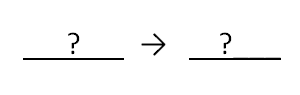
Select the pair of words that correctly displays the general FORMAT for writing CHEMICAL EQUATIONS.
a)
products --> reactants
b)
products --> products
c)
reactants --> products
d)
reactants --> reactants
5.
The number (mass) of all the atoms on the left side of a chemical equation is ALWAYS the same as the right side of the equation.
a)
true
b)
false
6.
Which of the following is evidence that a chemical reaction took place
a)
change in state
b)
formation of gas bubbles
c)
something was cut in half
d)
a mixture is formed
7.
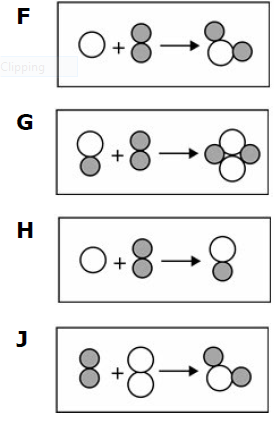
Which of the following models best demonstrates a balanced chemical equation?
a)
F
b)
G
c)
H
d)
J
8.

For an investigation a student poured a blue solution of CuSO4 into a beaker. The student placed a shiny, silver-colored strip of zinc metal in the solution and observed the changes.
The student inferred that a chemical reaction occurred. What evidence supports this inference?
The student inferred that a chemical reaction occurred. What evidence supports this inference?
a)
A dark solid formed on the zinc metal.
b)
The zinc metal remained silver-colored and shiny
The zinc metal remained silver-colored and shiny
c)
The CuSO4 solution turned blue when the zinc metal was added.
d)
None of these
9.

A scientist performed four investigations using eight different liquids. In each investigation, the scientist combined two of the liquids under a fume hood and recorded observations in the table below.In which investigation is it least likely that the liquids reacted chemically?
a)
1
b)
2
c)
3
d)
4
10.
The reactants are on the left side of the chemical equation.
a)
True
b)
False
11.

The red numbers in the image below represent ________
a)
subscripts
b)
coefficients
c)
I don't know, and don't want to try
d)
None of the answers are correct
12.

The blue numbers in the image below represent ________
a)
I don't know, and don't want to try
b)
coefficients
c)
subscripts
d)
none of the answers are correct
13.
In the equation, 2Mg + O2 ---> 2MgO, which are the reactants?
a)
Mg and O
b)
MgO
c)
Mg and MgO
d)
O and MgO
14.
Is the following equation balanced or unbalanced?
Fe + S --> FeS
Fe + S --> FeS
a)
balanced
b)
unbalanced
15.
Which of the following is evidence of a chemical reaction?
a)
fizzing
b)
water changing to ice
c)
saltwater
d)
paper being cut in half
16.

What are the reactants in the chemical equation pictured?
a)
CH4 and CO2
b)
CH4 and O2
c)
CO2 and H2O
d)
O2 and H2O
17.

What are the products of the chemical reaction pictured?
a)
CH4 and CO2
b)
CH4 and O2
c)
CO2 and H2O
d)
O2 and H2O
18.

What is a shorthand notation that represents a compound or molecule called?
a)
Chemical Equation
b)
Chemical Formula
c)
Chemical Reaction
d)
Chemical
19.

How many molecules are in this chemical formula?
a)
4 Molecules
b)
6 Molecules
c)
2 Molecules
d)
5 Molecules
20.

How many oxygen atoms are in this chemical formula?
a)
7 oxygen atoms
b)
4 oxygen atoms
c)
3 oxygen atoms
d)
1 oxygen atoms
21.

How many hydrogen atoms are in this chemical formula:
a)
4 hydrogen atoms
b)
1 hydrogen atom
c)
2 hydrogen atoms
d)
3 hydrogen atoms
22.

How many molecules are in this chemical formula?
a)
5 molecules
b)
4 molecules
c)
2 molecules
d)
6 molecules
23.
How many elements are in C6H12O6?
a)
1
b)
2
c)
3
d)
4
24.
When materials combine to form new compounds it is a chemical change. Which example is a chemical change?
a)
baking powder fizzing
b)
water boiling
c)
ice melting
d)
sugar cube dissolving
25.
Which is an example of a chemical reaction?
a)
paper cut into small pieces
b)
chocolate melting in a pan
c)
flour and sugar mixed in a bowl
d)
cookies baking in an oven
26.

a copper penny turning greenish after a few years.
a)
Chemical Change
b)
Physical Change
27.

An gel ice pack getting cold after you put it in the freezer for an hour.
a)
Chemical Change
b)
Physical Change
28.

The picture above represents what?
a)
An Atom
b)
A Molecule
c)
An Element
d)
A Proton
29.

What type of change is shown?
a)
Physical Change
b)
Chemical Change
c)
Nuclear Change
d)
Proton Change
30.

What type of change is shown?
a)
Physical Change
b)
Chemical Change
c)
Nuclear Change
d)
Change in State
31.
What is another way of saying PRODUCT?
a)
ingredient
b)
what you finish with
c)
fleek
d)
starter
32.
Is melting butter for popcorn a chemical or physical change?
a)
chemical
b)
physical
33.
A change where one or more new substances are created.
a)
Physical Change
b)
Chemical Change
34.
A mixture is the result of a physical change because...
a)
The parts can be separated
b)
A new substance is made
c)
There is a chemical reaction
d)
One part of the mixture disappears
100 %

