
 Worksheets
Waves
Total questions: 50
Worksheet time: 2hrs 36mins
Name
Class
Date
1.
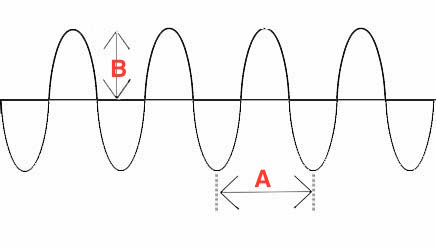
What property of this wave is represented by the letter "A"
a)
amplitude
b)
crest
c)
trough
d)
wavelength
2.
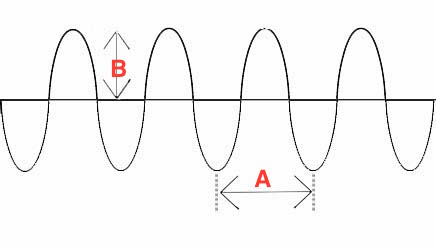
What property of the wave is represented by the letter "B"?
a)
amplitude
b)
crest
c)
trough
d)
wavelength
3.
The highest point on a wave is:
a)
the crest
b)
the trough
c)
the top
d)
the coast
4.
The lowest point on a wave is the:
a)
Amplitude
b)
Crest
c)
Trough
d)
Wavelength
5.
The number of waves that pass a point per second is:
a)
frequency
b)
period
c)
longitudinal
d)
transverse wave
6.
The type of waves that require medium to pass:
a)
Mechanical Waves
b)
Electromagnetic Waves
7.

Which vocabulary term is used to identify the distance between points C & G?
a)
Amplitude
b)
Crest
c)
Frequency
d)
Wavelength
8.
When the frequency of a wave increases, what happens to the wavelength?
a)
The wavelength is not directly affected by the frequency of a wave.
b)
The wavelength increases.
c)
The wavelength decreases.
d)
More specific information is needed to form a conclusion about the wavelength.
9.
A mechanical wave cannot travel through...
a)
a vacuum(empty space).
b)
water.
c)
air.
d)
glass.
10.
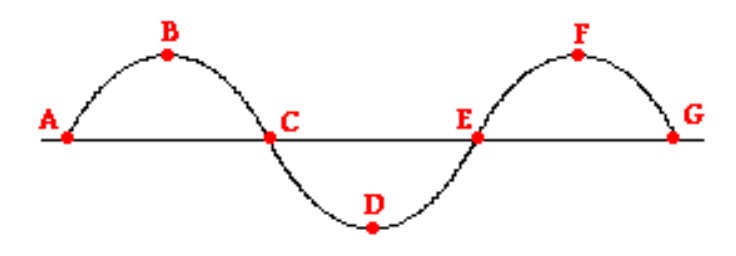
Which letter(s) represent the trough of the wave?
a)
A
b)
B & D
c)
D
d)
C & G
11.
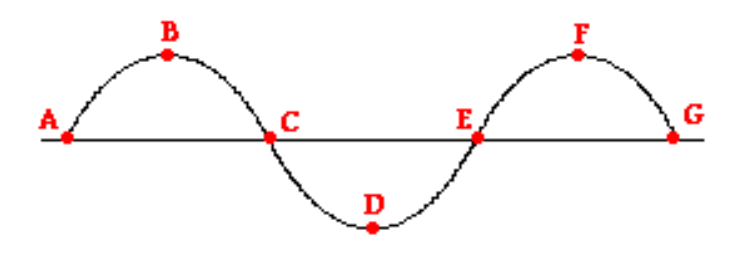
Which letter(s) represent the crest of the wave?
a)
A
b)
B & D
c)
B & F
d)
F
12.
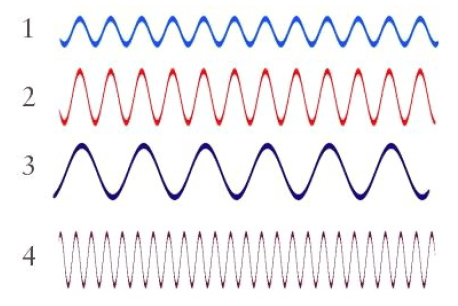
Which wave in the diagram has the greatest frequency?
a)
1
b)
2
c)
3
d)
4
13.
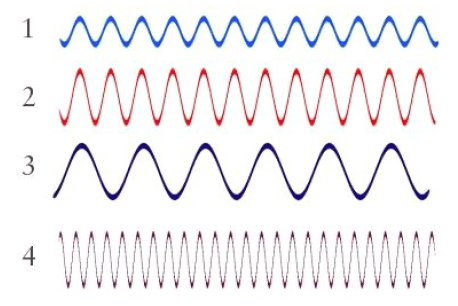
Which wave in the diagram has the greatest wavelength?
a)
1
b)
2
c)
3
d)
4
14.
Which of the following can sound travel through?
a)
solid
b)
liquid
c)
gas
d)
all of the above
15.
crest to crest or trough to trough
a)
crest
b)
trough
c)
amplitude
d)
wavelength
16.
regular disturbances that carry energy through matter or space
a)
crest
b)
energy
c)
wave
d)
trough
17.
When a wave strikes and object and bounces off. (example echo)
a)
medium
b)
refraction
c)
reflection
d)
interference
18.
When a wave bends as it passes through at an angle from one medium to another.(example: pencil in a glass of water-)
a)
medium
b)
refraction
c)
reflection
d)
interference
19.

The units for frequency are measured in _____________.
a)
hertz
b)
seconds
c)
m/s
d)
m
20.
What do we call the part of a longitudinal wave that is when the waves are squeezed together?
a)
compression
b)
rarefaction
c)
crest
d)
trough
21.
What do we call the part of a longitudinal wave that is spread a part?
a)
compression
b)
rarefaction
c)
crest
d)
trough
22.
Which answer best explains how a wave is created?
a)
A wave is created when energy stays still
b)
A wave is created by a vibration
c)
A wave is created when molecules become a medium
d)
A wave is created when a liquid becomes a solid
23.
Waves can travel through empty space or they can travel through a medium. Which statement best describes a medium?
a)
The solid matter that waves travel through
b)
The gas matter that waves travel through
c)
The liquid matter that waves travel through
d)
The solid, liquid, or gas matter that waves travel through
24.

All waves carry ________ as they travel from one place to another.
a)
matter
b)
space
c)
energy
d)
water
25.

Which is an example of a longitudinal wave?
a)
light wave
b)
sound wave
c)
visible wave
d)
radio wave
26.
___________ is How far the medium moves from rest position
a)
Crest
b)
Trough
c)
Amplitude
d)
Wavelength
27.
ג is the symbol for _______________
a)
Wavelength
b)
Hertz
c)
Hz
d)
Frequency
28.

What type of wave does the picture show?
a)
Longitudinal Wave
b)
Transverse Wave
29.

This is a picture of a
longitudinal wave: Is Section A Compression or Rarefaction?
longitudinal wave: Is Section A Compression or Rarefaction?
a)
Compression
b)
Rarefaction
30.
This is a picture of a longitudinal wave: Is Section B Compression or Rarefaction?
a)
Compression
b)
Rarefaction
31.
A periodic disturbance in a solid, liquid, or gas as energy is transmitted through a medium
a)
A. surface wave
b)
B. transverse wave
c)
C. wave
d)
D. mechanical wave
32.
The combination of two or more waves that result in a single wave
a)
A. diffraction
b)
B. resonance
c)
C. reflection
d)
D. interference
33.
When the crests of one wave overlap the crests of another wave or waves, this occurs.
a)
A. diffraction
b)
B. destructive
interference
c)
C. constructive
interference
d)
D. resonant
frequencies
34.
Which of the following is NOT a property of a wave?
a)
A. refraction
b)
B. amplitude
c)
C. frequency
d)
D. wavelength
35.
Why can you not hear sound in space?
a)
Distance is to great
b)
It has no medium
c)
The medium is too thin
36.

a)
Constructive Interference
b)
Destructive Interference
37.
When a wave bends around a barrier or passes through an opening, it is called
a)
Diffraction
b)
Reflection
c)
Refraction
d)
Interference
38.

What is happening in this picture?
a)
Reflection
b)
Refraction
c)
Diffraction
d)
Absorption
39.

What is happening in this picture?
a)
Reflection
b)
Refraction
c)
Diffraction
d)
Absorption
40.

What is happening in this picture?
a)
Reflection
b)
Refraction
c)
Diffraction
d)
Absorption
41.

What phenomenon does this image demonstrate?
a)
Constructive interference
b)
Destructive interference
c)
Increasing frequency
d)
Increasing period
42.

What wave behavior does this image demonstrate?
a)
Refraction
b)
Diffraction
c)
Reflection
d)
Difflection
43.

Which wave has a higher amplitude?
a)
The wave on top
b)
The wave on bottom
c)
They both have the same amplitude
44.

What kind of wave is pictured?
a)
Transverse
b)
Longitudinal
c)
surface
d)
none of the above
45.

What kind of wave is pictured?
a)
Transverse Wave
b)
Longitudinal Wave
c)
compressional wave
d)
none of the above
46.
Which wave in the diagram has the greatest wavelength?
a)
1
b)
2
c)
3
d)
4
47.
Which answer best explains what causes a wave?
a)
Shaking
b)
Potential energy
c)
Light
d)
Vibrations
48.

A wave has wavelength of 10 m and a speed of 340 m/s. What is the frequency of the wave?
a)
34 m/s
b)
3400 Hz
c)
3400 m/s
d)
34 Hz
49.

A wave has frequency of 50 Hz and a wavelength of 10 m. What is the speed of the wave?
a)
500 m/s
b)
50 m/s
c)
5 m/s
d)
0.5 m/s
50.
Which direction do waves travel?
a)
Toward the source
b)
Away from the source
c)
East to West
d)
North to south
100 %

