
 Worksheets
Unit #7 - Cold War and Civil Rights Movement
Total questions: 55
Worksheet time: 33mins
Name
Class
Date
1.

President Truman adopted a new foreign policy during the Cold War know as the Truman Doctrine. What was the main goal of the Truman Doctrine?
a)
To expand trade with Europe
b)
To limit the build up of nuclear weapons
c)
To stop the spread of communism
d)
to send financial aid to Europe
2.

The United States got involved in conflicts like Korea and Vietnam because they were afraid of the domino theory. What is the domino theory?
a)
If one country fell to democracy, others would follow
b)
If one country fell to communism, others would follow
3.

How did the Marshall plan try to stop the spread of communism in Western Europe after WWII?
a)
by providing government housing for refugees
b)
by providing military assistance to Vietnam
c)
by providing money to stop poverty
4.

Why did the United States become involved in the Korean War?
a)
to contain communism
b)
to colonize Korea
c)
to spread communism
d)
to Christianize Koreans
5.

In 1950, Korea fought a civil war over the spread of communism. Communists from the north tried to take over the south. What role did he US play in this war?
a)
The US and its allies went to Vietnam to fight Korean Communists.
b)
The US and its allies join the fight to keep communism from spreading.
c)
The US and its allies did not join the Korean War.
d)
The US and its allies fought to defend the North.
6.
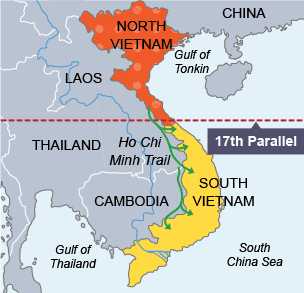
In the 1950s, the United States became involved in the Vietnam War. Why did the United States become involved in this war?
a)
to prevent the collapse of the government of North Vietnam
b)
to stop Vietnam from taking over Hong Kong
c)
to stop the spread of communism to South Vietnam
d)
to prevent attacks against United States shipping
7.

What was the name of the first satellite in space launched by the Soviet Union?
a)
Gagarin
b)
Apollo 11
c)
Sputnik
d)
Apollo 13
8.
The Cold War divided the world into two camps -
a)
those who were for slavery and those who were against it
b)
those who were for immigration and those who were against it
c)
those who supported a free society and those who supported communism
d)
those who supported women's suffrage (right to vote) and those who were against it
9.

The dividing line between Eastern and Western Europe during the Cold War was called _________________.
a)
The Iron Curtain
b)
The Iron Bars
c)
The Steel Curtain
d)
The Iron Road
10.
The United States and its allies had a policy called "containment." This means that they wanted to ...
a)
stop the spread of Fascism.
b)
stop the spread of slavery.
c)
stop other countries from building up their military power.
d)
stop the spread of Communism.
11.

Which of the following best describes the results of the Korean War?
a)
North Korea defeated South Korea, and now all of Korea is under Communist rule.
b)
China defeated Korea, and now all of Korea is under Chinese rule.
c)
The Korean War ended in a stalemate. Today, North Korea is still a Communist nation, and South Korea is a free nation.
d)
The United States defeated Korea, and today Korea is a territory of the U.S.
12.
NATO, or the North Atlantic Treaty Organization, is a treaty between the U.S. and other nations ...
a)
to protect one another against Communist aggression.
b)
to protect one another against slavery.
c)
to protect one another against Hitler's Fascist aggression.
d)
to protect one another against the affects of global warming.
13.
Joseph McCarthy, a U.S. Senator from Wisconsin, ruined many people's lives during the Cold War by ...
a)
accusing U.S. State Department officials of being illegal immigrants.
b)
accusing President Lyndon B. Johnson of being Communist.
c)
accusing U.S. State Department officials of being Communists.
d)
accusing President John F. Kennedy of being Communist.
14.
An "arms race" can be described as ...
a)
a race between countries to defeat another country in war
b)
a race between nations to acquire the most powerful weapons
c)
a race between states to build up their own militias
d)
a race between nations to see who can have the largest military
15.
The Cuban Missile Crisis occurred when ...
a)
Cuba attempted to invade the U.S. with the Soviet Union's help.
b)
the Soviet Union fired missiles at Cuba.
c)
the U.S. learned that the Soviet Union had built missile launching pads in Cuba (just 90 miles away from Florida!)
d)
the Soviet Union fired missiles at the U.S. from Cuba.
16.
Who was the Senator who started rumors of the Red Scare?
a)
John F. Kennedy
b)
Joseph Stalin
c)
Neil Armstrong
d)
Joseph McCarthy
17.
Which of the following caused the Vietnam War?
a)
Japan attacked South Vietnam
b)
North Vietnam wanted all of Vietnam to be communist
c)
South Vietnam wanted to remain communist
d)
The Soviet Union attacked South Vietnam
18.
Which U.S. President challenged America to be the first to put a man on the moon?
a)
Franklin D. Roosevelt
b)
Joseph Stalin
c)
John F. Kennedy
d)
Harry S. Truman
19.
What important entertainment industry influenced Americans the most in the 1950's and 1960's?
a)
Internet
b)
Newspapers
c)
Movies
d)
Television
20.

Television helped bring about economic growth in the 1950s through its:
a)
Financial programs
b)
Children’s programs
c)
Credit cards
d)
Advertisements
21.

William J. Levitt contributed to the growth of the suburbs by
a)
Mass-producing houses
b)
Criticizing urban life
c)
Designing interstate highways
d)
Providing
low-interest mortgage loans
22.

The post-war “baby boom” was strongly influenced by
a)
Very
high employment rates
b)
Americans
making more money than ever before
c)
General
prosperity
d)
All
of the above
23.

Buying a product on credit allowed customers to do all of the following EXCEPT:
a)
Buy
something that they might be not be able to normally afford
b)
Get
a product immediately while paying for it later
c)
Get
certain products for free
d)
Pay
for an item in fixed amounts
24.

Which of the following BEST characterizes the youth culture of the 1950s?
a)
More young people were
choosing to work rather than attend college
b)
Radio
programs became more popular amongst teenagers as a source of entertainment
c)
They
had more leisure (free) time to dedicate to entertainment and fun
d)
Automobiles
had little influence on the life of teens
25.

In the 1950s men’s roles usually included all of the following EXCEPT:
a)
Making
important family decisions
b)
Supporting
their families financially
c)
Cooking,
cleaning, and managing the household
d)
Going
to college
26.

The traditional role of the housewife called for her to:
a)
Contribute
an income to the family
b)
Home school their children
c)
Attend
a university to get an education to act as a role model for the children
d)
Support
the husband through domestic chores
27.

Many parents in the 1950s had issues with Elvis Presley for all of the following reasons EXCEPT:
a)
They believed he might cause a rise in immorality amongst teenagers
b)
They believed his music was tied to the African American race
c)
He was becoming more popular than the Beatles
d)
His
sexualized dance moves
28.

Rock and Roll gave the young people of the 1950s
a)
a way to conform with their parents’ expectations
b)
the values they needed to live through the depression and war
c)
a stable and secure cultural role
d)
a
new style of music they could call their own
29.
The Gulf of Tonkin Resolution (1964) provided congressional support for
a)
withdrawing from the United Nations
b)
expanding the Alliance for Progress
c)
escalating military action in Vietnam
30.
The Cuban Missile Crisis was resolved when
a)
Cuba became a capitalist nation
b)
Soviet Premier Nikita Khrushchev met with President Kennedy
c)
the Soviet Union withdrew its missiles from Cuba
31.
Which development is most closely associated with the belief in the domino theory?
a)
military involvement in Vietnam
b)
construction of the Berlin Wall
c)
end of the Korean War
32.
"...We chose to go to the moon" -JFK. What was the main purpose of this speech?
a)
surpassing the Soviet Union in the space race
b)
controlling the spread of nuclear weapons
c)
establishing a missile defense system on the Moon
33.
In 1965, Congress established Medicare to
a)
provide health care to the elderly
b)
grant scholarships to medical students
c)
establish universal health care
34.
“The war against poverty will not be won here in Washington. It must be won in the field, in every private home, in every public office, from the courthouse to the White House ...”
a)
entire country must help in the struggle against poverty
b)
court system must be held accountable for poverty
c)
problem of poverty is easily solved
35.
A major goal of the Great Society programs begun under President Lyndon B. Johnson was to
a)
stimulate oil production in the United States
b)
reduce poverty in the nation
c)
increase the size of the armed forces
36.
The Berkeley demonstrations, riots at the 1968 Democratic National Convention, and the Kent State protest all reflect student disapproval of
a)
the Vietnam War
b)
increases in college tuition
c)
racial segregation
37.
The term Great Society was used by President Lyndon B. Johnson to describe his efforts to
a)
end poverty and discrimination in the United States
b)
win the race for outer space
c)
lower taxes for all Americans
38.
What was a major reason President Lyndon B. Johnson decided not to run for reelection in 1968?
a)
He was ineligible to hold a third term as president.
b)
He was threatened with impeachment for government scandals.
c)
His Vietnam War policies had reduced his popularity with voters.
39.
The main purpose of the War Powers Act of 1973 was to
a)
expand the power of Congress to declare war
b)
end the Vietnam War on favorable terms
c)
limit the president’s ability to send troops into combat abroad
40.
During the 1950s, the main goal of the civil rights movement was to
a)
form a new nation for African American
b)
eliminate legal segregation from American life
c)
create separate African American economic and social institutions
41.
"Separate educational facilities are inherently unequal” -- Chief Justice Earl Warren, Brown v. Board of Education of Topeka
a)
keep public schools segregated
b)
overrule the ‘separate but equal’ doctrine established in Plessy v. Ferguson decision
c)
create job training for unemployed African Americans
42.
The primary goal of Southern Democrats (white southerners) in Congress was to ____.
a)
end the practice of racial segregation in the South
b)
maintain segregation in the South
c)
litigate for equal rights for all races in the South
43.
The Civil Rights Act of 1964 was intended to end
a)
discrimination based on race or sex
b)
affirmative action programs in education
c)
unfair treatment of the elderly
44.
What was the most important challenge the nation faced in the 1950s?
a)
Most Americans feared a growing national deficit.
b)
The Cold War was a major concern to most Americans.
c)
Americans were most concerned with the growing unemployment problem.
45.
The Freedom Rides, the March on Washington and civil disobedience helped lead to
a)
passage of the Civil Rights Act of 1964
b)
ratification of the Equal Rights Amendment
c)
a decision by the Supreme Court to integrate public schools
46.

Who was the U.S. Senator who was assassinated while running for president in 1968?
a)
Robert Kennedy
b)
John Kennedy
c)
Martin Luther King
d)
Lee Harvey Oswald
47.

What was the purpose of the Voting Rights Act of 1965?
a)
It gave black women the right to vote
b)
It made literacy tests in order to vote illegal
c)
It made Jim Crow Laws illegal
d)
It gave all blacks the right to vote
48.

The March on Washington was most famous because . . .
a)
it caused race riots in the nation's Capital
b)
200,000 people worked together to help blacks get the right to vote
c)
the KKK became an illegal organization because of the march
d)
Martin Luther King, Jr. gave his "I have a Dream: speech, which inspired hundreds of thousands to help the Civil Rights Movement
49.

How did the assassination of MLK affect the Civil Rights Movement?
a)
It had no effect
b)
The movement continued because he wasn't that important
c)
People were heartbroken and the movement slowed
d)
The movement gained strength because people of all races were outraged
50.

Which of the following best describes the Montgomery Bus Boycott?
a)
Segregation on buses became illegal a few days after Rosa Parks began the protest
b)
Thousands of blacks blocked the streets so that buses could not finish their routes
c)
Martin Luther King was arrested for not giving up his seat to a white person
d)
Segregation of buses became illegal after many months of protesting
51.

Which best describes the 1960's?
a)
It was a time of peace and a strong economy
b)
There were many assassinations and war protests
c)
People were pleased with the political leadership, but the economy struggled
d)
There were some protests for civil rights, but everything remained non-violent throughout the decade
52.

Which type of protest did Martin Luther King oppose during the Civil Rights Movement?
a)
Sit-in
b)
Bus Boycott
c)
March on Washington
d)
Race Riots
53.
Which Chief Justice ruled that segregation in schools violated the 14th amendment in the Brown V. Board of Education ?
a)
Earl Warren
b)
John Roberts
c)
Oliver W. Holmes
d)
Warren Burger
54.
which act prevents racial discrimination in voting?
a)
24th amendment
b)
civil rights act 1964
c)
voting rights act 1965
55.
Who played a pivotal role in boycotting the Montgomery Bus line after being arrested ?
a)
Ida Wells
b)
Rosa Parks
c)
Ella Baker
d)
Coretta Scott King
100 %

