wayground logo

Free Printable Worksheets

Font size

S
M
L
XL
Worksheets

FOSS Mixtures and Solutions: Part 5

Total questions: 40

Worksheet time: 36mins

Name
Class
Date
1.
In a ___________change, a substance changes into a different substance.
a)
Physical
b)
Chemical
2.
The Law of Conservation of Mass states that ____________________.
a)
matter can NOT be created, but can be DESTROYED
b)

matter can NOT be created or destroyed
c)
matter can be CREATED, but NOT destroyed
3.
Select the pair of words that correctly displays the general FORMAT for writing CHEMICAL EQUATIONS.
a)
products  -->  reactants
b)
products  -->  products
c)
reactants  -->  products
d)
reactants  -->  reactants
4.
The number (mass) of all the atoms on the left side of a chemical equation is ALWAYS the same as the right side of the equation.
a)
true
b)
false
5.
Which of the following is evidence that a chemical reaction took place
a)

change in state of matter

b)

formation of bubbles

c)
something was cut in half
d)
a mixture is formed
6.
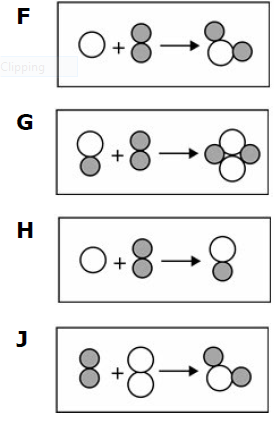
Which of the following models best demonstrates a balanced chemical equation?
a)
F
b)
G
c)
H
d)
J
7.
What are the products of the chemical reaction pictured?
a)
CH4 and CO2
b)
CH4 and O2
c)
CO2 and H2O
d)
O2 and H2O
8.
What are the reactants in the chemical equation pictured?
a)
CH4 and CO2
b)
CH4 and O2
c)
CO2 and H2O
d)
O2 and H2O
9.

When you mix methane + oxygen, they turn into into carbon dioxide + water, the methane and oxygen are called _______________.

a)
reactants
b)
products
c)
neutrals
d)
energizers
10.
A change in the shape of an object is an example of _________________.
a)
a chemical change
b)
energy
c)
an endothermic change
d)
a physical change
11.
In any chemical reaction, the mass of the products is always:
a)
slightly less than the mass of the reactants
b)
much less than the mass of the reactants
c)
the same as the mass of the reactants
d)
greater than the mass of the reactants
12.
How do chemical reactions turn substances into new substances?
a)
with burning acid
b)
the molecules mix together and create new substances
c)
the atoms break apart and combine back together in new ways
d)
the ionic compounds mix in water to form solutions
13.
When materials combine to form new compounds it is a chemical change. Which example is a chemical change?
a)
baking powder fizzing
b)
water boiling
c)
ice melting
d)
sugar cube dissolving
14.
Why must chemical equations be balanced?
a)
So that the equation doesn't explode
b)
The reaction won't happen until it is balanced
c)
Matter cannot be created or destroyed
d)
None of these
15.
The number of atoms on one side of a chemical equation is equal to
a)
a molecule of a substance
b)
the amount of gas released during a chemical reaction
c)
the number of atoms on the other side of a chemical equation
d)
all of the matter that exists in the universe
16.
What is the left part of a chemical equation called?
H2 + O → H2O
a)
Reactants
b)
Products 
c)
Yields 
d)
Chemical Equation 
17.
What is the right part of a chemical equation called?
H2 + O H2O
a)
Reactants
b)
Products 
c)
Yields 
d)
Chemical Equation 
18.

Which of the following is an example of a physical change?

a)

a bike rusting

b)

toast burning

c)

butter melting

d)

food spoiling

19.

Which of the following is a correct statement about the investigations?

a)

All of the situations are examples of physical changes because all of the investigations exhibit changes to the physical properties.

b)

None of the situations are examples of physical changes because they all involve a color change.

c)

Situation 2 is a physical change because rust forming is a natural process.

d)

Situations 1 and 3 are physical changes because no new substances are formed.

20.

A physical change...

a)

changes the physical properties of an object, but does not create a new substance.

b)

creates a new substance and cannot be undone.

21.

A chemical change

a)

changes the physical properties of an object, but does not create a new substance.

b)

creates a new substance and cannot be undone.

22.
Melting a chocolate bar?
a)
Physical Change
b)
Chemical Change 
23.
Is glass breaking a chemical or phyiscal change?
a)
chemical
b)
physical
24.
Is a a rusting bicycle a chemical or physical change?
a)
chemcial
b)
physical
25.
Salt dissolves in water
a)
physical Change
b)
chemical change
26.

Which of the following are examples of chemical changes.

a)

Salt dissolving

b)

Baking soda and vinegar mix and bubbles

c)

Rust forms on an iron shovel

d)

Butter melting

27.

Which of the following are examples of physical changes?

a)

Condensation forms on the mirror in your bathroom because of the warm shower.

b)

Sugar dissolves in a cup of warm tea.

c)

Baking soda, calcium chloride and water produce a terrible odor.

d)

I cut a sheet of paper in 4 pieces.

e)

The Statue of Liberty used to be brownish orange in color but now it is a greenish blue color

28.
what is condensing?
a)
physical property
b)
chemical property
c)
chemical change
d)
physical change
29.
When you break a cracker into pieces it is a 
a)
Chemical change
b)
Physical change
c)
Chemical Weathering
d)
Physical Weathering
30.
Which of the following is a sign that a chemical reaction has occurred?
a)
change in shape
b)
melting
c)
formation of a gas
d)
dissolving
31.
Is moldy cheese a chemical or physical change?
a)
chemical
b)
physical
32.
Is cream being whipped a physical or chemical change?
a)
physical
b)
chemical
33.
Is squeezing oranges to make orange juice a physical or chemical change?
a)
physical
b)
chemical
34.
Are fireworks exploding a physical or chemical change?
a)
phyiscal 
b)
chemical
35.
Is mowing the lawn a phyiscal or chemical change?
a)
physical
b)
chemical
36.
Baking a cake by mixing flour, sugar, chocolate powder, eggs, and milk, and then heating them in the oven.
a)
Chemical Change
b)
Physical Change
37.
One type of cold remedy is an effervescent tablet that breaks down in water.  When the tablet is placed in water, it forms gas bubbles.  In this example, the formation of gas
a)
is a physical property
b)
occurs when adding water to acid
c)
is a sign of a chemical change
d)
occurs wwhen the water boils
38.
Is burning wood a chemical or physical change?
a)
chemical
b)
physical
39.

Which of the following options provides evidence of a CHEMICAL change?

a)

Wood is burned releasing ash and smoke

b)

Rocks separate when soil is sifted

c)

Water turns to ice when you put it in the freezer

d)

Salt dissolves in water

40.


Which is an example of a physical

change?

a)

a candle burning

b)

baking a cake

c)

evaporating water

d)

metal rusting