
 Worksheets
Q1 Final BIOLOGY
Total questions: 37
Worksheet time: 43mins
Name
Class
Date
1.
Which one of the following is a characteristic of life?
a)
Growth
b)
Breathing
c)
Expelling toxins
d)
Photosynthesis
2.
The basic unit of life is called a (n)
a)
atom
b)
compound
c)
cell
d)
energy
3.
In order to be considered living an organism must have
a)
blood
b)
cells
c)
brains
d)
hair
4.
A worm turns away from light is an example of a worm
a)
reproducing
b)
doing cellular respiration
c)
having cells
d)
responding to its environment
5.
Which of the following characteristics of living things best explain a cat having a litter of kittens?
a)
living things respond to their environment
b)
living things maintain homeostasis
c)
living things reproduce
d)
living things are based on a genetic code
6.
Which of the following characteristics of living things best explains why your legs and arms get longer and stronger as you get older?
a)
living things respond to their environment
b)
living things maintain internal balance
c)
living things are made of cells
d)
living things grow and develop
7.
Before a soccer game Charlie always eats a big dinner. Which characteristic of life does this face best describe?
a)
living things use energy
b)
living things reproduce
c)
living things grow and develop
d)
living things are based on a universal genetic code
8.

This picture is a good example of
a)
Growth
b)
Development
c)
Organelle
d)
Cell
9.

This picture is a good example of
a)
Growth
b)
Development
c)
Organelle
d)
Cell
10.
Cells combine to make
a)
tissues.
b)
organs.
c)
systems.
d)
organelles.
11.
Tissue combine to make
a)
cells.
b)
organs.
c)
systems.
d)
organelles.
12.
Organs combine to make
a)
cells.
b)
tissues.
c)
systems.
d)
organelles.
13.
Systems combine to make
a)
cells.
b)
tissues.
c)
organisms.
d)
organelles.
14.

Robert Hooke, Anton van Leeuwenhoek, Theodor Schwann, Rudolf Virchow, and Matthias Schliden were all responsible for what theory?
a)
The Theory of Gravity
b)
The Theory of Relativity
c)
The Cell Theory
d)
The Theory of Continental Drift
15.

What tool do you use to view the cells?
a)
metric ruler
b)
centrifuge
c)
microscope
d)
telescope
16.
Rocks are not living because
a)
they never move
b)
they aren't needed for humans
c)
they are not made of cells
d)
they don't break down
17.
An organism made of one cell is called
a)
unicellular organism
b)
multicellular organism
18.
This is a double layer of phospholipids that creates a barrier between the cells internal and external environments; it controls what comes in or out of the cell (selective permeable)
a)
Nucleus
b)
Cilia
c)
Cell membrane
d)
Flagella
19.

What type of cell am I?
a)
I am eukaryotic because I have a nucleus and other membrane bound organelles.
b)
I am prokaryotic because I have no nucleus and other membrane bound organelles.
20.

What type of cell am I?
a)
Prokaryotic because I have a nucleus.
b)
Prokaryotic because I do not have a nucleus.
c)
Eukaryotic because I have a nucleus.
d)
None of these
21.
Which organelle directs the production of new proteins inside all cells?
a)
ribosome
b)
mitochondria
c)
nucleus
d)
chromosome
22.
Permeable means
a)
things can pass through
b)
the concentration levels are different
c)
it is permanent
d)
things are stuck
23.
The diffusion of water through a semi-permeable membrane is called?
a)
Osmosis
b)
Cell wall
c)
Diffusion
d)
Respiration
24.
When both inside and outside of a cell have the same amount of water it is said that the cell has reached a state of
a)
Osmosis
b)
Diffusion
c)
Equilibrium
25.
A person would never have pure water put into their veins in a hospital because their cells would...
a)
Shrink/Dehydrate
b)
Expand
26.
A person should never drink salty water because their cells would
a)
shrink
b)
expand
27.
What is diffusion?
a)
when molecules move
b)
when molecules move from a high concentration to a low.
c)
no movement
d)
molecules move everywhere
28.

The cell below is in a _________ solution.
a)
Hypotonic
b)
Hypertonic
c)
Isotonic
29.

The cell below is in a _____________ solution.
a)
Hypertonic
b)
Hypotonic
c)
Isotonic
30.
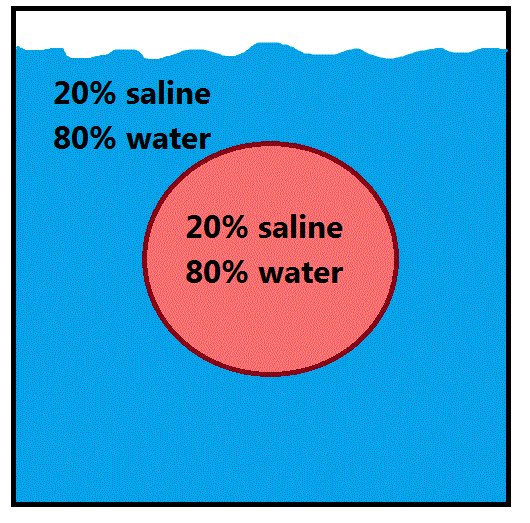
A blood cell is placed into the jar, as seen. Where will the water go?
a)
Into the cell
b)
Out of the cell
c)
Equally in & out - it's isotonic
d)
The water is a lie
31.
What was the name of the cat in Walt Disney's movie "Cinderella"?
a)
Lucifer
b)
Luxury
c)
Lucky
d)
Lazy
32.
What two colors are the cat's hat in "The Cat in the Hat"?
a)
Red and White
b)
Red and Blue
c)
Blue and White
d)
White and Black
33.
What name is given to the unit of electrical resistance?
a)
Ohm
b)
Calorie
c)
Spark
d)
Shock
34.
What human organs are affected by glaucoma?
a)
The eyes
b)
The ears
c)
The stomach
d)
The mouth
35.

Who is this
a)
Daphne
b)
Scooby
c)
Shaggy
d)
Velma
36.
Who was Mrs. Deters for Halloween?
a)
Professor Trelawney
b)
Professor Quirrell
c)
Professor Snape
d)
Professor Dumbledore
37.
What color eyes does Mrs. Deters have?
a)
Gray
b)
Brown
c)
Blue
d)
Green
100 %

