
 Worksheets
The Metric System (test is November 17)
Total questions: 135
Worksheet time: 5hrs 32mins
Name
Class
Date
1.
The base unit of metric length.
a)
Meter
b)
Liter
c)
Kilogram
d)
milligram
2.
The correct abbreviation for milliliter is..
a)
ML
b)
Ml
c)
mL
d)
ml
3.
The basic unit of metric volume is called a_____.
a)
Kilogram
b)
milligram
c)
Liter
d)
milliliter
4.
How many cm's is in a meter?
a)
1000
b)
10
c)
100
d)
1
5.
The width of a kernel of corn would be about...
a)
4 cm
b)
4 mm
c)
4 m
6.
The appropriate abbreviation of centimeter is..
a)
cm
b)
Cm
c)
cM
d)
CM
7.
The abbreviation for gram is...
a)
G
b)
gg
c)
g
8.
m stands for....
a)
millimeter
b)
meter
c)
centimeter
d)
Liter
9.

What is the volume?
a)
50.0 mL
b)
53.0 mL
c)
54.0 mL
10.
Which metric unit would be used to measure the weight of a peanut?
a)
kilogram
b)
gram
c)
ounce
d)
millilter
11.

What is the volume of liquid in this graduated cylinder?
a)
40.0 mL
b)
40.3 mL
c)
43.0 mL
d)
44.0 mL
12.

At which point should your eyes be when you read a graduated cylinder? (Hint: see the letter next to the eye)
a)
A
b)
B
c)
C
13.

Calculate the volume of the rock
a)
10.0 cm3
b)
16.0 cm3
c)
30.0 cm3
d)
40.0 cm3
14.

What is the volume of the fish?
a)
18.0 cm3
b)
6.0 cm3
c)
38.0 cm3
15.

How much water should be added to raise the volume to 20mL?
a)
1.0 mL
b)
2.0 mL
c)
3.0 mL
d)
4.0 mL
16.

Looking at the chart, what prefix means you have something that is one thousand times bigger than
a)
deci-
b)
kilo-
c)
centi-
d)
milli-
17.
Looking at the chart, what prefix means you have something that is one thousand times smaller than
a)
deci-
b)
kilo-
c)
centi-
d)
milli-
18.

In the SI, what is the symbol for the quantity of time
a)
kg
b)
m
c)
s
d)
cd
19.
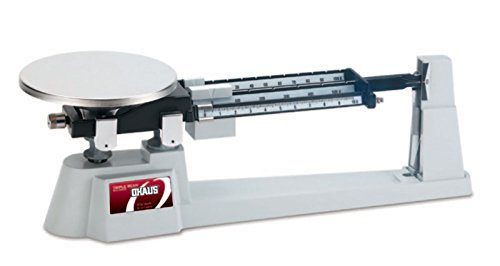
The base unit for mass is the
a)
Meter
b)
Gram
c)
Metric
d)
Liter
20.
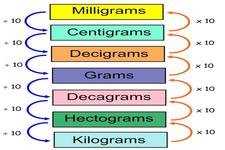
Which unit is the largest?
a)
m
b)
km
c)
cm
d)
mL
21.

What is the mass reading on the triple beam balance?
a)
336.8 g
b)
336.8 m
c)
306.8 g
d)
306.8 m
22.

What is the reading at point A?
a)
1.5 cm
b)
1.5 mm
c)
1.5g
d)
1.5mL
23.
What is the reading at point C?
a)
4.2 cm
b)
4.2 mm
c)
4.2g
d)
42cm
24.

What is the reading at point d?
a)
3.2 cm
b)
3.2 mm
c)
32cm
d)
320mm
25.
What is the reading at point c?
a)
2.2mm
b)
22cm
c)
220 cm
d)
22mm
26.
What number is the metric system based?
a)
10
b)
20
c)
1
d)
100
27.
The amount of matter in an object is the
a)
mass
b)
volume
c)
length
d)
density
28.
The amount of space an object takes up is its'
a)
mass
b)
volume
c)
length
d)
density
29.

What is the volume of this rectangular prism?
a)
14cm3
b)
35cm3
c)
70cm3
d)
37cm3
30.

How much liquid is in this graduated cylinder?
a)
16 mL
b)
13 mL
c)
14mL
d)
15 mL
31.
The height of the ceiling in this room would be about..
a)
10 meters
b)
3 meters
c)
12 meters
d)
25 meters
32.
Weight of a backpack filled with books would be in _____
a)
grams
b)
kilograms
c)
milligrams
d)
liters
33.
The the best measure for distance from this classroom to the lunchroom would be in....
a)
centimeters
b)
millimeters
c)
meters
d)
Kilometers
34.
10 football fields equals the length of a
a)
meter
b)
megameter
c)
kilometer
d)
millimeter
35.
A centimeter is about the size of .....
a)
The length of your thumb
b)
the width of you pinkie
c)
the length of a baseball bat
d)
the length of a football field
36.

How many centimeters are in a meter?
a)
1000
b)
10
c)
100
d)
1
37.
When measuring the mass of a paperclip you'd use
a)
millimeters
b)
gram
c)
kilogram
38.
If an eraser is 25 millimeters long, how many centimeters long is it?
a)
2
b)
2.5
c)
25
d)
250
39.

Put the liquids in order from most dense to least dense?
a)
4, 3, 2, 1
b)
1, 2, 3, 4
c)
3, 4, 2, 1,
d)
4, 3, 1, 2
40.
If an object has a density of 3.6 g/mL and you put it into water, will it sink or float?
a)
sink
b)
float
41.

Which liquid is the least dense?
a)
oil
b)
water
c)
syrup
d)
plastic bottle
42.

What is the best estimate for the amount of water in a fish bowl.
a)
4 L
b)
4 mL
c)
4 cm
d)
4 g
43.
How many millimeters (mm) = 1 centimeter (cm)?
a)
1
b)
10
c)
100
d)
1000
44.
What is the better instrument to measure liquid volume?
a)
beaker
b)
ruler
c)
graduated cylinder
d)
triple beam balance
45.

What is the better instrument to measure volume of a regular solid?
a)
beaker
b)
ruler
c)
graduated cylinder
d)
triple beam balance
46.
The base for mass is the
a)
meter
b)
gram
c)
kilogram
d)
liter
47.
The scientific instrument typically used to measure mass in our science class...
a)
bathroom scale
b)
balance
c)
spring scale
d)
triple-beam balance
48.
The amount matter in an object...
a)
mass
b)
weight
c)
matter
d)
atoms
49.
Units for the volume of a solid...
a)
cubic centimeters
b)
mL
c)
cubic inches
d)
grams
50.
Weight measures...
a)
the mass of an object
b)
the pull of gravity on an object
c)
how big you are
d)
how old you are
51.
What does weight measure?
a)
the amount of stuff or matter in an object
b)
the amount of space something takes up
c)
the gravitational pull on an object
d)
the measure of how hot or cold something is
52.
What does volume measure?
a)
the amount of stuff or matter in an object
b)
the amount of space something takes up
c)
the gravitational pull on an object
d)
the measure of how hot or cold something is
53.
What does mass measure?
a)
the amount of stuff or matter in an object
b)
the amount of space something takes up
c)
the gravitational pull on an object
d)
measure of how hot or cold something is
54.

What tool do you use to measure volume of an irregular solid (rock)?
a)
Ruler
b)
Triple Beam Balance
c)
Thermometer
d)
Graduated Cylinder
55.
Which one is not in the metric system?
a)
Kilometer
b)
Yard
c)
Centimeter
d)
Meter
56.

What would you use to measure the liquid in a coffee cup?
a)
liter
b)
mililiter
c)
gallon
57.
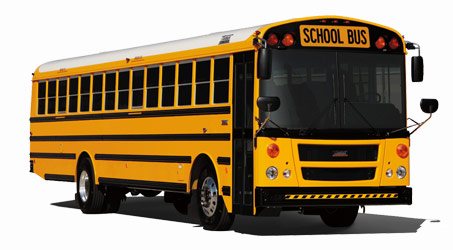
I would measure this bus in
a)
centimeters
b)
milimeters
c)
kilometers
d)
meters
58.

The thickness of a penny is about
a)
1 milimeter
b)
2 grams
c)
1 centimeter
d)
2 mililiters
59.
What instrument should be used if the lab directions ask you to measure to the nearest milliliter?
a)
graduated cylinder
b)
triple beam balance
c)
Erlenmeyer flask
d)
meter stick
60.

What is the name of this piece of science equipment?
a)
Beaker
b)
Florence flask
c)
Erlenmeyer flask
d)
Graduated cylinder
61.
Always read a graduated cylinder at the ______ of the meniscus.
a)
top
b)
middle
c)
bottom
62.

The amount of matter in an object is the
a)
mass
b)
volume
c)
length
d)
density
63.

The amount of space an object takes up is its
a)
mass
b)
volume
c)
length
d)
density
64.

What is the volume of the liquid in this graduated cylinder?
a)
1.5 mL
b)
15 mL
c)
10.5 mL
d)
.15 mL
65.

What is the volume of the liquid in this graduated cylinder?
a)
43 mL
b)
40.3 mL
c)
4.3 mL
d)
.43 mL
66.

What is the volume of the liquid in this graduated cylinder?
a)
43 mL
b)
30.7 mL
c)
37 mL
d)
38 mL
67.

What is the mass on the triple beam balance?
a)
439.0
b)
437.2
c)
437.0
d)
400307.2
68.

What is the mass on the triple beam balance?
a)
345.5g
b)
304.5g
c)
345g
d)
340.5g
69.

What is the mass on the triple beam balance?
a)
206.0g
b)
260.0g
c)
200.6g
d)
none of these
70.
What is the mass on the triple beam balance?
a)
206.0g
b)
260.0g
c)
20.6g
d)
none of these
71.

What is the scale on this graduated cylinder (how much is each little line worth)?
a)
.1 mL per line
b)
.2 mL per line
c)
.5 mL per line
d)
1 mL per line
72.
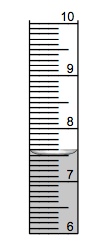
What is the volume of the liquid in this graduated cylinder?
a)
8.5 mL
b)
7.5 mL
c)
8 mL
d)
.1 mL
73.

What is the volume of the liquid in this graduated cylinder?
a)
19 mL
b)
35 mL
c)
24 mL
d)
1.9 mL
74.
1 m = ____ cm
a)
10
b)
100
c)
1000
75.

Which box has a higher density?
a)
Box A
b)
Box B
c)
cannot be determined
d)
they are the same
76.
What is the formula for density?
a)
density = mass x volume
b)
density = mass ÷ volume
c)
density = mass + volume
d)
density = mass - volume
77.
Jack has a rock. The rock has a mass of 14g and a volume of 2cm3. What is the density of the rock?
a)
7 mL
b)
7 g/cm3
c)
28 g/cm3
d)
.143 g/cm3
78.

What is the volume and density?
a)
5 mL and 5 cm/g
b)
95 mL and 20 mL/g
c)
5 mL and 5 g/mL
d)
10 mL and 10 g/Ml
79.

What is the volume?
a)
120
b)
120 cm3
c)
2 cm3/g
d)
2 g/cm3
80.
Identify the units for density.
a)
g/cm3
b)
g
c)
cm3
d)
mL
81.
If copper floats on mercury, and gold sinks in mercury, then which one of the following statements is TRUE?
a)
Copper is less dense than gold.
b)
Mercury is the least dense of the three metals
c)
Copper is more dense than mercury
d)
None of these
82.
At which temperature does water boil in Celsius?
a)
0
b)
32
c)
100
d)
212
83.
At which temperature does water freeze in Celsius?
a)
0
b)
32
c)
100
d)
212
84.
A graduated cylinder full of water has an initial volume of 45 mL. You drop a bean in the water, and the final volume is 49 mL. What is the volume of the bean?
a)
94 mL
b)
8 mL
c)
5 mL
d)
4 mL
85.
An object that is more dense than water will..
a)
Sink
b)
Float
c)
Can not be determined
86.
How do we calculate density of an object?
a)
Mass x Volume
b)
Mass+Volume
c)
Mass/Volume
d)
Volume/Mass
87.
"cm3" is a unit of
a)
Volume
b)
Mass
c)
Density
d)
Time
88.
"g/mL" is a unit of _____
a)
Density
b)
Mass
c)
Weight
d)
Volume
89.

What was the temperature (likely) when the picture was taken?
a)
10 celsius
b)
20 celsius
c)
70 celsius
d)
100 celsius
90.

What was the temperature (likely) when the picture was taken?
a)
5 celsius
b)
25 celsius
c)
75 celsius
d)
100 celsius
91.

What is the temperature on this thermometer in Celsius degrees?
a)
32° Fahrenheit
b)
0° Celsius
c)
0° Fahrenheit
d)
40° Fahrenheit
92.

Which thermometers temperature is about 25° Celcius?
a)
Blue
b)
Green
c)
Blue
d)
Blue and Green
93.

What is the temperature on the thermometer?
a)
28° Celsius
b)
20° Fahrenheit
c)
18° Celsius
d)
20° Celsius
94.

The temperature on the thermometer is about?
a)
68°F
b)
23°F
c)
68°C
d)
23°C
95.

What is the temperature on the thermometer?
a)
-26°C
b)
-36°C
c)
-32°C
d)
-39°C
96.

What temperature does the thermometer show?
a)
16 °
b)
12 °
c)
13 °
d)
14 °
97.
What would be an ideal temperature to go swimming?
a)
10 celisus
b)
30 celsius
c)
60 celisus
d)
90 celsius
98.
What is the formula for volume?
a)
V= l x w x h
b)
V= l x w
c)
V =( l x w) + h
d)
V= l + w + h
99.

What is the volume of this toy block if each side measures 5 centimeters?
a)
15 cubic centimeters
b)
125 cubic centimeters
c)
15 square centimeters
d)
125 square centimeters
100.
Which statement best describes the difference between area and volume?
a)
Area is the distance around a shape, and volume is the amount of area shape covers.
b)
Area is the number of square units needed to cover a plane figure, and volume is the number of unit cubes needed to fill a solid figure.
101.

Sam is using this box to pack books. He needs to know the volume so he can figure out how many books to pack.
Which expression below would Sam use to find the volume of the box?
Which expression below would Sam use to find the volume of the box?
a)
3 + 4 + 5
b)
3 + 4 x 5
c)
3 x 4 + 5
d)
3 x 4 x 5
102.
Which units are NOT used for volume?
a)
cm3
b)
m3
c)
mm3
d)
km2
103.
This is the force of Earth's pull on an object
a)
gravity
b)
mass
c)
volume
d)
grams
104.
the amount of matter in a solid, liquid, or gas
a)
mass
b)
melting
c)
volume
d)
weight
105.

Alisa placed a small seashell on the pan of a balance. What other tool does she need to determine the density of the seashell?
a)
Scale
b)
Calculator
c)
Thermometer
d)
Graduated Cylinder
106.

What is the volume of Object X?
a)
10.0 cm3
b)
15.0 cm3
c)
20.0 cm3
d)
25.0 cm3
107.
Find the density of a 2 cm x 2 cm x 2 cm cube with a mass of 64 g.
a)
6 cm3
b)
12 g/cm3
c)
128 g/cm3
d)
8 g/cm3
108.
True or False: The density of a specific type of material never changes.
a)
True
b)
False
109.

How can you find the density of an irregular shaped object?
a)
weight then volume using a graduated cylinder
b)
weight then volume using a ruler and the formula v=l x w x h
c)
mass then volume using a graduated cylinder
d)
mass then volume using a ruler and the formula v=l x w x h
110.

Frank has a paper clip. It has a mass of 9g and a volume of 3cm3. What is its density?
a)
3 g/cm3
b)
1/3 g/cm3
c)
27 g/cm3
d)
39 g/cm3
111.

I have two objects with the same volume but different masses. Which object will be more dense?
a)
The object with less weight.
b)
The object with more weight.
c)
The object with more mass.
d)
The object with less mass.
112.

How can you find the density of a regular shaped object?
a)
weight then volume using a graduated cylinder
b)
weight then volume using a ruler and the formula v=l x w x h
c)
mass then volume using a graduated cylinder
d)
mass then volume using a ruler and the formula v=l x w x h
113.
What will never change, wherever you are in the universe?
a)
mass
b)
weight
114.
How do you calculate density?
a)
mass divided by volume
b)
volume divided by mass
c)
mass times volume
d)
very carefully
115.

Which choice best represents the height of a flag pole?
a)
9 kilometers
b)
9 millimeters
c)
9 meters
d)
9 centimeters
116.

Which choice best represents the height of an apple?
a)
10 centimeters
b)
10 millimeters
c)
10 kilometers
d)
10 meters
117.
Which choice represents the length of a toothbrush?
a)
18 centimeters
b)
18 meters
c)
18 kilometers
d)
18 millimeters
118.

Which would be the best metric units to use to find the mass of a dog?
a)
milligram
b)
gram
c)
kilogram
d)
pound
119.
Which of the following is a metric unit used for measuring mass?
a)
Ounce
b)
Centimeter
c)
Kilogram
d)
Kilometer
120.

A dropper holds about 1 __ of liquid.
a)
Liter (L)
b)
gram (g)
c)
milliliter (mL)
d)
centimeter (cm)
121.

Look at the thermometer. Select the activities that you can do at this temperature in °F
a)
Beach and Swimming
b)
Picnic and Swimming
c)
Ice Skate and Play in snow
d)
Beach and Flying a Kite
122.
What is room temperature in Celsius?
a)
59
b)
20
c)
68
d)
32
123.
What is body temperature in Celsius?
a)
37
b)
47
c)
98.6
d)
96.8
124.

Which thermometer shows about how much warmer the temperature on Thermometer X is than the temperature on Thermometer Y?
a)
12° Celsius
b)
22° Celsius
c)
22° Fahrenheit
d)
12° Fahrenheit
125.

What is the temperature on the thermometer?
a)
-26°C
b)
-36°C
c)
-32°C
d)
-39°C
126.
The temperature of water in a beaker measures 87 degrees Celsius. How many more degrees must the temperature increase to reach the boiling point?
a)
23 degrees Celsius
b)
212 degrees Celsius
c)
13 degrees Celsius
d)
100 degrees Celsius
127.
Freezing point is...
a)
32 degrees Fahrenheit
b)
0 degrees celsius
c)
all of the above
128.
Boiling Point is...
a)
212 degrees Fahrenheit
b)
100 degrees Celsius
c)
Both
129.
Mass is measured in
a)
grams
b)
grams and kilograms
c)
kilograms
d)
centimetres
130.
What do you use to measure the mass of an object?
a)
Graduated cylinder
b)
water displacement method
c)
Triple beam balance
d)
length times width times height
131.
If you travel to the moon will your mass be greater than, less than, or the same as on Earth?
a)
greater
b)
same
c)
less
132.
If you travel to the moon will your weight be greater than, less than, or the same as on Earth?
a)
greater
b)
same
c)
less
133.
How can volume be determined through water displacement?
a)
measure the graduated cylinder
b)
drop object in cylinder and measure amount water rises
c)
measure length, width, and height
d)
place on a scale
134.
The amount that gravity pulls on you is called
a)
mass
b)
volume
c)
density
d)
weight
135.
Mass is measured with what unit?
a)
grams (g)
b)
centimeters (cm)
c)
milliliters (mL)
d)
pounds (lbs)
100 %

