
NEW
Font size
S
M
L
XL
 Worksheets
Atomic Theory
Total questions: 26
Worksheet time: 10mins
Name
Class
Date
1.
Idea was of an indivisible particle of matter he called "atomos"
a)
John Dalton
b)
Aristotle
c)
Democritus
d)
Plato
2.
His atomic model was depicted similar to a planetary/solar system
a)
Niels Bohr
b)
Joseph Thomson
c)
Ernest Rutherford
3.
His atomic model included a dense positive core in an atom, surrounded by negatively charged particles
a)
Joseph Thomson
b)
Niels Bohr
c)
Ernest Rutherford
4.

Which subatomic particle has no electric charge?
a)
the proton
b)
the neutron
c)
the electron
d)
the photon
5.

Which subatomic particle has a relative charge of -1?
a)
the proton
b)
the neutron
c)
the electron
d)
the photon
6.
This contains most of the mass of an atom
a)
Electron Cloud
b)
Nucleus
c)
Electron
7.
How did Rutherford discover the proton?
a)
Cathode tube ray experiment
b)
Gold Foil Experiment
c)
Planetary Model
d)
Plum Pudding Model
8.
Rutherford's gold foil experiment provided evidence that...
a)
negative and positive charges are spread evenly throughout the atom.
b)
alpha particles have a positive charge.
c)
gold is not a dense as previously thought.
d)
there is a dense positively charged nucleus at the center of an atom.
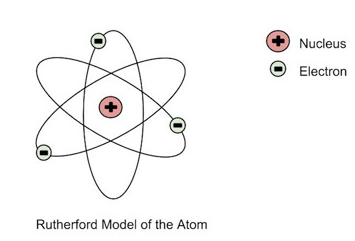
9.

Who came up with this model of an atom?
a)
J.J. Thompson
b)
Ernest Rutherford
c)
Neils Bohr
d)
James Chadwick
10.

J.J. Thomson provided evidence that an atom...
a)
is the smallest particle of matter
b)
contains negatively charged particles
c)
has an overall negative charge
d)
has an overall positive charge
11.
Electrons are not factored into atomic mass because:
a)
They are so small their mass is negligible
b)
They're not in the nucleus
c)
They're too big
d)
They move so quickly their mass is zero
12.
He came up with the Saturnian Model of the atom, the first atom model to have real movement in the atom.
a)
Nagaoka
b)
Nissan
c)
Nibisquaka
d)
Niquila
13.
Earth, Air, Fire, and Water were the fundamental elements propose by ___.
a)
Aristotle
b)
Democritus
c)
Plato
d)
Galileo
14.
Discovered the nucleus
a)
Democritus
b)
Robert Millikan
c)
James Chadwick
d)
Ernest Rutherford
15.
Discovered the electron using cathode ray tube
a)
Joseph Thomson
b)
John Dalton
c)
Ernest Rutherford
d)
Robert Millikan
16.
Atomic model was termed the "plum pudding model"
a)
Joseph Thomson
b)
Niels Bohr
c)
Ernest Rutherford
17.
Discovered the proton in 1920
a)
James Chadwick
b)
Ernest Rutherford
c)
John Dalton
d)
Niels Bohr
18.

The sum of the number of protons and the number of neutrons is called the _____
a)
atomic number
b)
mass number
c)
isotope number
d)
average weight
19.

The middle of the atom, which contains protons and neutrons, is called _____
a)
the shell
b)
the nucleus
c)
the cell
d)
the control center
20.

number of neutrons = _____
a)
atomic number - mass number
b)
isotope number - atomic weight
c)
mass number - atomic weight
d)
mass number - atomic number
21.

In the Bohr model of the atom, what is the maximum number of electrons in the second shell?
a)
2
b)
6
c)
8
d)
18
22.

Which subatomic particle has a relative charge of +1?
a)
the proton
b)
the neutron
c)
the electron
d)
the photon
23.

For an atom to be electrically neutral, it must contain the same number of _____
a)
protons and neutrons
b)
neutrons and electrons
c)
protons and electrons
d)
nucleons and electrons
24.

If you want to know which atom an element is, then count the _____
a)
protons
b)
neutrons
c)
electrons
d)
nucleons
25.
An atom has a mass of 54 while is atomic number is 32. How many electrons does it have?
a)
22
b)
32
c)
54
d)
0
26.
An atom has a mass of 54 while is atomic number is 32. How many neutrons does it have?
a)
22
b)
32
c)
54
d)
86
Reset

