
 Worksheets
unit 2 6 weeks review
Total questions: 56
Worksheet time: 46mins
Name
Class
Date
1.
____________ is the ability to cause change.
a)
Energy
b)
Force
c)
Friction
d)
Motion
2.
Energy can cause an object to ______________ the position of its motion.
a)
Energy
b)
Change
c)
Speed
d)
Stored
3.
Energy due to motion is ____________ energy.
a)
Potential
b)
Energy
c)
Kinetic
d)
Friction
4.
The faster an object moves, the ________ kinetic energy it has.
a)
more
b)
less
c)
none of the above
d)
all of the above
5.
__________ is stored energy.
a)
Potential
b)
Kinetic
c)
None of the above
d)
All of the above
6.
When you are holding a book, energy is stored between the book and Earth; this type of energy is called ________ potential energy.
a)
Kinetic
b)
Potential
c)
Gravity
d)
Friction
7.
Gravitational potential energy depends on the ________ and ________ of the object.
a)
Height and mass
b)
Friction and movement
c)
Mass and Movement
d)
Height and Friction
8.
When you stretch a rubber band, you are storing __________ energy.
a)
kinetic
b)
potential
c)
none of the above
d)
all of the above
9.
Food has _________ energy.
a)
Potential
b)
Kinetic
c)
None of the above
d)
All of the above
10.
Which of the following correctly states the law of conservation of energy?
a)
Energy can be created and destroyed.
b)
Energy can be created but not destroyed.
c)
Energy cannot be created or destroyed.
d)
Energy cannot be created but it can be destroyed.
11.

Describe the energy in this picture.
a)
Potential
b)
Kinetic
c)
Potential and Kinetic
d)
The slinky has no energy.
12.

Describe the energy in this picture.
a)
Gravitational Potential
b)
Kinetic
c)
Elastic Potential
d)
No Energy
13.

Describe the energy in this picture.
a)
Gravitational Potential
b)
Kinetic
c)
Elastic Potential
d)
No Energy
14.

Describe the energy transformation in this picture.
a)
Potential to Kinetic
b)
Kinetic to Potential
c)
No transformation - it's all potential.
d)
No transformation - it's all kinetic.
15.
What happens to energy?
a)
It is created.
b)
It is destroyed.
c)
It is transformed.
d)
Nothing changes.
16.

Describe the energy in the picture.
a)
Gravitational Potential
b)
Kinetic
c)
Elastic Potential
d)
No energy.
17.
What word best describes Kinetic Energy?
a)
Stored
b)
Motion
c)
Elastic
d)
Gravity
18.
What word best describes potential energy?
a)
Stored
b)
Motion
19.
Gravitational Potential energy increases as _________ increases.
a)
Speed
b)
Elasticity
c)
Height
d)
Movement
20.
Kinetic energy is related to the ________ of an object.
a)
Position
b)
Elasticity
c)
Speed
d)
Volume
21.

Describe the energy at Position B.
a)
High Potential
b)
Low Kinetic
c)
High Kinetic
d)
Equal Potential and Kinetic
22.

At which position would the roller coaster be transforming kinetic energy to potential energy?
a)
A to B
b)
B to C
c)
C to D
d)
No such transformation.
23.
What is the unit to MEASURE force?
a)
Kilogram
b)
Meter
c)
Pascal
d)
Newton
24.

A ____________ is a push or a pull on an object.
a)
friction
b)
force
c)
magnet
d)
gravity
25.
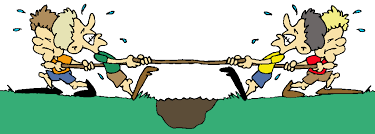
If these teams are pulling with the same amount of force what will happen?
a)
The boy in blue will win.
b)
They will not move at all.
c)
The boy in red will win.
d)
Both will fall down.
26.

Balanced or unbalanced?
a)
balanced
b)
unbalanced
27.
What will cause an object to move?
a)
Applied forces
b)
Balanced forces
c)
Unbalanced forces
28.

Balanced or Unbalanced?
a)
Balanced
b)
Unbalanced
29.

This is an example of what kind of force?
a)
Balanced Force
b)
Pushing Force
c)
Gravity Force
d)
Unbalanced Force
30.

If an object is not moving the forces acting upon it are _____________
a)
unbalanced
b)
weak
c)
balanced
d)
Hulk Smash!
31.
A push or pull that causes a change in motion
a)
Friction
b)
Gravity
c)
Force
d)
Mass
32.
The force that pulls objects towards Earth.
a)
Gravity
b)
Friction
c)
Inertia
d)
Force
33.
When forces are _________ the object DOES NOT move.
a)
unbalanced
b)
balanced
c)
heavy
d)
light
34.
When forces are ___________ the object will move.
a)
unbalanced
b)
balanced
c)
light
d)
gravity
35.

What is the formula to calculate speed?
a)
S = t/d
b)
S = d/t
c)
S = d x t
d)
S = t x d
36.

A runner races in the 100 meter dash. It takes her 10 seconds to finish. What is her average speed?
a)
10 m/s
b)
1000 m/s
c)
100 seconds
d)
10 seconds
37.

Total distance divided by total time is
a)
average speed
b)
constant speed
c)
instantaneous speed
d)
acceleration
38.

The correct equation to calculate speed is
a)
distance/time
b)
time/distance
c)
distance x time
d)
distance/time2
39.

Shona cycles at an average speed of 8km/h. How far has she travelled if she cycles for 4 hours?
a)
55km
b)
32km
c)
43km
d)
32miles
40.

Alan travels 100 km in 5hrs. Find his average speed in km/h
a)
5km/hr
b)
10km/hr
c)
50km/hr
d)
20km/hr
41.

Joanna drives for 400km at an average speed of 80km/h. How long was her journey?
a)
Joanna's journey was 5hrs long
b)
Joanna's journey was 10hrs long
c)
Joanna's journey was 20hrs long
d)
Joanna's journey was 15hrs long
42.

Find speed when distance is 142 km and time is 2 hours.
a)
71km/hr
b)
52km/hr
c)
17km/hr
d)
90km/hr
43.

Which is correct?
a)
speed = distance x time
b)
speed = speed divided time
c)
speed = Distance divide time
d)
Speed = time x speed
44.

What does this graph represent?
a)
Constant Speed
b)
Acceleration
c)
Not moving
45.

What two measurements are necessary for calculating speed?
a)
Mass and time
b)
Temperature and mass
c)
Mass and distance
d)
Distance and time
46.

How far will a person go if they jog for 2 hours at a speed of 12 km/hr?
a)
6 km
b)
0.5 km
c)
10 km
d)
24 km
47.

What is happening at D?
a)
Stationary
b)
Accelerating
c)
Fast steady speed; moving away from the starting position
d)
Slower steady speed; moving away from the starting position
48.

What is happening at E?
a)
Stationary
b)
Accelerating
c)
Fast steady speed; moving away from the starting position
d)
Steady speed; returning to start position
49.

What is happening at A?
a)
Stationary
b)
Accelerating
c)
Slower steady speed; moving away from the starting position
d)
Steady speed; returning to start position
50.

Which runner won the race?
a)
A
b)
B
c)
C
d)
It was a tie
51.

Which runner had a head start?
a)
A
b)
B
c)
C
d)
None of them
52.
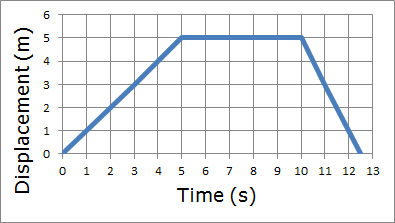
According to the graph how far does the person travel in the first 5 seconds?
a)
2 m
b)
10 m
c)
0 m
d)
5 m
53.
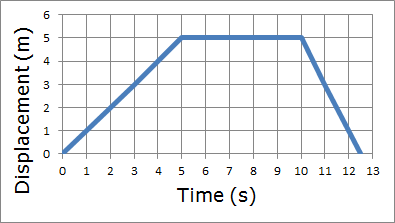
What is the person doing from 5 seconds to 10 seconds?
a)
Walking
b)
Running
c)
Standing Still
d)
Walking Fast
54.

How far is the person from the starting point after 3 seconds?
a)
0 m
b)
2 m
c)
3 m
d)
6 m
55.

What is the average speed of the person during the first 5 seconds?
a)
0 m/s
b)
1 m/s
c)
3 m/s
d)
6 m/s
56.

Total distance divided by total time is
a)
average speed
b)
constant speed
c)
instantaneous speed
d)
acceleration
100 %

