
 Worksheets
APES Unit 3 Review
Total questions: 43
Worksheet time: 42mins
Name
Class
Date
1.
Which biome covers most of the land mass near the Earth's equator?
a)
tundra
b)
desert
c)
grassland
d)
tropical rainforest
2.
Which major biome is home to cacti, mesquite, white thorn, pack rats, small reptiles, and coyotes?
a)
desert
b)
taiga
c)
tundra
d)
grassland
3.
Which biome receives between 0 to 25 centimeters of rain per year, has a temperature range of 0 to 50 degrees Celsius, has poor soil, and is home to lizards, scorpions, and snakes?
a)
desert
b)
mountain
c)
taiga
d)
tundra
4.
Which biome receives between 0 and 25 centimeters of precipitation each year, has a temperature range from -27 to 5 degrees Celsius, has frozen soil, and is home to hares, caribou, and wolves?
a)
desert
b)
mountain
c)
savannah
d)
tundra
5.
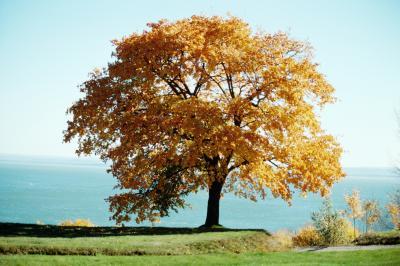
The biome known for trees with broad leaves that fall off the trees in the winter.
a)
Coniferous Forests
b)
Deciduous Forests
c)
Deserts
d)
Tropical Rain Forests
6.

Which biome is represented by the rainfall amounts in letter C?
a)
desert
b)
prairie
c)
deciduous forest
d)
tropical rain forest
7.
Have wide tolerance range; have ability to live in a wide array of habitats or use a wide array of resources
a)
Specialist
b)
Generalist
8.
Competitive interactions among members of the same species
a)
Intraspecific
b)
Interspecific
9.
A niche restricted by competition
a)
Realized Niche
b)
Fundamental Niche
10.

The image shows....
a)
Interspecific competition
b)
Intraspecific competition
c)
Mutualism
d)
Resource Partitioning.
11.
Sea Otters function as a _________in the kelp forest ecosystem because when they are removed, the whole system fails.
a)
Keystone Species
b)
Apex Predator
c)
Primary Producer
d)
Primary Consumer
12.

This picture illustrates which concept?
a)
Ecological Succession
b)
Plant growth
c)
Different forest types
d)
None of these
13.

In this picture, the ZEBRA is the __________________
a)
predator
b)
prey
14.
A tick and a dog have this type of relationship.
a)
mutualism
b)
commensalism
c)
neutralism
d)
parasitism
15.
Relationship where 1 species benefits from another species that is not affected
a)
Parasitism
b)
Commensalism
c)
Competition
d)
Mutualism
16.

This invasive plant came from Asia and was believed to be a pretty decoration. Unfortunately, it covers native plants and blocks sunlight from reaching them.
a)
Kudzu Vine
b)
Feral Swine
c)
Sea Lamprepy
d)
Zebra Mussels
17.

The picture represent the world __________.
a)
ecosystems
b)
continents
c)
biomes
d)
US territory
18.

The _____________ succesion is the succession wich start after a natural desaster, like fire.
a)
primary
b)
secondary
c)
tertiary
d)
quaternary
19.
The efficiency of energy transfer from a lower trophic level to the next highest level is roughly
a)
1%
b)
10%
c)
100%
d)
1000%
20.

Which animal is the apex predator?
a)
hawk
b)
lizard
c)
snake
d)
grass
21.
What does every food chain start with?
a)
producers
b)
sun
c)
consumer
d)
decomposers
22.
These are organisms such as mushrooms and bacteria that break down tissues of dead organisms.
a)
decomposers
b)
producers
c)
autotrophs
d)
algae
23.
Biomass refers to
a)
Chemical Energy
b)
Light Energy
c)
Rank in the feeding heirarchy
d)
Amount of living tissue in an ecosystem
24.
The number and abundance of species in a biological community is called ____.
a)
Species Diversity
b)
Genetic Diversity
c)
Ecosystem Diversity
d)
Biomass
25.
In which location would you expect to find the greatest species diversity?
a)
Canada
b)
Costa Rica
c)
Mexico
d)
United Stastes
26.
Which organisms are affected most by biological magnification?
a)
Algae
b)
Plants
c)
Wolves
d)
Mice
27.
When resources begin running out, a population is...
a)
Growing successfully
b)
Getting close to the carrying capacity.
c)
Rapidly declining
d)
Staying the same
28.

If a disease destroying barley plants in a field swept through an ecosystem, what would happen to the barley eating bird population in the the field ?
a)
The bird population would stay the same
b)
The bird population would infinitely increase
c)
The bird population would decrease
29.

Will competition increase/decrease the carrying capacity of an ecosystem for the animal in competition?
a)
Decrease
b)
Increase
30.

What type of growth is represented in this graph?
a)
exponential
b)
logistics
c)
a good kind
d)
representative
31.
It refers to the movement/ transfer of contaminant from one trophic level to another.
a)
Bioaccumulation
b)
Biomagnification
c)
Bioremediation
d)
Phytoremediation
32.
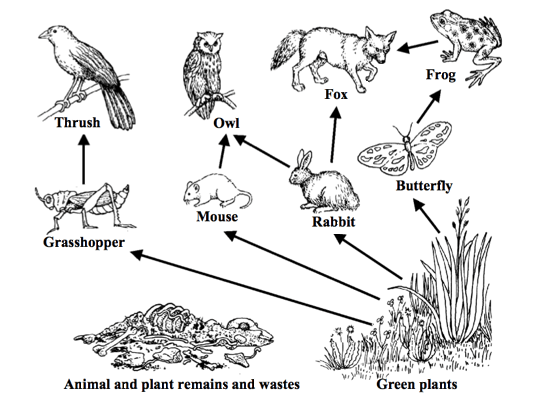
The owl receives energy from which organisms?
a)
grasshopper and mouse
b)
mouse and rabbit
c)
rabbit and butterfly
d)
butterfly and frog
33.
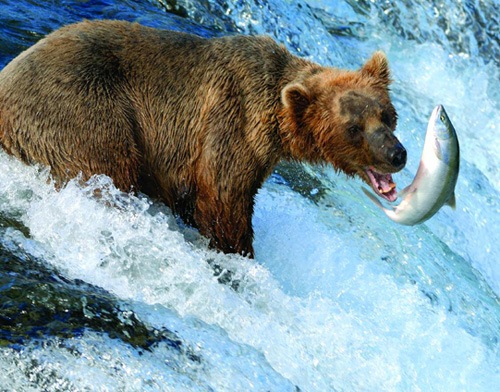
An organism that needs to eat other organisms to obtain energy is known as a:
a)
Autotroph
b)
Producer
c)
Consumer
d)
Mutualist
34.
Almost all energy on Earth ultimately comes from what source?
a)
Water
b)
Sun
c)
Consumers
d)
Oxygen
35.
A place where an organism gets everything it needs to survive.
a)
habitat
b)
community
c)
ecosystem
d)
population
36.
Different organisms living together in the same area:
a)
community
b)
population
c)
species
d)
ecosystem
37.
All of the living AND non-living things in an particular area is called a(n):
a)
ecosystem
b)
house
c)
community
d)
mountain
38.
Which type of succession occurs on a surface where no ecosystem has existed before?
a)
primary
b)
secondary
c)
tertiary
39.
Which of the following is an example of secondary succession?
a)
new islands created by volcanic eruption
b)
areas exposed when a glacier retreats
c)
regrowth after wildfire in California
40.

Based on the graph shown, what is the effect of removing a keystone species from an ecosystem?
a)
biodiversity goes up
b)
biodiversity goes down
c)
biodiversity stays about the same
d)
not enough information to tell
41.

What is a keystone species?
a)
A species that helps to hold an ecosystem together
b)
A species that lives in or around rocks
c)
Keys and stones have nothing to do with ecology
d)
A keystone isn't a living thing, it's just a stone
42.
The term for the role an organism has in the community.
a)
niche
b)
habitat
c)
tolerances
d)
competition
43.
The number of different species a community contains
a)
richness
b)
evenness
c)
density
d)
abundance
100 %

