
NEW
Font size
S
M
L
XL
 Worksheets
Sun, Moon, Earth and Planets Vocabulary
Total questions: 25
Worksheet time: 17mins
Name
Class
Date
1.

Jupiter, Saturn, Uranus, and Neptune are known as the.....
a)
Outer Planets
b)
Big Planets
c)
Ringed Planets
d)
Moons
2.

The moon is a natural ______ of Earth.
a)
comet
b)
axis
c)
satellite
d)
planet
3.

When an object moves in a circular motion around something.
a)
axis
b)
rotation
c)
revolve
d)
sinks
4.
Where is the asteroid belt found?
a)
between earth and mars
b)
Between Uranus and Neptune
c)
Between Mercury and Venus
d)
Between Mars and Jupiter
5.
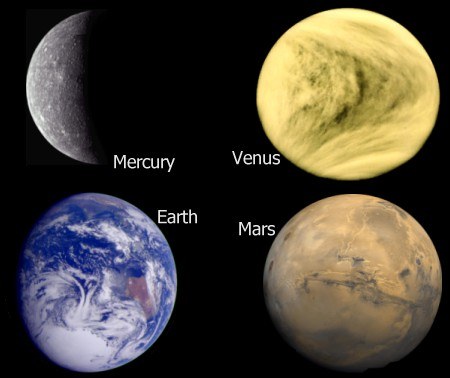
Earth and the other planets closest to the Sun are made mostly of _______
a)
gas
b)
metal
c)
water
d)
rock
6.
Which is an example of rotating?
a)
running around a track
b)
fan
c)
running around baseball field
7.

Made up of all the planets that orbit the sun. Also consists of moons, comets, asteroids, minor planets, and dust and gas.
a)
asteroid
b)
solar system
c)
sun
d)
planet
8.
A star, and the largest object in the solar system. Burns brightly in the center as planets and other objects orbit around it.
a)
Sun
b)
asteroid
c)
planet
d)
gravity
9.

Mercury, Venus, Earth, and Mars are known as the....
a)
Outer Planets
b)
Inner Planets
c)
Tiny Planets
d)
Boring Planets
10.
the path one object in space takes around another object in space
a)
orbit
b)
solar system
c)
road
d)
rotate
11.

Light changes speed as it travels through various mediums. What are examples of mediums that light can travel through.
a)
snow and ice
b)
air and water
c)
cloth and wood
d)
glass and wood
12.

to spin around on an axis
a)
rotate
b)
revolve
c)
orbit
d)
axis
13.
Which is an example of revolving?
a)
Moon moving around Earth
b)
fan
c)
toy top
14.
a huge ball of very hot gasses in space
a)
star
b)
comet
c)
planet
d)
galaxy
15.

Which objects on the table are "Translucent"?
a)
Fish Bowl; Supply Box; Goggles
b)
Pencil; Fish Bowl; Cup
c)
Fish Bowl; Supply Box; Pitcher
16.
All of the following are true about the Sun
EXCEPT
EXCEPT
a)
the Sun makes the light we see
b)
the heat from the Sun is reflected from Moon to the Earth
c)
sunlight is Earth’s primary source of energy
17.
Earths rotation (turning on its axis) causes...
a)
Solar Eclispe
b)
Day and Night
c)
moon phases
d)
seasons
18.
why does the moon shine in the night sky?
a)
The moon makes its own light
b)
the moon reflects light off of jupiter
c)
The moon reflects light off the sun
d)
just shines for no reason
19.
Why does the moon appear to be larger than the stars?
a)
The moon is closer to earth then the stars
b)
The moon is brighter than the stars
c)
The moon is the largest of all stars
d)
The moon is larger than the stars
20.
Which of the following is a characteristic of both the Earth and the Moon?
a)
Atmosphere containing oxygen
b)
Rocky surface covered with landforms
c)
Flowing water in oceans and rivers
d)
Fossils and fossil fuels under the surface
21.

The Moon rotates around the Earth once, about every -
a)
year
b)
week
c)
month
d)
180 days
22.
Which of the following lists the Earth, Sun, and Moon in order of size, from largest to smallest?
a)
Earth, Sun, and Moon
b)
Earth, Moon, and Sun
c)
Sun, Earth, and Moon
d)
Sun, Moon, and Earth
23.
What characteristic do the Earth and Moon share that makes them different from the Sun?
a)
spherical shape
b)
rotate on an axis
c)
rocky crust and surface
d)
found in our Solar System
24.
A student wants to observe the physical features of the Moon. In addition to using websites on the internet, the student should use -
a)
binoculars.
b)
telescope.
c)
a hand lens.
d)
a microscope.
25.
Earth has seasons because.....
a)
Its axis is tilted
b)
Revolves around Saturn
c)
The sun revolves around Earth
Reset

