
 Worksheets
Ecosystems
Total questions: 20
Worksheet time: 10mins
Name
Class
Date
1.
Where are the organisms that live in an area together with the nonliving factors of the environment
a)
Ecology
b)
Ecosystem
c)
Populations
d)
Species
2.
Define Ecology
a)
The study of how organisms interact with each other and with their physical environment
b)
All the organisms that live in an area together with the nonliving factors of the environment
c)
A group of organisms that can mate and produce offspring that in turn can produce more offspring
d)
All the populations that live in an area along with physical factors in the environment
3.
What does a dichotomous key do?
a)
classify organisms according to their place within the kingdoms
b)
shows what ancestor organisms have in common
c)
show the evolutionary relationships among different groups of organisms
d)
helps you identify organisms by presenting you with a series of choices
4.
Of the following, which one is NOT a kingdom?
a)
Plant
b)
Animal
c)
Algae
d)
Protist
5.
Who was the Greek philosopher that was the first person known to classify living things scienctifically?
a)
Aristotle
b)
Sir Isaac Newton
c)
Plato
d)
Linnaeus
6.
Define Biome
a)
the general weather of an area over a long period of time, including its seasonal changes
b)
the part of Earth that supports life
c)
a large region characterized as having a distinct climate and specific types of plant and animal life
d)
the natural process by which one community of organisms slowly replace one another in a certain area
7.
For any population to thrive, there must be enough food, water, and living space. What are these such factors called?
a)
Population
b)
Community
c)
Species
d)
Limiting Factor
8.
Which of these is a relationship between populations?
a)
Competition
b)
Ecosystem
c)
Consumer
d)
Producer
9.

The picture is an example of
a)
Food Web
b)
Food Chain
c)
Feeding Relationship
d)
Food Cycle
10.
Another type of tree, called a BLANK , is used to show the evolutionary relationships among different groups of organisms.
a)
Vascular
b)
Nonvascular
c)
Taxonomic Trees
d)
Identification Key
11.
What is the largest, single group of invertebrates?
a)
Mammals
b)
Plants
c)
Arthropods
d)
Amphibians
12.
Which of the following are the correct order of the Kingdom levels?
a)
Species, Order, Family, Genus, Class, Kingdom, Domain, Phylum
b)
Domain, Kingdom, Phylum, Class, Order, Family, Genus, Species
c)
Species, Genus, Family, Order, Class, Phylum, Kingdom, Domain
d)
Domain, Kingdom, Species, Genus, Phylum, Class, Family, Order
13.

A toucan would belong in which biome?
a)
Rainforest
b)
Grassland
c)
Tundra
d)
Artic
14.
Define Classify
a)
organizing the organisms into groups based on similar characteristics
b)
the natural process by which one community of organisms slowly replaces another in a certain area
c)
the part of Earth that supports life
d)
group that has the largest number of different organisms
15.
Which of these are not part of the three domains
a)
archaea
b)
protists
c)
bacteria
d)
eukarya
16.

What biome is the one pictured above?
a)
Rainforest
b)
Grassland
c)
Artic
d)
Desert
17.
The first organism to live in an area are called?
a)
Newcomers
b)
Pioneer Species
c)
Pilgrims
d)
Lichens
18.

Which Biome would these fish belong in?
a)
Tundra
b)
Grassland
c)
Terrestrial
d)
Aquatic
19.
What is the system used to organize into groups the many different organisms found on Earth?
a)
Domain System
b)
Classification Hierarchy
c)
Classification
d)
Ecosystem
20.
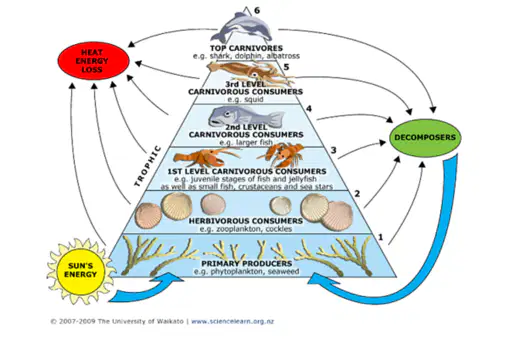
This is an example of
a)
Food Web
b)
Food Chain
c)
Energy Web
d)
Autotroph
100 %

