
NEW
Font size
S
M
L
XL
 Worksheets
Seismic Waves
Total questions: 54
Worksheet time: 37mins
Name
Class
Date
1.

What does letter "a" represent?
a)
amplitude
b)
wavelength
c)
crest
d)
trough
2.
What does letter "b" represent?
a)
amplitude
b)
wavelength
c)
crest
d)
trough
3.
What does letter "d" represent?
a)
amplitude
b)
wavelength
c)
crest
d)
trough
4.
Which type of wave arrives to a point first?
a)
Primary Waves (P-Waves)
b)
Secondary Waves (S-Waves)
c)
Rayleigh Waves
d)
Love Waves
5.
Which classification of wave does the most damage?
a)
Body Waves
b)
Mega Waves
c)
Surface Waves
d)
Love Waves
6.
Which classification of wave does the most damage?
a)
Body Waves
b)
Mega Waves
c)
Surface Waves
d)
Love Waves
7.
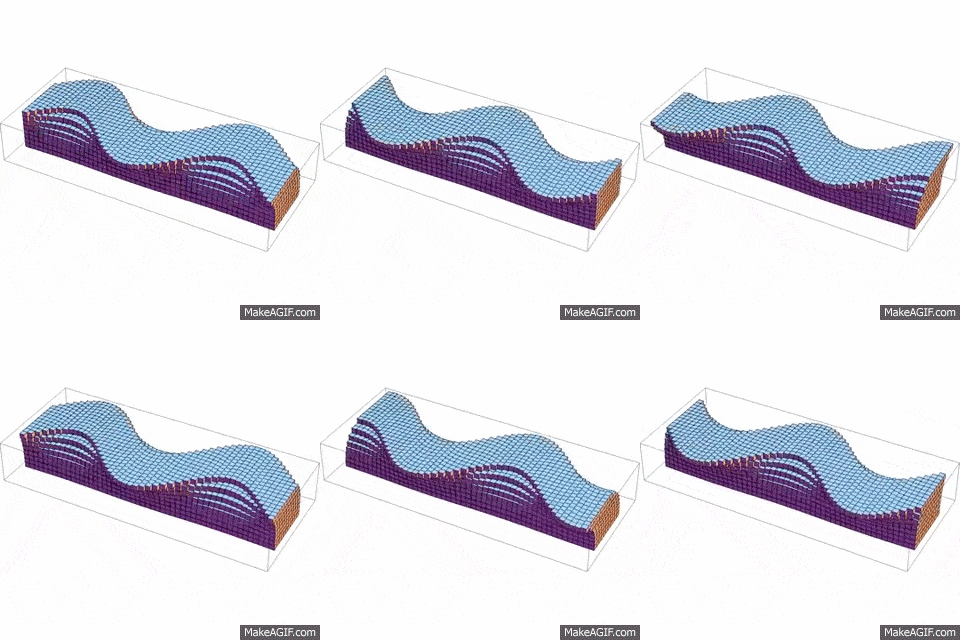
Which surface wave is pictured?
a)
P-Wave
b)
S-Wave
c)
Rayleigh Wave
d)
Love Wave
8.
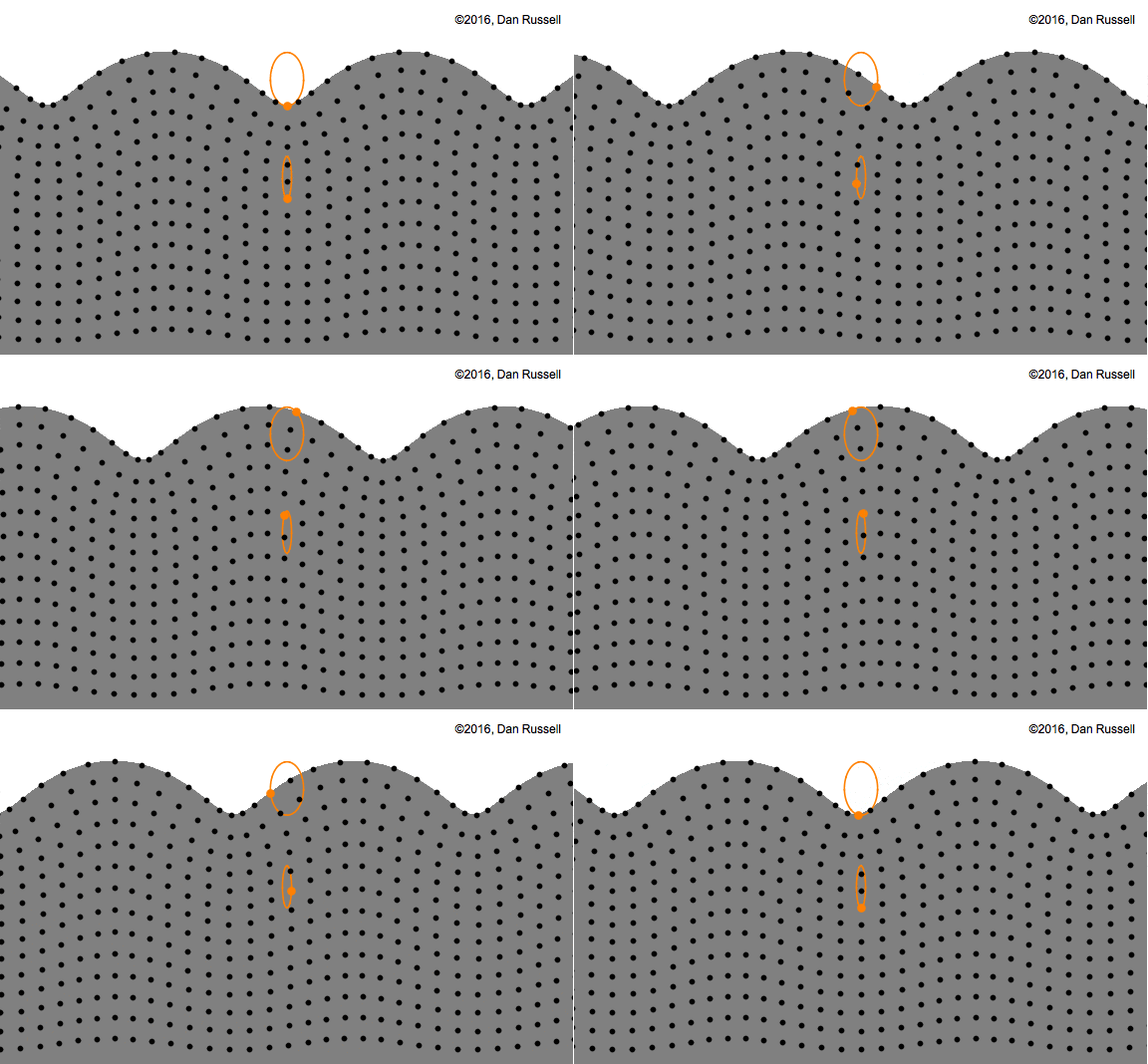
Which surface wave is pictured?
a)
P-Wave
b)
S-Wave
c)
Rayleigh Wave
d)
Love Wave
9.
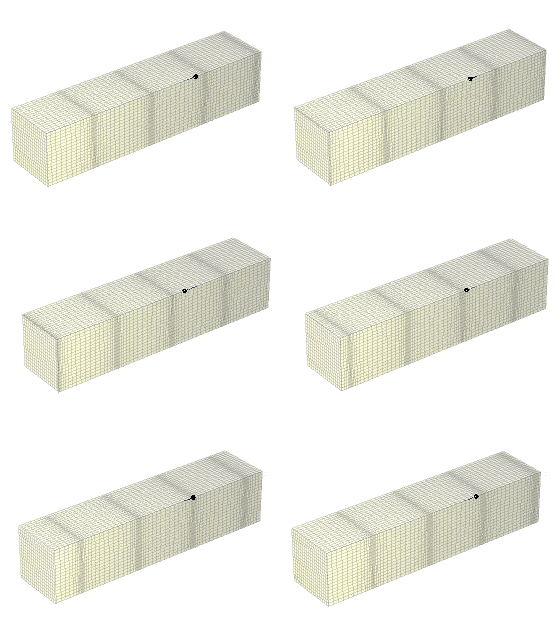
Which body wave is pictured?
a)
P-Wave
b)
S-Wave
c)
Rayleigh Wave
d)
Love Wave
10.
A shaking of the Earth's crust caused by a release of energy is a(n)
a)
fault
b)
earthquake
c)
tectonic plate
d)
epicenter
11.
The focus of an earthquake is
a)
The point (below Earth's surface) where rocks first begin to break and the first movement occurs
b)
The closest seismic station
c)
The place where the greatest damage occurs
d)
A fault
12.
P and S waves travel through the earth, and so are called
a)
surface waves
b)
body waves
c)
tsunamis
d)
earth waves
13.
What does S in an S wave stand for?
a)
super
b)
secondary
c)
slow
d)
sideways
14.
What does P in a P wave stand for?
a)
peridot
b)
picky
c)
primary
d)
partial
15.
Which kind of wave arrives at seismic stations second?
a)
P (primary)
b)
S (secondary)
c)
L (love)
d)
R (rayleigh)
16.
Which kind of waves usually do the most damage in an earthquake?
a)
Body waves (P and S waves)
b)
Surface waves (L and R waves)
17.
Which kind of waves canNOT travel through a liquid?
a)
P waves
b)
S waves
18.

What are the "waves" called that come from an earthquake?
a)
Thunder
b)
Seismic
c)
Hang 10
d)
Lava
19.
Which classification of wave does the most damage?
a)
Body Waves
b)
Mega Waves
c)
Surface Waves
d)
Love Waves
20.

Earthquakes release these which let us study what the Earth is made out of
a)
Tectonic Plates
b)
Seismic Waves
c)
Plateaus
d)
P Waves
21.

These are the first waves released during an earthquake
a)
S waves
b)
Surface Waves
c)
P waves
22.

These are the secondary, or second waves to be released. They cannot travel through the liquid outer core
a)
S waves
b)
Surface Waves
c)
P waves
23.

This is the area beneath the Earth's surface where the earthquake begins
a)
epicenter
b)
focus
c)
fault line
d)
tectonic plate
24.
True or False
Primary Waves travel the fastest and cause the most damage
Primary Waves travel the fastest and cause the most damage
a)
True
b)
False
25.
Which type of Seismic Waves travel through the Earth?
a)
Primary Waves
b)
B Waves
c)
Body Waves
d)
Ocean Waves
26.
Secondary Waves can pass through ______ only
a)
gas
b)
water
c)
solids
d)
the defense of the Panthers
27.
A wave that can only travel through matter.
a)
mechanical wave
b)
electromagnetic wave
c)
transverse wave
d)
longitudinal wave
28.
The lowest point that a medium sinks to.
a)
crest
b)
trough
c)
wavelength
d)
wave
29.
A transverse wave that can travel through empty space and through matter.
a)
mechanical wave
b)
electromagnetic wave
c)
longitudinal wave
d)
radio wave
30.
The highest point the medium travels to.
a)
trough
b)
wave
c)
wavelength
d)
crest
31.
A wave in which the disturbance is perpendicular to the direction the wave travels.
a)
mechanical wave
b)
electromagnetic wave
c)
transverse wave
d)
longitudinal wave
32.
The distance from the crest of one wave to the crest of the next.
a)
trough
b)
crest
c)
wave
d)
wavelength
33.
A wave in which the disturbance is parallel to the direction the wave travels.
a)
mechanical wave
b)
transverse wave
c)
longitudinal wave
d)
electromagnetic wave
34.
The maximum distance a wave varies from its resting position.
a)
crest
b)
trough
c)
wavelength
d)
amplitude
35.
Which type of wave arrives to a point first?
a)
Primary Waves (P-Waves)
b)
Secondary Waves (S-Waves)
c)
Rayleigh Waves
d)
Love Waves
36.
Which classification of wave does the most damage?
a)
Body Waves
b)
Mega Waves
c)
Surface Waves
d)
Love Waves
37.
Which body wave is pictured?
a)
P-Wave
b)
S-Wave
c)
Rayleigh Wave
d)
Love Wave
38.
These cause the most damage and are the slowest waves caused by an Earthquake
a)
seismic
b)
meteorite
c)
primary
d)
surface
39.
What is the best description of primary waves?
a)
Waves that are the slowest, largest, and cause the most destruction
b)
Waves that cause rock particles to vibrate
c)
Waves that travel the fastest and cause rock material to move back and forth
d)
Waves that travel through a vacuum
40.
A wave carries...?
a)
energy only
b)
matter only
c)
energy and matter
d)
neither
41.
In a longitudinal wave, the particles move...?
a)
back and forth
b)
up and down
c)
not at all
d)
at a 90 degree angle
42.
The focus of an earthquake is
a)
The point (below Earth's surface) where rocks first begin to break and the first movement occurs
b)
The closest seismic station
c)
The place where the greatest damage occurs
d)
A fault
43.
A sound wave moving through the air is what kind of wave?
a)
a Longitudinal
b)
water wave
c)
a transverse wave
d)
hand wave
44.
Which direction does a compressional wave travel
a)
parallel
b)
perpendicular
45.
Love wave was discovered by AEH Love in what year?
a)
1921
b)
1901
c)
1931
d)
1911
46.
Lord Rayleigh discovered the Rayleigh wave by the year
a)
1885
b)
1985
c)
1905
d)
1965
47.
The most damaging type of wave
a)
Love wave
b)
S wave
c)
P wave
d)
Rayleigh wave
48.
The motion of this wave is like a snake rolling on the ground
a)
S wave
b)
P wave
c)
Love wave
d)
Rayleigh wave
49.
This is known as shear wave
a)
P wave
b)
S wave
c)
Love wave
d)
Rayleigh Wave
50.
The wave that moves like rolling ocean wave
a)
P wave
b)
S wave
c)
Love wave
d)
Rayleigh wave
51.
It travels only in SOLID
a)
P wave
b)
S wave
c)
Love wave
d)
Rayleigh wave
52.
It travels in solid, liquid and gas
a)
P wave
b)
S wave
c)
Love wave
d)
Rayleigh wave
53.
The waves that travel in the inner portion of the Earth.
a)
Surface wave
b)
Shear wave
c)
Body wave
d)
compressional wave
54.
The slowest type of wave detected by the seismograph
a)
S wave
b)
P wave
c)
Body wave
d)
Surface wave
Reset

