
 Worksheets
Atmosphere, Climate, Weather, Air Masses
Total questions: 52
Worksheet time: 34mins
Name
Class
Date
1.
Which gas in our atmosphere is most abundant?
a)
Argon
b)
Oxygen
c)
Nitrogen
d)
Carbon Dioxide
2.
The air in the troposphere has a greater density than the air in any other layer of the atmosphere,
a)
True
b)
False
3.
Temperature in the stratosphere warms as altitude increases.
a)
True
b)
False
4.
Temperature decreases as altitude increases in the Thermosphere.
a)
True
b)
False
5.
What percentage of our atmosphere is made up of other gases such as argon, water vapor, and carbon dioxide?
a)
1%
b)
21%
c)
78%
d)
90%
6.
What is the percentage of oxygen in Earth's atmosphere?
a)
1%
b)
21%
c)
78%
d)
90%
7.
What is the percentage of nitrogen in Earth's atmosphere?
a)
1%
b)
21%
c)
78%
d)
90%
8.
Which layer of the atmosphere contains the greatest amount of water vapor?
a)
Thermosphere
b)
Troposphere
c)
Mesosphere
d)
Stratosphere
9.
In which layer of the atmosphere does weather occur?
a)
Mesosphere
b)
Thermosphere
c)
Stratosphere
d)
Troposphere
10.
What causes the temperature to increase in the stratosphere?
a)
Nitrogen
b)
Ozone
c)
Water Vapor
d)
carbon dioxide
11.
What decreases as you go up in the atmosphere?
a)
Altitude
b)
Atmosphere
c)
Meteors
d)
Air Pressure
12.
What is the lowest main layer of Earth's atmosphere?
a)
Thermosphere
b)
Troposphere
c)
Stratosphere
d)
Mesosphere
13.
What is the second lowest main layer of Earth's atmosphere?
a)
Thermosphere
b)
Troposphere
c)
Stratosphere
d)
Mesosphere
14.

Where is the temperature the highest?
a)
1
b)
2
c)
3
d)
4
15.

Where is the air pressure the greatest?
a)
1
b)
2
c)
3
d)
4
16.

Where is the altitude the greatest?
a)
1
b)
2
c)
3
d)
4
17.
What are the 2 most abundant gases in Earth's atmosphere?
a)
carbon dioxide and oxygen
b)
carbon dioxide and nitrogen
c)
nitrogen and oxygen
d)
nitrogen and hydrogen
18.
True or False. Scientist classify climates according to temperature and precipitation.
a)
True
b)
False
19.
Where do you find the polar climate?
a)
temperate zones
b)
between the tropics
c)
at the poles
d)
in the warm areas
20.
If I wanted to live where it is warm which climate would I chose?
a)
temperate
b)
tropical
c)
polar
21.
Where would I find humid equatorial climate?
a)
along the poles
b)
at 90N and 90S
c)
close to Japan
d)
along the equator
22.
Define climate.
a)
different air masses
b)
condition of the atmsophere over a short time
c)
average condition over a long period of time
23.
Area that gets 10 inches or less of rainfall per year.
a)
desert
b)
highlang
c)
semi-arid
d)
tundra
24.
Climate region that is covered with taiga.
a)
subarctic
b)
tundra
c)
highland
d)
icecap
25.
Permafrost is found throughout the land in this climate region.
a)
icecap
b)
tundra
c)
taiga
d)
subarctice
26.
This climate region as warm/rainy summers and cool/dry winters.
a)
humid subtropical
b)
tropical wet and dry
c)
tropical wet
d)
mediterranean
27.
A cloudy and damp atmosphere is found in this climate region with a constant temperature all year.
a)
marine west coast
b)
mediterranean
c)
humid sub-tropical
d)
tropical wet and dry
28.
This climate region is located around deserts and gets about 16 inches of rainfall a year.
a)
highland
b)
semi-arid
c)
humid continental
d)
tundra
29.
This climate region is full of mountains and has a variety of climates that change with elevation.
a)
highland
b)
desert
c)
semi-arid
d)
tundra
30.
This climate region has an average temperature of 80 degrees F with little variation throughout the year.
a)
humid sub-tropical
b)
tropical wet
c)
tropical wet and dry
d)
humid continental
31.
Long, hot, and humid summers cause hurricanes to form in this climate region.
a)
humid continental
b)
humid sub-tropical
c)
tropical wet
d)
tropical wet and dry
32.
The coldest temperature of -128 degrees F was recorded in this climate region.
a)
tundra
b)
icecap
c)
subarctic
d)
taiga
33.
This climate region boasts 4 distinct seasons with a wide variety of temperatures throughout the year.
a)
humid continental
b)
humid sub tropical
c)
mediterranean
d)
marine west coast
34.
How do we name air masses?
a)
Water and temperature
b)
Air pressure
c)
Humidity and temperature
d)
Cold and warm
35.
How do we characterize an air mass that forms over the ocean?
a)
Dry
b)
Wet
c)
Cold
d)
Warm
36.
How do we characterize an air mass that forms over land?
a)
Dry
b)
Wet
c)
Cold
d)
Warm
37.
How do we characterize an air mass that forms over near the equator?
a)
Dry
b)
Wet
c)
Cold
d)
Warm
38.
How do we characterize an air mass that forms near the poles?
a)
Dry
b)
Wet
c)
Warm
d)
Cold
39.
What types of air masses form over oceans?
a)
Maritime
b)
Continental
c)
Polar
d)
Tropical
40.
What's the humidity and temperature of a maritime tropical air mass?
a)
Wet and cold
b)
Dry and warm
c)
Wet and warm
d)
Dry and cold
41.
A wet and cold air mass would be a...
a)
Maritime polar
b)
Continental polar
c)
Maritime tropical
d)
Continental tropical
42.
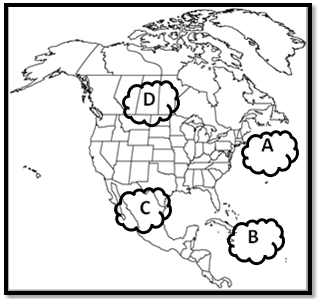
Which type of air would you find at air mass A?
a)
cold, dry
b)
warm, humid
c)
warm, dry
d)
cold, humid
43.
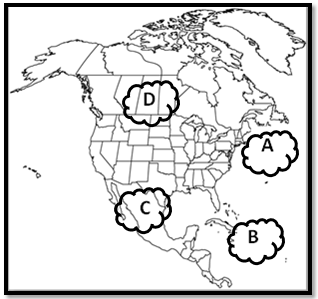
Which type of air would you find at air mass B?
a)
cold, dry
b)
warm, humid
c)
warm, dry
d)
cold, humid
44.
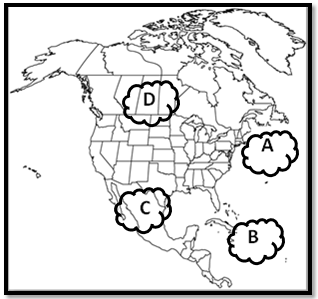
Which type of air would you find at air mass C?
a)
cold, dry
b)
warm, humid
c)
warm, dry
d)
cold, humid
45.
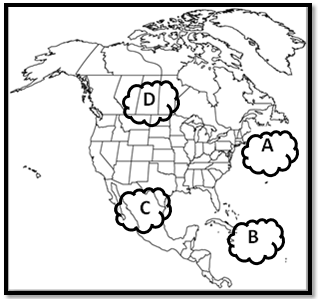
Which type of air would you find at air mass D?
a)
cold, dry
b)
warm, humid
c)
warm, dry
d)
cold, humid
46.
stormy weather
a)
High Pressure System
b)
Low Pressure System
47.
clear skies
a)
High Pressure
b)
Low Pressure
48.
rapidly moving cold air mass runs into a warm air mass the cold air slides under the warm air. This is called a .....
a)
cold front
b)
warm front
c)
stationary front
49.
When a warm air mass gently slides on top of a cold air mass, and you have drizzly rain and then warmer weather, what type of front is it?
a)
warm front
b)
cold front
c)
occluded front
d)
stationary front
50.
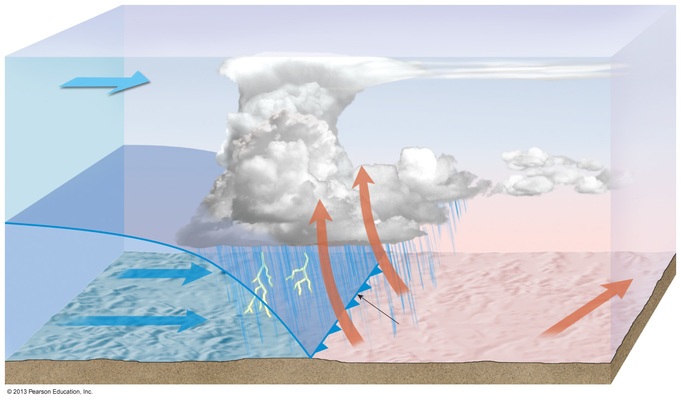
What type of storm front is this?
a)
warm front
b)
cold front
c)
stationary front
d)
occluded front
51.

What does symbol # 3 mean?
a)
stationary front
b)
occluded front
c)
warm front
d)
cold front
52.
When a cold front or a warm front stays in place for several days without invading another front, it is called a ______.
a)
stationary front
b)
cold front
c)
occluded front
d)
warm front
100 %

