

Wayground logo

Free Printable Worksheets

Font size

S
M
L
XL
Worksheets

Pure Substances and Mixtures

Total questions: 33

Worksheet time: 18mins

Name
Class
Date
1.
 Which of these common substances is a homogeneous mixture?
a)
pure water
b)
table salt
c)
whole milk
d)
maple syrup
2.

Which of these substances is an example of a solution?

a)

milk

b)

brass

c)

mercury

d)

concrete

3.
 Which is true of all mixtures?
a)
All mixtures are made up of only compounds
b)
All mixtures are made up of one type of element
c)
All mixtures are made up of atoms
d)
All mixtures are made up of colloids
4.
 Which of these substances is a compound?
a)
chlorine
b)
nitrogen
c)
uranium
d)
ammonia
5.
 Consider a wooden chair and a balloon. What do these two objects always have in common?
a)
Both are made of the same kind of atom
b)
Both are made of atoms
c)
Both have the same mass number
d)
Both are made of the same number of atoms
6.

A magnet was placed near a pile that contained both iron and sulfur. The magnet was moved gradually closer to the pile. As it neared the pile, the magnet started attracting small pieces of iron from the pile. Which of the following statements best describes the contents of the pile?

a)

It is a colloid of sulfur and iron that can separated by magnetism.

b)

It is a compound of iron and sulfur that can be separated by magnetism.

c)

It is a heterogeneous mixture of iron and sulfur that can be separated by magnetism.

d)

It is a solution of iron that can be separated by magnetism.

7.
 A heterogeneous mixture in which the particles are unevenly spread throughout the mixture but are not settling out. Examples: milk, mayonnaise, gelatin
a)
colloid
b)
suspension
c)
solution
d)
homogeneous mixture
8.
 A homogeneous mixture in which one substance is dissolved in another substance. Example: tea
a)
colloid
b)
suspension
c)
solution
d)
homogeneous mixture
9.

A heterogeneous mixture in which particles of a material are too large to stay mixed with-out being stirred or shaken.

a)

colloid

b)

suspension

c)

solution

d)

homogeneous mixture

10.
 A mixture that has a uniform composition. Example: sugar-water
a)
colloid
b)
suspension
c)
solution
d)
homogeneous mixture
11.
 A mixture that does not have a uniform composition. Example: Soil
a)
heterogeneous mixture
b)
suspension
c)
solution
d)
homogeneous mixture
12.
 An atom is . . .
a)
Made of one or more of the same kind of atom chemically combined
b)
Made up of different kinds of atoms chemically combined
c)
Combination of two or more substances that are physically combined.
d)
The smallest unit of matter
13.
 A compound is . . .
a)
Made of one or more of the same kind of atom chemically combined
b)
Made up of different kinds of atoms chemically combined
c)
Combination of two or more substances that are physically combined.
d)
The smallest unit of matter
14.
 An element is . . .
a)
Made of one or more of the same kind of atom chemically combined
b)
Made up of different kinds of atoms chemically combined
c)
Combination of two or more substances that are physically combined.
d)
The smallest unit of matter
15.
 A mixture is . . .
a)
Made of one or more of the same kind of atom chemically combined
b)
Made up of different kinds of atoms chemically combined
c)
Combination of two or more substances that are physically combined.
d)
The smallest unit of matter
16.

Trail mix is just that - a mix. Or in science terms, it is a mixture. One way you can tell this is a mixture is that you can. .

a)

eat all the parts

b)

measure the amounts of the parts.

c)

separate the parts by their properties.

d)

identify the parts that make up the mixture

17.

A solution is a special mixture where you cannot see the individual substances that are mixed. You look at two bowls of ice cream. One bowl is plain vanilla ice cream and the other is vanilla with chocolate chips. Which statement accurately describes the two bowls of ice cream?

a)

Both are mixtures but only the vanilla is a solution.

b)

Only the chocolate chip ice cream is a mixture.

c)

Neither are mixtures because they are solid.

d)

Both ice creams bowls are solutions.

18.

To determine the density of an object, which set of instruments would be helpful?

a)

triple beam balance and meterstick

b)

graduated cylinder and meterstick

c)

meterstick and an erlenmeyer flask

d)

ruler and graduated cylinder

19.

Which is an example of a solution?

a)

air

b)

oxygen

c)

salt

d)

water

20.

Which is an example of a heterogenous mixture?

a)

gasoline

b)

diet soda

c)

grape juice

d)

flour and water

21.

One difference between mixtures and pure substances is that...

a)

mixtures can be physically separated.

b)

mixtures are made of one type of atom.

c)

pure substances have no chemical bonds

d)

)pure substances can be physically separated.
22.
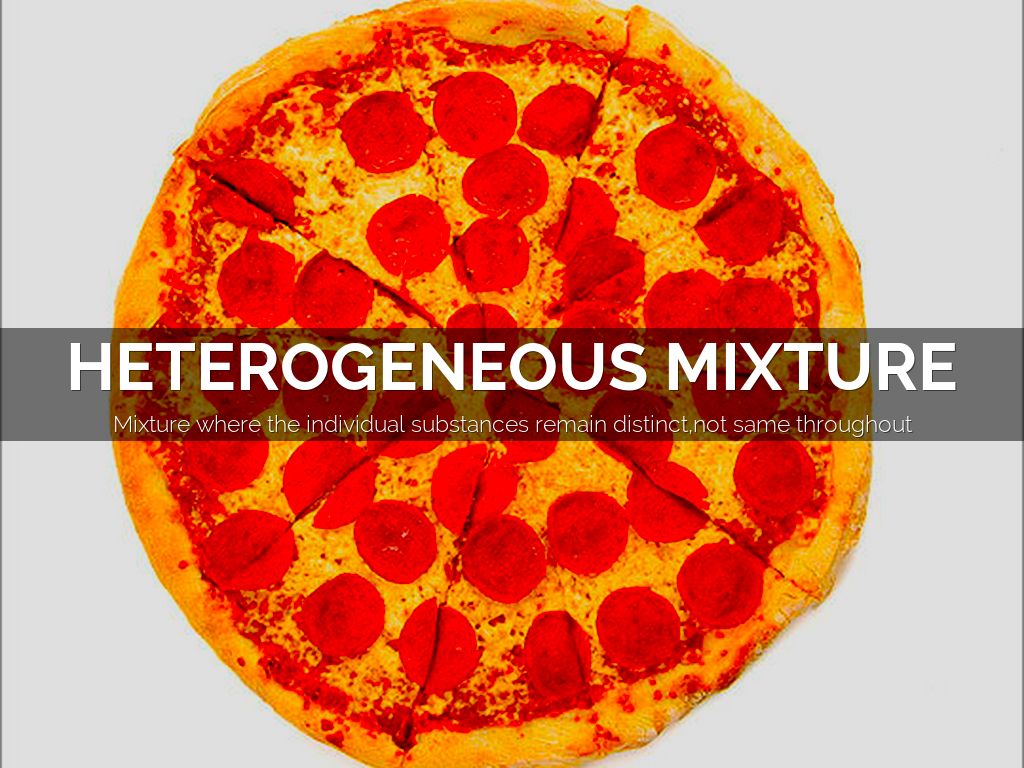
What does it mean if a mixture is heterogeneous?
a)
you can see the different parts
b)
cannot tell one part from another
c)
very well blended
d)
made of elements
23.
What does it mean if a mixture is homogeneous?
a)
you can see the different parts
b)
cannot tell one part from another
c)
chunks of particles
d)
made of elements
24.
What type of mixture is this?
a)
heterogeneous 
b)
homogeneous
25.
What type of mixture is this?
a)
heterogeneous 
b)
homogeneous
26.
To separate the sugar and lemonade what method should you use?
a)
filtration 
b)
sorting
c)
magnet
d)
boiling
27.
To separate trail mix what method should you use?
a)
filtration 
b)
sorting
c)
magnet
d)
boiling
28.
Elements and compounds are always ___.
a)
pure
b)
mixed
29.
air is a 
a)
compound
b)
element
c)
heterogeneous mixture
d)
solution
30.
salt water is a 
a)
compound
b)
element
c)
heterogeneous mixture
d)
solution
31.
Another name for a homogeneous mixture is 
a)
an element.
b)
a solution.
c)
a compound.
32.
This type of mixture contains two or more substances that are visibly distinguishable. 
a)
homogeneous
b)
heterogeneous
c)
solution
d)
colloid
33.
The image shown is an example of a ___________.
a)
solution
b)
mixture
c)
gas
d)
plasma
