
 Worksheets
Test Review for Unit 4, Amazing Atmospheres
Total questions: 50
Worksheet time: 37mins
Name
Class
Date
1.

This image demonstrates that air pressure is greater close to Earth's surface because
a)
the air is less dense at lower altitudes
b)
the air molecules are larger near the surface
c)
the air is more dense near the surface
d)
warm air is more dense than cold air
2.
Which of these is least likely to occur due to increased carbon dioxide in the atmosphere?
a)
drought and loss of crops like corn
b)
decrease in evaporation
c)
polar ice caps melt
d)
sea level rises
3.
Which planet has the greatest greenhouse effect?
a)
Earth
b)
Mars
c)
Mercury
d)
Venus
4.
Which planet out of the choices below has the least greenhouse effect?
a)
Venus
b)
Jupiter
c)
Earth
5.
Which gas, when added to Earth's atmosphere from volcanic eruptions, allowed it to hold heat?
a)
nitrogen
b)
hydrogen
c)
carbon dioxide
d)
oxygen
6.
Of the following gases, which became abundant in Earth's atmosphere only recently?
a)
oxygen
b)
nitrogen
c)
carbon dioxide
d)
water vapor
7.
Which of the following best decribes how Earth's atmosphere and that of Venus compare to each other?
a)
Earth has less carbon dioxide than Venus
b)
Earth has less oxygen than Venus
c)
Earth has more carbon dioxide than Venus
d)
Earth's atmosphere is more dense than Venus' atmosphere
8.
What percentage of Earth's atmosphere is nitrogen?
a)
21%
b)
less than 1%
c)
1%
d)
78%
9.
What percentage of Earth's atmosphere is a mix of trace gases (meaning they are found in only tiny amounts)?
a)
1%
b)
21%
c)
78%
d)
50%
10.
What do scientists study to learn more about Earth's ancient atmosphere?
a)
rocks
b)
dinosaur fossils
c)
ice cores
d)
mammal fossils
11.
Which gas was not abundant in Earth's atmosphere soon after the formation of Earth's moon (Earth's second atmosphere)?
a)
water vapor
b)
nitrogen
c)
carbon monoxide
d)
hydrogen
12.
Where did cyanobacteria form?
a)
in Earth's early atmosphere
b)
in Earth's early ocean
c)
in Earth's first rock layers
d)
in the nebula that later formed our solar system
13.
How do blue-green algae get food?
a)
they consume oxygen during respiration
b)
they consume oxygen during photosynthesis
c)
they consume carbon dioxide during respiration
d)
they consume carbon dioxide during photosynthesis
14.

Which pie chart describes the composition of Earth's atmosphere?
a)
A
b)
B
c)
C
d)
D
15.
The "source" of something is
a)
its evolution, or changes
b)
how it developed its shape
c)
what it looks like
d)
where it came from or started
16.
If something is "abundant," it means
a)
it is rare
b)
there is a lot of it
c)
it is unusual in some way
d)
there is very little of it but it is very valuable
17.
If there was a increase in carbon dioxide in our atmosphere, what might be the effect on Earth?
a)
No effect
b)
It would reflect some sunlight but absorb energy from the ground causing little change
c)
It would absorb more of the suns energy causing the atmosphere to cool down
d)
It would act as a blanket and keep heat energy from escaping, causing the atmosphere to heat up.
18.
Which statement best describes the atmospheres of outer planets (gas giants?)
a)
very thick and the main gases are hydrogen and helium
b)
they are very thick and the main gases are carbon dioxide and methane
c)
they are very thin and the main gases are nitrogen and carbon dioxide
d)
they are very thin and the main gases are hydrogen and helium
19.
What evidence is there for the time frame of when oxygen became common in Earth's atmosphere?
a)
we have an abundance of fossil fuels
b)
rocks containing iron oxidized, or rusted
c)
moon rocks have a similar composition to Earth's seafloor
d)
comets contain frozen water
20.
Burning fossil fuels and combustion may cause
a)
more oxygen to form in Earth's atmosphere
b)
more carbon dioxide to enter the atmosphere
c)
more nitrogen to remain in the atmosphere
d)
more water vapor to enter the atmosphere
21.
The stratosphere is where you can find
a)
the ozone layer
b)
weather
c)
meteors burning up
d)
auroras
22.
What role did volcanic eruptions play in the formation of Earth's atmosphere?
a)
removed oxygen
b)
removed carbon dioxide
c)
released oxygen
d)
released gases like water vapor, carbon dioxide, and carbon monoxide
23.
Complex organisms were able to develop once this happened
a)
asteroids stopped impacting Earth
b)
more sunlight was reflected instead of absorbed
c)
atmosphere's gases changed, and more oxygen was present
d)
comets began to impact Earth more frequently
24.
What happened to the first oxygen that was produced by photosynthetic cyanobacteria?
a)
it was consumed by chemical reactions with rocks that contained iron (oxidation)
b)
it was blown away by the solar wind
c)
it underwent a reaction with sunlight that turned it into ozone
d)
it was broken apart by greenhouse gases
25.

In the troposphere as altitude increases, temperature_____
a)
increases
b)
decreases
c)
stays the same
26.

The layers of the atmosphere are based on:
a)
Temperature
b)
Altutude
c)
Density
27.

Where is the air pressure the greatest?
a)
1
b)
2
c)
3
d)
4
28.
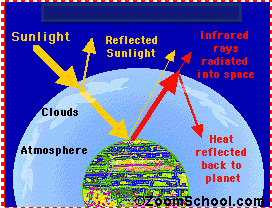
What does this diagram illustrate?
a)
Ozone Layer
b)
The Greenhouse Effect
c)
Ultraviolet Radiation
d)
Layers of the atmosphere
29.
Air pressure...
a)
is the "weight" of air molecules on an object
b)
depends on the density of air molecules (how many there are)
c)
is higher closer to the Earth's surface and lower farther from the Earth's surface
d)
all are correct
30.
What is the only layer of the atmosphere that contains water vapor, therefore the only layer that experiences weather?
a)
Thermosphere
b)
Troposphere
c)
Stratosphere
d)
Mesosphere
31.

What is happening to temperature from 0 to 10 km in height?
a)
temperature rises as height rises
b)
temperature falls as height rises
c)
the higher you go the warmer it gets
d)
there is no correlation
32.
What is happening to temperature from 10 to 30 km in height?
a)
temperature rises as height rises
b)
temperature falls as height rises
c)
the higher you go the warmer it gets
d)
temperature remains about the same as height rises
33.
What is happening in segment C of the graph?
a)
overall as temperature rises as height rises
b)
overall as temperature falls as height rises
c)
the higher you go the colder it gets
d)
temperature remains about the same as height rises
34.
What is the function of the ozone layer?
a)
to allow UV rays to get to Earth
b)
to block UV rays from getting to Earth
c)
To keep oxygen in
d)
to allow meteors to get to Earth
35.
Which of the following is the correct order of the atmosphere layers from Earth to space?
a)
troposphere, stratosphere, mesosphere, thermosphere, exosphere
b)
troposphere, mesosphere, thermosphere, exosphere, stratosphere
c)
thermosphere, stratosphere, mesosphere, troposphere, exosphere
d)
troposphere, stratosphere, mesosphere, exosphere, thermosphere
36.
Convection in the atmosphere causes
a)
wind
b)
tides
c)
solar wind
d)
ozone depletion
37.
What causes wind?
a)
movement of high pressure to low pressure
b)
movement of low pressure to high pressure
38.
Earth absorbs radiation from the sun during the day and at night, reradiates infrared wavelengths (heat) back to space. Clouds
a)
absorb the heat and send it back to Earth the next day
b)
reflect this heat to space even faster
c)
trap heat at night, keeping it warmer than a clear night might be
d)
do not play a role in Earth's heating or cooling cycles
39.
Convection transfers energy in all of these except
a)
the ocean
b)
the atmosphere
c)
interior of Earth (mantle)
d)
groundwater
40.
Volcanic eruptions and meteorite impacts add ____ to the atmosphere.
a)
carbon dioxide
b)
dust and gases
c)
oxygen
d)
nitrogen
41.
The word "composition" refers to
a)
how something changes
b)
what something is made of ("compos"-ed of"
c)
how fast something moves
d)
the way something mixes with other things
42.
The word "least" refers to
a)
lowest amount of
b)
highest amount of
c)
greatest impact from
d)
least impact from
43.
How do the tides affect Earth's atmosphere
a)
tides absorb more carbon dioxide
b)
tides decrease water vapor
c)
tides increase water vapor
d)
tides don't affect the atmosphere
44.
Manmade chemicals called CFCs have decreased ___ in the atmosphere.
a)
carbon dioxide
b)
methane
c)
carbon monoxide
d)
ozone
45.
Most carbon dioxide and carbon monoxide released into Earth's atmosphere comes from
a)
vehicles
b)
factories
c)
volcanoes
d)
power plants
46.
Currents in the atmosphere (wind) are caused by
a)
warm air rising and cooler air sinking
b)
the pattern of currents in the ocean
c)
the concentration of ozone in the upper atmosphere
d)
solar heating of the upper atmosphere
47.
Which layers of the atmosphere are suitable for airplanes to fly through?
a)
thermosphere and mesosphere
b)
stratosphere and mesosphere
c)
troposphere and stratosphere
d)
troposphere and thermosphere
48.
What does "ancient" mean?
a)
very high
b)
very old
c)
very sophisticated
d)
very twisted
49.
What does "organism" mean?
a)
a living thing
b)
a type of rock
c)
a process
d)
the best way to do something
50.
A "process" refers to
a)
the way something died
b)
an object
c)
the age of a once-living organism
d)
the way something is done
100 %

