
 Worksheets
Unit 2 Formative Assessment
Total questions: 53
Worksheet time: 39mins
Name
Class
Date
1.
The thinest layer
a)
crust
b)
inner core
c)
mantle
d)
outer core
2.
The thickest layer
a)
crust
b)
inner core
c)
mantle
d)
outer core
3.
This layer is completely liquid
a)
crust
b)
inner core
c)
mantle
d)
outer core
4.
This layer is completely solid due to the intense pressure it is under
a)
crust
b)
inner core
c)
mantle
d)
outer core
5.
The name for the actual lithospheric plates
a)
Tectonic Plates
b)
Plate Tectonics
c)
Pangaea
d)
Continental Drift
6.
The theory stating the continents were once joined in a large mass that broke apart.
a)
Continental Drift
b)
Seafloor Spreading
c)
Plate Tectonics
d)
Pangaea
7.
The theory that states that the Earth is divided into plates that float and move in slow, constant motion.
a)
Continental Drift
b)
Seafloor Spreading
c)
Plate Tectonics
d)
Tectonic Plates
8.
Faults and tectonic plate boundaries are the same thing.
a)
True
b)
False
9.
The circular pattern of heating, rising, cooling, sinking of magma in the mantle causing tectonic plates to move.
a)
Plate Tectonics
b)
Convection Currents
c)
Pangaea
d)
Subduction
10.
Volcanoes are most often formed at this boundary.
a)
Divergent
b)
Convergent
c)
Normal
d)
Transform
11.
The Mid-Atlantic Ridge is formed at this boundary.
a)
Divergent
b)
Convergent
c)
Normal
d)
Transform
12.
A fossil's location in the Earth's strata can help us know if it is older or younger than other fossils found in the strata.
a)
True
b)
False
13.

Scientists think that convection currents that move the plates flow in Earth's
a)
Continental crust
b)
Oceanic crust
c)
Asthenosphere
d)
Lithosphere
14.
Which of the following occurs because of convection currents?
a)
Tectonic plates on the crust move.
b)
The mantle increases in size.
c)
Pressure in the crust increases.
d)
Pressure in the crust decreases.
15.
What was the name given to all the continents when they were joined as one super continent?
a)
Supreme Continent
b)
Eurasia
c)
Plate tectonics
d)
Pangea
16.

Which of these layers is ALL solid iron and nickel?
a)
inner core
b)
outer core
c)
lithosphere
d)
mesosphere
17.
The layer that makes up most of the earth's mass and volume is the
a)
crust
b)
mantle
c)
core
d)
asthenosphere
18.
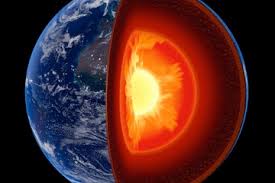
As you travel from the inner core to the crust, how would temperature, pressure and density of the material change?
a)
The would all increase
b)
The would all decrease.
c)
They would stay the same.
d)
Temperature would decrease, but pressure and density would increase.
19.

The physical layer of Earth made of solid rock and soil is called the ___________.
a)
mesosphere
b)
lithosphere
c)
asthenosphere
d)
mantle
20.

Name the boundary
a)
convergent boundary
b)
divergent boundary
c)
transform boundary
d)
sergent boundary
21.

Name the boundary
a)
convergent boundary
b)
divergent boundary
c)
transform boundary
d)
sergent boundary
22.

Name the boundary
a)
convergent boundary
b)
divergent boundary
c)
transform boundary
d)
sergent boundary
23.
___________________ rock means FIRE and is formed from melted rock either from magma below Earth's crust or from lava above it
a)
sedmetary
b)
igneous
c)
metamorphic
d)
magma
24.
Sedimentary and igneous rocks go through _____________________________ to become metamorphic rocks.
a)
weathering and erosion
b)
heat and pressure
c)
compacting and cementing
d)
melting and cooling
25.
True/False: Igneous rocks can only turn into metamorphic rocks.
a)
True
b)
False
26.

Which type of rock is made from magma cooling inside Earth?
a)
cool rock
b)
igneous
c)
metamorphic
d)
sedimentary
27.

Which type of rock is made by small bits of rock, mud, or sand compacted and cemented together?
a)
Coal
b)
igneous
c)
metamorphic
d)
sedimentary
28.

Each rock type can follow only one pathway of the rock cycle.
a)
True
b)
False
29.
Which is the process that forms and change rocks?
a)
rock cycle
b)
water cycle
c)
life cycle
30.
A type of rock that forms when particles compact and are cemented together
a)
igneous
b)
sediment
c)
erosion
d)
sedimentary rock
31.

Name the process by which sediment is moved from one place to another; this can be caused by water, wind, ice, and gravity.
a)
Rock Cycle
b)
Uplift
c)
Deposition
d)
Erosion
32.
Name the process by which water, wind, ice, and changes in temperature break down rock into fragments called sediments.
a)
Deposition
b)
Erosion
c)
Weathering
d)
Igneous Rock
33.
How many major rock types are there
a)
2
b)
4
c)
3
d)
5
34.

Rock that forms when minerals form from solutions or sediment from older rocks get pressed and cemented together.
a)
Sedimentary Rock
b)
Metamorphic Rock
c)
Igneous Rock
35.

What does it mean for a rock to be extrusive
a)
Have layers
b)
Have Rounded Edges
c)
Form from Lava
d)
Form By Sediment
36.
The color of a mineral in powder form is called the mineral's
a)
hardness
b)
specific gravity
c)
luster
d)
streak
37.
How light reflects off of a mineral is called the mineral's
a)
luster
b)
streak
c)
cleavage
d)
fracture
38.
Why is coal not a mineral?
a)
It's not a solid
b)
It is man-made
c)
It is not inorganic
d)
It is made of carbon
39.
Diamond has a hardness of ___ on Mohs Hardness Scale.
a)
1
b)
5
c)
8
d)
10
40.
How do you test the hardness of a mineral?
a)
Throw it against a wall
b)
Step on it
c)
Scratch Test
d)
Kick it until it breaks
41.

What mineral is used for pencils?
a)
Graphite
b)
Galena
c)
Magnetite
d)
Quartz
42.
A naturally occurring, inorganic solid with a crystal structure and a definite chemical composition is referring to
a)
density
b)
streak
c)
mineral
d)
non silicate mineral
43.
What mineral is the softest mineral on Moh's Hardness Scale and the main ingredient in baby powder?
a)
feldspar
b)
talc
c)
gypsum
d)
kaolinite
44.
The mineral iron is primarily used to make
a)
jewelry
b)
tools
c)
cement
d)
glass
45.

When determining the color of a minerals powder, what tool would you need?
a)
streak plate
b)
hand lens
c)
microscope
d)
triple-beam balance
46.

Which indicator would not be good as the only indicator when identifying a mineral?
a)
Color
b)
Breaking Pattern
c)
Specific Gravity
d)
Hardness
47.

Which mineral is number 6 on the hardness scale?
a)
Conrundum
b)
Topaz
c)
Quartz
d)
Orthoclase
48.
What does inorganic mean?
a)
Something that is living
b)
Something that is dead, but was once living
c)
Something that was never living
49.
What is the relationship between a rock and a mineral?
a)
Rocks are made up of minerals.
b)
Minerals are made up of rocks.
c)
Rocks are on the Earth's surface. Minerals are found underground.
d)
Rocks and minerals are different names for the same thing.
50.
If magma cools ____, it has a ____ texture.
a)
quickly; course-grained
b)
quickly; fine-grained
c)
slowly; course-grained
d)
slowly; fine-grained
51.
Physical properties of minerals include all of the following EXCEPT
a)
hardness
b)
color
c)
streak
d)
specific gravity
52.
Which of the following properties does the Mohs scale measure?
a)
Luster
b)
Hardness
c)
Density
d)
Streak
53.

What is this a picture of?
a)
plate tectonics
b)
continental drift
c)
pangea
d)
glacier scaring
100 %

