
 Worksheets
Mid Term Review =)
Total questions: 65
Worksheet time: 38mins
Name
Class
Date
1.
Which of the following is an example of natural selection?
a)
People drink milk
b)
Cows with the most milk are bred together
c)
The fastest deer live longer and reproduce more
d)
Ducks with large beaks are happy
2.
________ is when the best-adapted organisms survive and reproduce while those with the worse traits do not.
a)
Natural Selection
b)
Artificial Selection
c)
Adaptation
d)
Mutation
3.
Trends in traits of a species are________.
a)
Always the same
b)
The bad trait will increase as the good trait decreases
c)
Equal and opposite
d)
the same for both the good and bad trait
4.
A squirrel eats walnuts. Through natural selection only the thickest and strongest walnuts survive. What is the most reasonable adapation for the squirrel?
a)
Better eyesight
b)
Brighter colored fur
c)
Shorter claws
d)
larger/stronger teeth
5.
The flowers that produce the most scent get more insects to pollinate them. Which of the following is the most logical description of how natural selection will affect these flowers?
a)
The flowers with the most colorful petals will have more offspring
b)
The flowers with the strongest smell will have more offspring
c)
The flowers with the largest petals will reproduce more
d)
The flowers will go extinct
6.
Which of the following best explains the process of natural selection with peacocks.
a)
The male peacocks with the brightest feathers reproduce more and pass down that trait to the next generation.
b)
The female peacocks with the brightest feathers reproduce more and pass down that trait to the next generation.
c)
The peacocks with the brightest feathers are eaten and thats why all peacocks are dull in color
d)
The peacocks with the smallest feathers survive better in the wild
7.
An earthquake kills most of the short bushes in a poputation. What will happen in the next generation of these bushes.
a)
The bush will go extinct
b)
There will be more tall bushes
c)
There will be more short bushes
d)
Nothing will change
8.
In a hospital people use hand sanitizer and antibiotics all the time. How are they accidentally causing bacteria to go through natural selection?
a)
Nothing will happen
b)
Only the weak bacteria survive so they become easier to kill with antibiotics
c)
Only the smart bacteria survive, so the bacteria will become more intelligent
d)
Only the strong bacteria survive so the next generation of bacteria are more likely to resist antibiotics
9.
Natural selection starts with_______.
a)
Disease
b)
Genetic Variation of traits
c)
A natural disaster
d)
happiness
10.
Someone has a wild cat breed with a house cat in order to have a cat that looks wild but is more gentle. This is__.
a)
Genetic Modification
b)
Gene Therapy
c)
Animal Husbandry
d)
Selective breeding
11.
Someone selects specific turkeys in order to have turkeys that have more meat. This is_____.
a)
Gene Therapy
b)
Gene Modification
c)
Selective Breeding
d)
Animal Husbandry
12.
Parkinson's is a disease that could be potentially cured through_____.
a)
Gene Therapy
b)
Gene Modification
c)
Selective Breeding
d)
Animal Husbandry
13.
The flavor savor tomato doesn't rot as quickly as normal tomatoes because they were
a)
going through gene therapy
b)
Genetically Modified
c)
Selectively Bred
d)
changed through Animal Husbandry
14.
Goats, cows, chicken and pigs are_______.
a)
Never changed through artificial selection
b)
the best
c)
Farm animals
d)
selectively bred
15.
Correcting mistakes in DNA is _______
a)
Gene therapy
b)
Gene modification
c)
Selective breeding
d)
animal husbandry
16.
Choosing which organisms can have offspring is_____.
a)
Selective Breeding
b)
Gene Modification
c)
Gene Therapy
d)
Animal Husbandry
17.
Selective breeding of farm animals is____.
a)
Selective Breeding
b)
Animal Husbandry
c)
Gene Therapy
d)
Gene Modification
18.
Messing with DNA by doing things like putting genes from one organism into another is _____.
a)
Gene modification
b)
gene therapy
c)
Selective breeding
d)
Animal husbandry
19.
What decade did genetically modified organisms first enter supermarkets?
a)
1920s
b)
1990s
c)
1490s
d)
1870s
20.
If you want to change an organism a lot in a short amount of time which method would be the best?
a)
Selective Breeding
b)
Animal husbandry
c)
Gene Therapy
d)
Gene Modification
21.
Why aren't more scientists using gene modification?
a)
Because they are poor
b)
Because they are lazy
c)
Because of ethics and morality
d)
Because of how long it takes
22.
A trait that helps an organism survive and reproduce in its environment is a______.
a)
Trait
b)
Mutation
c)
Adaptation
d)
Organism
23.
Female birds tend to be ____ in comparison to male birds.
a)
Prettier
b)
Dull and less vibrant
c)
more intelligent
d)
the ones that try harder to attract a mate
24.
Trees want their seeds (offspring) to be________.
a)
spread apart or taken to other places
b)
close to them
c)
destroyed
d)
without sunlight
25.
Which of the following is an adaptation for a flower?
a)
Being ugly
b)
Being dull and plain
c)
smelling good to insects
d)
Having small roots
26.
Is being a good dancer important to male birds?
a)
Yes
b)
No
27.
Does having a good mating call increase a male bird's chances of reproducing?
a)
Yes
b)
No
c)
Only in the arctic
d)
Possiblly
28.
Which of the following organisms tries to attract a mate through bellowing and water dancing?
a)
Humming bird
b)
water snake
c)
shark
d)
Alligator
29.
What is warning coloration?
a)
Being brightly colored in order to let other organisms know that you are dangerous
b)
Blending into the environment in order to not be seen by either prey or predators.
c)
A dance to help you attract a mate
d)
Pretending to be something your not
30.
Mutations are__________
a)
Harmful
b)
Harmful or beneficial
c)
Neutral
d)
Harmful, neutral, or beneficial
31.
A rabbit that has short deformed legs and cannot jump or run fast would have a____
a)
Harmful mutation
b)
Beneficial mutation
c)
Neutral mutation
d)
normal life
32.
A desert animal with extra thick fur/hair would be___
a)
Harmful
b)
Neutral
c)
Beneficial
d)
Happy
33.
An extra hump on a camel
a)
Harmful
b)
Neutral
c)
Beneficial
d)
Sad
34.
Is a scar a mutation
a)
Yes
b)
No
35.
Things you like, dislike (feelings) are mutations
a)
True
b)
False
36.
A new trait that was never in the gene-pool before is called a ______
a)
Adaptation
b)
Neutral
c)
Beneficial
d)
Mutation
37.
How to mutations happen?
a)
By willing yourself to get them
b)
when there is a mistake in your DNA
c)
When your parents dunk you in milk
d)
When you step in dog poop
38.

What are the green organelles inside of the cell called?
a)
Cell membrane
b)
cytoplasm
c)
chloroplast
d)
Nucleus
39.
The organelle that contains DNA and controls the cell is called the____
a)
cell wall
b)
mitochondria
c)
nucleus
d)
carrot
40.

What is on the outside of this type of cell?
a)
cell wall
b)
cell membrane
c)
cytoplasm
d)
chloroplast
41.

What does the second square or inner line represent on plant cells?
a)
cell wall
b)
cell membrane
c)
cytoplasm
d)
chloroplast
42.
What takes sugar and turns it into ATP energy?
a)
Mitochondria
b)
Chloroplast
c)
Sunshine
d)
Cytoplasm
43.

What organelle is on the outside of this type of cell?
a)
cytoplasm
b)
chloroplast
c)
cell wall
d)
cell membrane
44.
A cell is...
a)
big
b)
always the same in everything
c)
the basic unit of structure and function in living things
d)
the most annoying and gross thing that I have ever seen in my life
45.
What 2 organelles are found in plant cells but not in animal cells?
a)
Cytoplasm and chloroplast
b)
Chloroplast and cell wall
c)
cell membrane and chloroplast
d)
nucleus and cytoplasm
46.
What is the purpose of the green Chloroplasts?
a)
to take sunshine and turn it into sugar
b)
to take sugar and turn it into energy (ATP)
c)
To hold everything in place
d)
to make Ms. Bird happy
47.

What kind of cell is this?
a)
Plant
b)
Animal
c)
Bacterial
d)
Gross
48.

Does this shape go with a plant or animal cell?
a)
Plant
b)
Animal
49.
What is another name for natural selection?
a)
survival of the smartest
b)
survival of the fastest
c)
survival of the biggest
d)
survival of the fittest
50.
What is the study of organisms at the early stages of development?
a)
DNA studies
b)
embryology
c)
extinction
d)
fossil record
51.

What is this an example of?
a)
diversity of species
b)
variation
c)
vestigial structures
d)
DNA studies
52.
The cause of artificial selection is…
a)
The environment
b)
Humans
c)
Mutation
d)
Gene Flow
53.
Which of the following is NOT an example of natural selection?
a)
People selectively breeding hamsters.
b)
Insect populations developing resistance to certain pesticides.
c)
Bacteria becoming resistant to antibiotics.
d)
Male birds of certain species developing colorful feathers to attract female mates.
54.
Which term refers to the process by which individuals that are better suited to the environment survive and reproduce therefore passing down their genes to their offspring?
a)
Evolution
b)
Variation
c)
Adaptation
d)
Natural Selection
55.
Why are advantageous traits more likely to be passed onto offspring?
a)
Because they are more likely to survive and reproduce.
b)
Because they come from dominant alleles.
c)
Because they come from recessive alleles.
d)
Because the trait is an acquired phenotype.
56.
The most recent ancestral form or species from which two different species evolved is known as ________________________.
a)
a common ancestor.
b)
an embryonic stage.
c)
development.
d)
evolution.
57.

In stage one (top row) of these embryos, most of the embryos________
a)
look very similar.
b)
have very different features.
c)
show different stages of development.
d)
have only a tail if they are non-human.
58.
The more similar the stages of embryonic development, the more likely that organisms share ____________
a)
a common ancestor.
b)
embryos.
c)
eggs.
d)
embryology.
59.
Humans, birds, whales, and lizards all have similar arm bones. What is the reason for this?
a)
The function of these bones is the same in all animals
b)
They live in similar environments
c)
They have a common ancestor
d)
All organisms resemble humans
60.
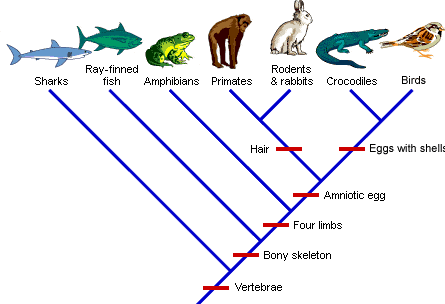
According to this cladogram, sharks are MOST closely related to which organism?
a)
Amphibians
b)
Ray finned fish
c)
Crocodiles
d)
Birds
61.

Which organism is most like the tortose?
a)
Fish
b)
Chick
c)
Salamander
d)
Human
62.
An organism that hasn't been born or hatched yet is called a________.
a)
alien
b)
ember
c)
embryo
d)
planet
63.
Worms have eyes.
a)
True
b)
False
64.

Human embryos have _________, and human adults don't
a)
arms
b)
gills
c)
hard shell
d)
beak
65.
When looking at embryos to compare which ones look the same you look for_____.
a)
gill slits
b)
arms
c)
differences
d)
Similar traits and shapes
100 %

