
 Worksheets
Science Practice 2
Total questions: 60
Worksheet time: 30mins
Which is the best way to determine if an object is made of pure silver?
Determine the solubility of the object.
Test to see if the object is chemically reactive.
Determine the density of the object and compare the known density of pure silver.
Compare the mass of the silver object to the mass of a piece of pure silver.
If you were to take a radio to the moon, which of the following would correctly describe its changes to its mass and weight?
Its mass and weight would not change.
Its mass would increase, and its weight would remain the same.
Its weight would increase, and its mass would remain the same.
Its weight would decrease, and its mass would remain the same.
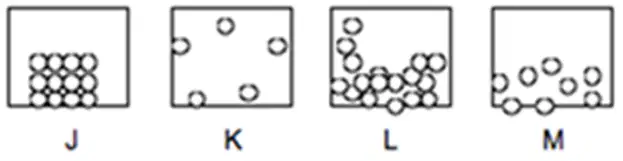
Which of the pictures demonstrates a state of matter without a fixed shape or fixed volume?
J
K
L
M
Which of the following substances would have the greatest solubility if placed in 500 mL of water?
5 g of sand
5 g of vegetable oil
5 g of fresh soil
5 g of sugar
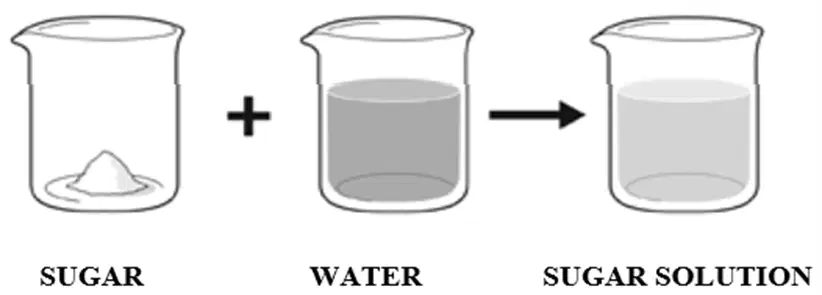
5- Physical properties can be used to compare and classify substances. The process below demonstrates a physical property of sugar. Which of the following physical properties of sugar is demonstrated by the process?
A. Solubility
B. Density
C. Thermal conductivity
D. Melting point
Which of the following characteristics is independent of sample size?
Mass
Density
Heat content
Volume
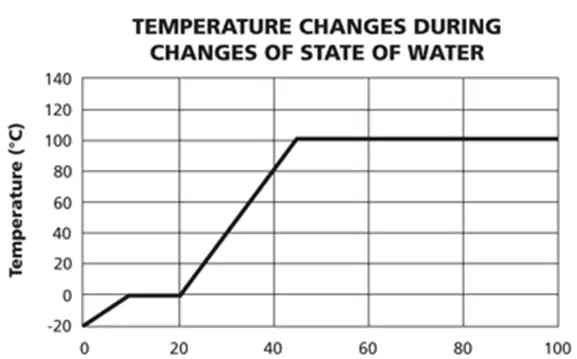
Thomas performed an experiment to measure the temperature of water as he heated it on a hotplate. At the end of his experiment, he plotted the results as shown in the graph below.
Which of the following physical properties of water did Thomas measure?
Solubility and electrical conductivity
Densities and physical states of matter
Volume and thermal conductivity
Melting point and boiling point.
Which of the following best describes an atom?
Protons, neutrons, and electrons all grouped together in the center.
A core of negatively and positively charged particles surrounded by neutral particles.
A core of positive and neutral particles surrounded by negative particles.
A core of electrons and neutrons surrounded by protons.
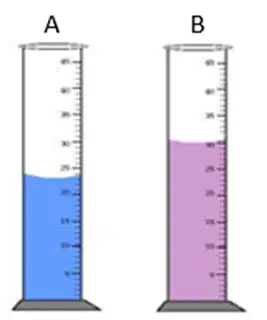
The diagram shows water in a graduated cylinder. Graduated cylinder B has 30 mL of water. What is this statement an example of?
Prediction
An observation
A theory
A hypothesis
10- Elements on the periodic table are arranged into vertical columns called groups. Which of the following is true of the elements in a group?
A. All the elements in a group have the same mass.
B. Elements in a group have the same number of neutrons.
C. Elements in a group have similar properties.
D. Elements in a group have the same number of protons.
As Mia mixed two substances in a test tube, she noticed that the test tube became warm. She also noticed gas coming from the test tube. Based on Mia’s observations, what was most likely occurring inside the test tube?
The two substances underwent a physical change.
The two substances were melting.
A new substance was forming.
A change in the mass of the two substances.

What do these data indicate about gastric juice?
A. It is very acidic
B. It is very basic
C. It is neutral
D. It is dark red
Which sentence describes one important energy conversion that occurs as a result of photosynthesis?
A. Light is converted to chemical energy.
B. Carbon dioxide is converted to light energy.
C. Oxygen is converted to chemical energy.
D. Chlorophyll is converted to light energy.
Which statement about plant and animal cells is true?
Both have a cell wall to give them support.
Both have a large vacuole to store water.
Both use mitochondria to release energy.
Both use chloroplasts to store energy.
What features of plant cells make them different from animal cells?
A. Larger nucleus and fewer chromosomes.
B. A rigid cell wall and chloroplasts.
C. More cytoplasm and smaller vacuoles.
D. A changing size and no definite shape.
Which of the following is produced during the process of cellular respiration?
Carbon dioxide
Sodium chloride
Oxygen
Sugar
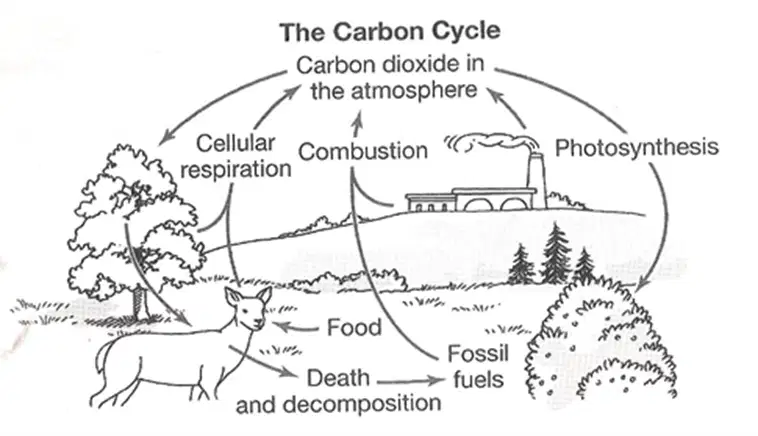
Which statement is best represented by the diagram?
A. All carbon is in the form of carbon dioxide.
B. Carbon can exist in many forms, but the total amount of carbon stays the same.
C. The amount of carbon in the cycle can increase or decrease based on the number of factories present.
D. Only living things release carbon dioxide into the atmosphere.
Plants get energy from which source?
Fertilizer
Soil
Sunlight
Water

Which flasks contain organisms undergoing cellular respiration?
Flask 1, 2, and 3
Flask 1 and 3
Flask 2 and 3
Flask 4
Space exploration has advanced our knowledge of the universe. Which space journey would take the longest?
A journey from Earth to the Sun.
A journey from Earth to the Moon.
A journey from Earth to the nearest galaxy to the Milky Way.
A journey from Earth to the farthest planet in our solar system.
Which distance is the greatest?
The distance across the Milky Way galaxy.
The distance to the nearest star.
The distance across the solar system.
The distance to the nearest galaxy.
Objects in the universe vary in their composition. Which of the following best describes the composition of a galaxy?
A solar system containing more than one star larger than our sun.
A collection of asteroids, dust, and gases orbiting each other in space.
An unidentified object in space that can be seen using a powerful telescope.
A collection of billions of stars and their satellites held together by gravity.
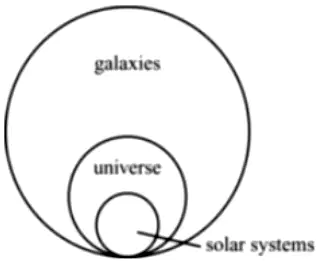
Is the diagram BEST represents the relationship between galaxies, the Universe, and solar systems?
True
False
Which of the following is the smallest?
Our solar system
Jupiter
Andromeda Galaxy
Sun
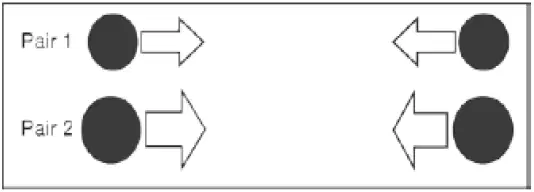
The objects shown in the following diagrams have different masses. Which diagram shows the two objects that have the greatest force of gravity acting between them?
Pair 1
Pair 2
Pair 1 and Pair 2
Similar gravitational force
Earth, Jupiter, Mars, the Moon, and the Sun are objects found within our Solar System. Suppose a 1 kilogram (kg) mass was placed on the surface of each object.
Which of the following arranges the objects based on increasing weight of the 1 kg mass?
A. Earth, Jupiter, Mars, Moon, Sun
B. Jupiter, Sun, Moon, Earth, Mars
C. Moon, Mars, Earth, Jupiter, Sun
D. Sun, Jupiter, Mars, Moon, Earth
A “year” on Earth is 365.26 days long. A “year” on Saturn lasts over 29 times longer than Earth. Which of the following best explains this difference between the two planets?
A. Saturn is farther from the Sun than Earth.
B. Saturn rotates on its axis faster than Earth.
C. Saturn has greater gravitational force than Earth.
D. Saturn revolves around the Sun faster than Earth.
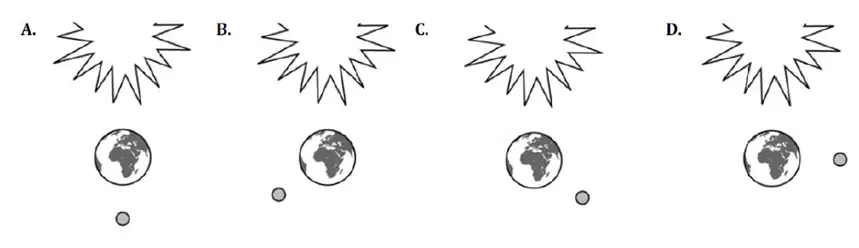
The diagrams below show the alignment of the Sun, the Moon, and Earth. Which diagram shows an alignment in which spring tide takes place?
A
B
C
D
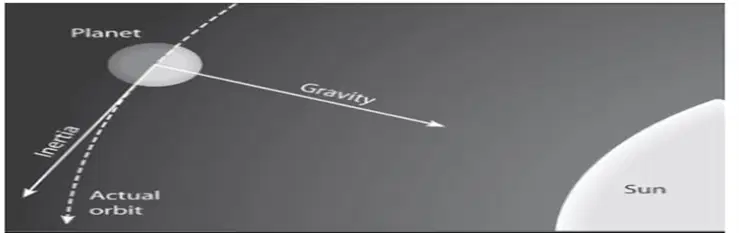
According to the diagram below, which of the following factors keeps Earth in motion around the sun?
Speed
Mass
Gravity
Friction
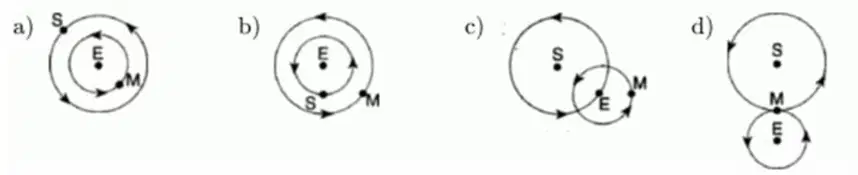
Which image best represents a portion of the heliocentric model of the solar system? (S=Sun, E=Earth, and M=Moon)
a
b
c
d
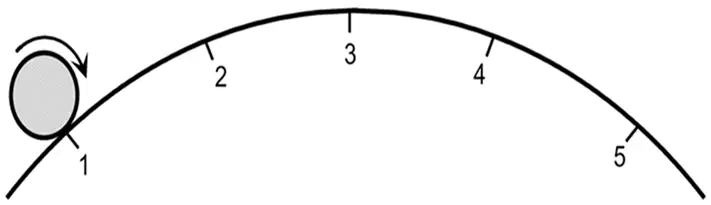
The ball is moving from point 1 to point 5. How is the ball transforming energy throughout its displacement?
Ball is transforming potential energy into kinetic energy from point 1 to point 5.
Ball is transforming kinetic energy into potential energy from point 1 to point 5.
Ball is transforming potential energy into Kinetic energy from point 1 to point 3 and then the ball is transforming kinetic energy to potential energy from point 3 to point 5.
Ball is transforming Kinetic energy into potential energy from point 1 to point 3 and then the ball is transforming potential energy to Kinetic energy from point 3 to point 5.
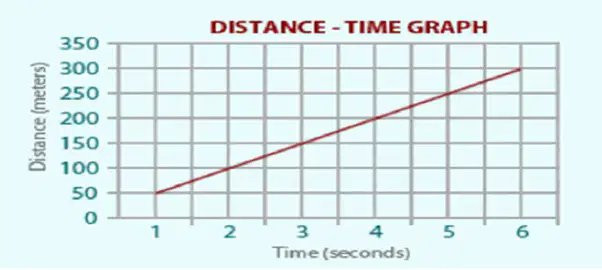
An object travels at constant speed, and its distance and time are shown in the graph. What is the average constant speed of the object between 3 and 5 seconds?
25 m/s
50 m/s
150 m/s
300 m/s
What happens when the forces applied to an object at rest produce a net force of zero?
It does not affect the object
The object will have positive acceleration.
The object will have negative acceleration.
The object will not move at all.
When Charlie came home from school, he turned on a garden hose that had been sitting in the sun all day. The water that came out of the hose was so hot, he could hardly touch it. What happened to the water molecules that made the water feel so hot?
The solar energy hitting the hose made the water molecules move faster.
The individual water molecules got larger as they absorbed the solar energy.
The warmth of the soil around the hose made the water molecules move slower.
The heat energy from the Sun was stored as chemical energy in the water molecules.
Convection currents in the atmosphere influence many weather patterns. What property of the air has the most influence on convection currents?
the direction of the wind
the velocity of the wind
the temperature of the air
the mass of the air
If you walk barefoot on a hot surface such as concrete, the bottom of your feet may become uncomfortably hot. This is a result of what form of energy transfer?
A. convection
B. radiation
C. conduction
D. reflection
An unusual and rare type of fossil clam is discovered in rock layers high in the Swiss Alps, a mountain range in Europe. The same type of clam fossil is also found in the Rocky Mountains of North America.
What best explains the discovery of fossilized sea organisms at the tops of mountains in these two distant mountain ranges?
glaciers carried the fossils up the mountains.
the Rocky Mountains and the Swiss Alps are both volcanic in origin.
clams once lived in mountains but have since evolved into sea-dwelling creatures.
the layers of rocks in which the fossils were found are from the same geologic age.
What causes the phases of the Moon?
the tilt of Earth on its axis.
Earth's shadow being cast on the Moon.
the relative positions of the Sun, Moon, and Earth.
the elliptical orbit that Earth travels around the Sun.
What causes seasons on Earth?
the tilt of Earth on its axis.
the elliptical orbit that Earth travels around the Sun.
the relative positions of the Sun, Moon, and Earth.
the tilt of Earth on its axis and the elliptical orbit that Earth around the Sun.
What is the flaw with using apparent brightness rather than absolute brightness to determine the brightness of a star?
A. Apparent brightness does not use the star's color or temperature.
B. Apparent brightness does not take into account the distance of the star from Earth.
C. Apparent brightness is only theoretical, its value cannot be directly measured with equipment.
D. Apparent brightness is only on a comparative scale that determines how bright a star looks from a theoretical distance of 10 parsecs from Earth.
41- Humans, dogs, and trees are all living things. In which of these organisms would you find DNA molecules?
Only in humans.
Only in humans and dogs.
In humans, dogs, and trees.
DNA is not found in any of these organisms.
Which of the following is something that all living organisms have in common?
They all contain at least one cell.
They all need a source of oxygen.
They all use other organisms for food.
They all find mates to reproduce.
43- Elements on the periodic table are arranged into vertical columns called groups. Which of the following is true of the elements in a group?
A. All the elements in a group have the same mass.
B. Elements in a group have the same number of neutrons.
C. Elements in a group have similar properties.
D. Elements in a group have the same number of protons.
Which of the following statements is true about how new evidence affects theories?
As new evidence is found, the evidence is changed to make it better fit the existing model.
As new evidence is found, the theory is revised in order to make it fit the data better.
As new evidence is found, the theory is discarded completely and scientists start over with a completely new theory.
As new evidence is found a new theory is introduced that does not fit the data as well.
As Mia mixed two substances in a test tube, she noticed that the test tube became warm. She also noticed gas coming from the test tube. Based on Mia’s observations, what was most likely occurring inside the test tube?
The two substances underwent a physical change.
The two substances were melting.
A new substance was forming.
A change in the mass of the two substances.
When carbon and oxygen combine chemically, what is true about the mass of the product?
Greater than the mass of the carbon plus the mass of the oxygen.
Equal to the mass of the carbon plus the mass of the oxygen.
Equal to the mass of the carbon.
Less than the mass of the carbon.
47- Copper (Cu) reacts with oxygen (O) to form copper oxide (CuO). The properties of copper oxide (CuO) are most likely:
Different from copper or oxygen.
Similar to both copper and oxygen.
Similar to only copper.
Similar to only oxygen.
Scientists use a system called binomial nomenclature to classify organisms. For example, the goldfish is known as Carassius auratus. Each of the two names has a different significance. Which of the following correctly describes the meaning of the two names?
A-Carassius is a distant evolutionary ancestor of the goldfish, while auratus is a more recent species.
B-Carassius is a group of organisms with similar behavior, while auratus is a group with similar structures.
C-Carassius is a group of organisms with similar external structures, while auratus is a group with similar internal structures.
D-Carassius is a group of different organisms with similar structures, while auratus is a smaller group of members that can only breed with another auratus.
Chemists once believed that an atom was made of negative electrons dispersed inside a positive mass like raisins in pudding. They adopted a new model of the atom that showed the electrons orbiting the nucleus of the atom from a distance. Which of the following statements about the new model is true?
A-The new model is perfect and will not change.
B-The new model is a wrong model and will not last.
C-The new model fits the data worse than the old model.
D-The new model fits the data better than the old model.
Scientists have found many marine fossils on mountains far from any ocean or sea. What is the best explanation for these fossils?
Meteors with marine fossils landed on the mountains.
Wind carried fossils from the seashore to the mountains.
The mountains were made out of land that was once below the ocean.
Predators caught marine prey and carried it to the top of the mountains.
- Radars can help meteorologists detect clouds and sailors detect submarines. Radars send out radio waves and record their echoes after the radio waves reflect off an object. Two radars send out radio waves with the same frequency. The first radar sends radio waves through the air. The second radar sends radio waves through the ocean. What is true about these radio waves?
They are visible.
They are audible.
They have different speeds.
They have the same wavelength.
Because sound is energy created by vibrations; through which medium will it move the fastest?
A-gas
B-liquid
C-solid
D-Vacuum
Part of the electromagnetic spectrum is visible light. Which color is at the opposite end from red on the visible spectrum?
A-green
B-infrared
C-violet
D-Yellow
Which of the following types of radiation from the Sun has the longest wavelength?
A-gamma
B-infrared
C-ultraviolet
D-visible
The validity of scientific theories and laws depends on evidence. Which of the following statements of evidence supports a law rather than a theory?
A-Electrons orbit the nucleus of an atom within a certain radius.
B-DNA analysis reveals that a modern species is related to an extinct species.
C-Seafloor spreading occurs at a rate of three centimeters per year in the mid-Atlantic.
D-The amount of matter in a closed system is the same at the start of a reaction as at the end of the reaction.
Which of the following is a renewable source of energy?
Coal
Oil
Solar
Natural Gas
Which gas is primarily responsible for the greenhouse effect?
Oxygen
Nitrogen
Carbon Dioxide
Hydrogen
Every river on the surface of the earth flows, this river drains into a water body such as lake, ocean or sea. The reduction in velocity of the current makes the river incapable of transporting sediment farther. and deposition of sediment occurs at this time, creating a landform. What is the name of the process?
Mid ocean ridge
Water convection
Delta
Alluvial fan
Which of the following best describes the purpose of an experimental control in an experiment?
To ensure that the experiment is conducted in a controlled environment
To provide a standard for comparison against the experimental group
To increase the number of variables in the experiment
To ensure that the experiment is repeated multiple times
The end of mitosis results in ____ to each other.
2 cells that are identical
2 cells that are not identical
4 cells that are identical
4 cells that are not identical

