
 Worksheets
Weather Quiz
Total questions: 117
Worksheet time: 3hrs 32mins
Name
Class
Date
1.
A severe storm which involves a funnel cloud forming over land is:
a)
hurricane
b)
tornado
c)
thunderstorm
d)
blizzard
2.
A severe storm that involves winds over 119mph and forms over water is:
a)
tornado
b)
thunderstorm
c)
hurricane
d)
blizzard
3.
This severe weather involves low temperatures and snow either falling or drifting
a)
hurricane
b)
thunderstorm
c)
tornado
d)
blizzard
4.
This severe weather involves lightning, rain, and possibly hail
a)
thunderstorm
b)
tornado
c)
hurricane
d)
blizzard
5.
The boundary between two air masses is known as:
a)
front
b)
storm
c)
climate
d)
flood
6.
When severe weather conditions are present, a _______ is issued
a)
watch
b)
warning
7.
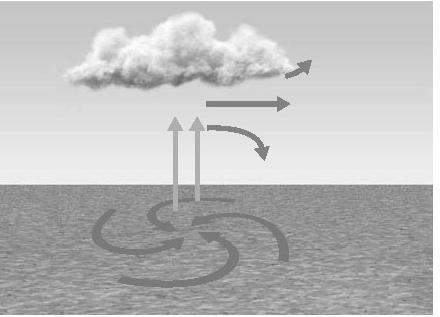
Which type of pressure system is pictured?
a)
high
b)
low
c)
medium
d)
none
8.

What type of weather would you expect with the pressure system pictured?
a)
clear
b)
cloudy
c)
severe storms
d)
hot
9.
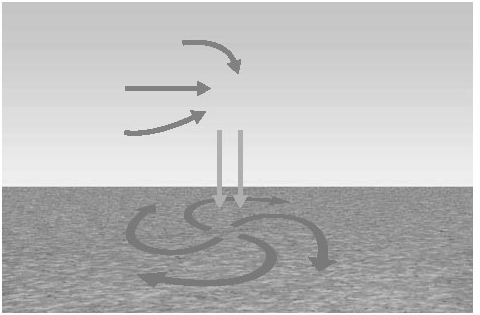
Which type of pressure system is pictured?
a)
high
b)
low
c)
medium
d)
none
10.

What type of weather would you expect from the pressure system pictured?
a)
clear
b)
cloudy
c)
hot
d)
stormy
11.
Cold air traveling south from Canada is:
a)
continental tropical
b)
continental polar
c)
maritime tropical
d)
maritime polar
12.
Warm air moving upwards from the Gulf of Mexico is:
a)
continental tropical
b)
continental polar
c)
maritime tropical
d)
maritime polar
13.
Warm air mass that does not carry water:
a)
continental tropical
b)
continental polar
c)
maritime tropical
d)
maritime polar
14.
Cold air mass that is carrying water is:
a)
continental tropical
b)
continental polar
c)
maritime tropical
d)
maritime polar
15.
These can be produced by thunderstorms
a)
stationary fronts
b)
tornadoes
c)
volcanoes
d)
tsunamis
16.
This type of front can bring strong storms
a)
cold
b)
warm
c)
stationary
d)
occluded
17.
This type of front results in the same weather for several days
a)
warm
b)
cold
c)
stationary
d)
occluded
18.
This weather tool measures wind speed and direction
a)
thermometer
b)
barometer
c)
anemometer
d)
psychrometer
19.
Which weather tool measures air pressure?
a)
thermometer
b)
barometer
c)
anemometer
d)
psychrometer
20.
This means that the conditions are right for severe weather
a)
watch
b)
warning
21.
This is the scale by which tornadoes are measured
a)
Fujita
b)
Ferrari
c)
Fermi
d)
Falling
22.

Which number illustrates Condensation?
a)
1
b)
2
c)
3
d)
4
23.

What does this symbol on a weather map indicate?
a)
High pressure system
b)
Low pressure system
c)
Cold front
d)
Warm front
24.

What does this symbol indicate on a weather map?
a)
High pressure system
b)
Low pressure system
c)
Cold front
d)
Warm front
25.
What kind of weather is usually associated with a high pressure system?
a)
Sunny weather
b)
Precipitation (rain, snow, etc.)
26.
Which weather tool measures air pressure?
a)
thermometer
b)
barometer
c)
anemometer
d)
psychrometer
27.
This weather tool measures wind speed and direction
a)
thermometer
b)
barometer
c)
anemometer
d)
psychrometer
28.
Which weather tool measures temperature?
a)
thermometer
b)
barometer
c)
psychrometer
d)
anememeter
29.
The boundary between two air masses is known as:
a)
front
b)
storm
c)
climate
d)
flood
30.
Mark looks at the clouds in the sky and decides that he does not need to
take his umbrella with him today. Which clouds did Mark most likely see
in the sky?
take his umbrella with him today. Which clouds did Mark most likely see
in the sky?
a)
cirrus
b)
nimbostratus
c)
cumulonimbus
31.
Which type of cloud is most often observed during a thunderstorm?
a)
cirrus
b)
stratus
c)
cumulus
d)
cumulonimbus
32.
Hot air (RISES / FALLS) __________.
a)
RISES
b)
FALLS
33.
Cold air (RISES/ FALLS) _________.
a)
RISES
b)
FALLS
34.
Which condition usually means cloudy, stormy weather?
a)
high pressure
b)
low pressure
35.

a)
nimbostratus cloud
b)
cumulonimbus cloud
c)
cirrocumulus cloud
d)
altostratus cloud
36.

name this front
a)
warm front
b)
cold front
c)
stationary front
d)
occluded front
37.
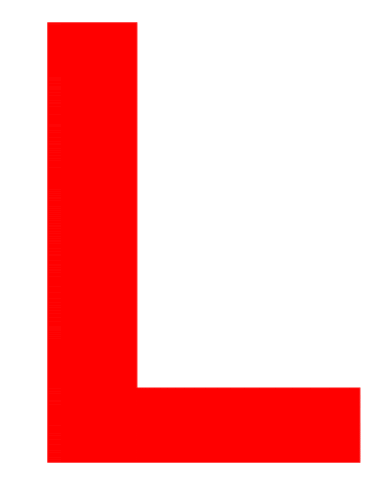
What does this symbol on a weather map indicate?
a)
High pressure system
b)
Low pressure system
c)
Cold front
d)
Warm front
38.

A _____ is a large, swirling, low-pressure system that forms over the Atlantic Ocean.
a)
blizzard
b)
cold front
c)
tornado
d)
hurricane
39.

A violently rotating column of air called a _____ when it comes in contact with the ground.
a)
hurrican
b)
tornado
c)
trade wind
d)
local wind
40.
Rain, snow, sleet, and hail are all forms of _____.
a)
precipitation
b)
condensation
c)
evaporation
d)
climate
41.

The amount of water vapor present in the air is called ________________.
a)
weather
b)
humidity
c)
air mass
d)
dew point
42.
When a warm air mass gently slides on top of a cold air mass, and you have drizzly rain and then warmer weather, what type of front is it?
a)
warm front
b)
cold front
c)
occluded front
d)
stationary front
43.

What type of storm front is this?
a)
warm front
b)
cold front
c)
stationary front
d)
occluded front
44.

What part of the illustration shows Evaporation?
a)
1
b)
2
c)
3
d)
4
45.

White, thin, feathery clouds, usually made of ice crystals are...
a)
Stratus
b)
Cumulus
c)
Cirrus
46.

An anemometer is used to measure...
a)
air pressure
b)
humidity
c)
precipitation
d)
wind speed
47.

The gradual increase in average global surface temperature is called...
a)
global warming
b)
the greenhouse effect
c)
the trump effect
48.
The amount of mass in a given volume of air is _.
a)
density
b)
pressure
c)
altitude
d)
air pressure
49.

The layer of the atmosphere where weather occurs is the _.
a)
thermosphere
b)
stratosphere
c)
mesosphere
d)
troposphere
50.

An instrument used to measure the amount of rainfall
a)
barometer
b)
thermometer
c)
rain guage
d)
wind sock
51.

An instrument used to show the direction of wind and measure the speed
a)
rain guage
b)
Thermometer
c)
barometer
d)
wind sock
52.

the amount of water vapor in the air
a)
warm front
b)
precipitation
c)
humidity
d)
air pressure
53.
An instrument used to measure how hot or cold something is
a)
barometer
b)
thermometer
c)
wind sock
d)
rain guage
54.

An instrument that measures air pressure
a)
thermometer
b)
barometer
c)
rain guage
d)
wind sock
55.
_____________ has the same temperature and moisture content throughout.
a)
convection current
b)
front
c)
air mass
56.
Which term describes a circulation of air or water that is caused by uneven heating?
a)
convection current
b)
conduction current
c)
radiation current
d)
emission current
57.
Every few years, an event occurs in which the waters in the eastern Pacific Ocean become warmer. This event changes weather patterns worldwide, causing drought, floods, blizzards, hurricanes and tornadoes. What is the name of this event?
a)
Kuroshio Current
b)
Global conveyor
c)
El Nino
d)
Typhoon
58.
The ozone is in the stratosphere layer of the atmosphere. The purpose of the ozone is
a)
To generate heat for the earth
b)
To protect earth from the harmful solar radiation
c)
To produce weather
d)
To allow satellites to circle the earth
59.
Which of the following are used to study and forecast most weather-related events?
a)
Doppler radar
b)
satellites and satellite images
c)
weather maps
d)
all of the above
60.
The place where two air masses meet.
a)
air mass
b)
air pressure
c)
water cycle
d)
front
61.
The weight of air as it presses down on Earth's surface
a)
front
b)
air pressure
c)
air mass
d)
evaporation
62.
The conditions of the atmosphere at a certain time and place.
a)
weather
b)
climate
c)
precipitation
d)
atmosphere
63.

What does this symbol on a weather map indicate?
a)
High pressure system
b)
Low pressure system
c)
Cold front
d)
Warm front
64.
What role do oceans play in hurricane formation?
a)
they provide cool, dense water
b)
warm water supplies energy to hurricanes
c)
warm ocean water slows hurricane formation
d)
cold ocean water supplies energy to hurricanes
65.

name this front
a)
warm front
b)
cold front
c)
stationary front
d)
occluded front
66.

name this front
a)
warm front
b)
cold front
c)
stationary front
d)
occluded front
67.
what kind of pressure predicts good weather?
a)
high
b)
low
c)
cold
d)
stationary
68.

A(n) _____ is a large body of air that has properties similar to the part of Earth's surface over which it depends.
a)
tornado
b)
pressure system
c)
front
d)
air mass
69.
What type of of air mass is dry and warm?
a)
cP
b)
cT
c)
mP
d)
mT
70.
What type of of air mass is wet and warm?
a)
mP
b)
mT
c)
cT
d)
cP
71.
What type of of air mass is dry and cold?
a)
mP
b)
mT
c)
cP
d)
cT
72.
What type of air mass is wet and cold?
a)
mP
b)
MT
c)
cT
d)
cP
73.

What type of storm front if this?
a)
Warm Front
b)
Cold Front
c)
Stationary Front
d)
Occluded Front
74.

What type of storm front is this?
a)
Warm Front
b)
Cold Front
c)
Occluded Front
d)
Stationary Front
75.

What type of storm front is this?
a)
Warm Front
b)
Cold Front
c)
Occluded Front
d)
Stationary Front
76.
What is the jet stream?
a)
Precipitation in North Carolina
b)
Weather over a long period of time
c)
Strong winds above the Earth's surface
d)
Football flying over the Earth
77.
What flows does the Jet Stream have?
a)
West to East
b)
West to South
c)
North to West
d)
South to East
78.
How does the jet stream affect the weather?
a)
The jet stream transports weather systems that affect us.
b)
The jet stream does not affect the weather.
c)
The jet stream releases oxygen so we can breathe.
d)
The jet stream brings only bad weather.
79.
Which best describes how winds in the jet stream blow?
a)
between a boundary of cold air and a boundary of warm air
b)
between two boundaries of hot air
c)
no pattern
d)
between two boundaries of cold air
80.
Which has the greatest affect on the movement of the jet stream?
a)
differences in air temperatures
b)
amount of precipitation
c)
size of clouds
d)
The jet stream does what it wants.
81.
On a given day, which most affects the amount of rainfall an area is expected to receive?
a)
Climate
b)
Jet Stream
c)
Rain
d)
Wind Speed
82.

What causes wind?
a)
convection currents
b)
conduction currents
c)
radiation currents
d)
tropical currents
83.
Winds are caused by
a)
equal heating
b)
unequal heating
84.
What is the instrument called that measures air pressure?
a)
thermometer
b)
ruler
c)
yard stick
d)
barometer
85.
When air is heated, it will MOST likely
a)
expand and fall
b)
expand and rise
c)
condense and fall
d)
condense and rise
86.

Why does warm air rise?
a)
Warm air is more dense than cooler air.
b)
Warm air has more pressure than cooler air.
c)
Warm air is less dense than cooler air.
d)
Warm air has a higher dew point than cooler air.
87.
Which describes how wind speed if affected by weather?
a)
rainy weather causes greater wind speeds
b)
warmer weather causes greater wind speeds
c)
differences in air pressure cause greater wind speeds
d)
small temperature changes cause greater wind speeds
88.
Which global winds have the greatest impact on the weather in the US?
a)
trade winds
b)
prevailing westerlies
c)
doldrums
d)
polar easterlies
89.
In which direction do prevailing westerlies flow?
a)
from east to west
b)
from west to east
c)
from north to south
d)
from south to north
90.
Which types of winds cause weather in North Carolina?
a)
polar easterlies
b)
prevailing westerlies
c)
polar westerlies
d)
prevailing easterlies
91.
I am a fast-moving ribbon of AIR that moves from west to east in the Northern Hemisphere around the Earth.
a)
California Current
b)
Gulf Stream
c)
Jet Stream
d)
Atlantic Ocean
92.
Which of the following are narrow belts of strong winds found in the upper troposphere?
a)
doldrums
b)
westerlies
c)
trade winds
d)
jet streams
93.
What will most likely result when the jet stream moves south of North Carolina?
a)
A North Carolina will experience tropical weather conditions.
b)
B North Carolina will experience hot, dry weather.
c)
C North Carolina will experience mild weather.
d)
D North Carolina will experience cold weather.
94.
In which direction do prevailing westerlies flow?
a)
from east to west
b)
from west to east
c)
from north to south
d)
from south to north
95.
Which is most responsible for guiding the movement of different air masses across the United States?
a)
the oceans
b)
trade winds
c)
the jet stream
d)
easterly winds
96.
How does the jet stream affect the weather?
a)
The jet stream transports weather systems that affect us.
b)
The jet stream does not affect the weather.
c)
The jet stream releases oxygen so we can breathe.
d)
The jet stream brings only bad weather.
97.
Which best describes a characteristic of the jet stream?
a)
A It forms a boundary between a cold air mass and a warm air mass.
b)
B It creates the high winds around the eye of a hurricane.
c)
C It forces the hot air along the equator to rise to areas in North America.
d)
D It causes high pressure air masses to rotate clockwise.
98.
The change of state from a gas to a liquid.
a)
Condensation
b)
Precipitation
c)
Evaporation
d)
Sublimation
99.
Any form of water that falls to the Earth's surface from the clouds.
a)
Air Pollution
b)
Weather
c)
Condensation
d)
Precipitation
100.
Collection of small water droplets or ice crystals suspended in the air which forms when the air is cooled and condensation occurs.
a)
Condensation
b)
Precipitation
c)
Rain
d)
Cloud
101.
The amount of water vapor in the air
a)
Condensation
b)
Moisture
c)
Humidity
d)
Precipitation
102.
The Coriolis Effect is caused by
a)
Earth rotating around the sun
b)
Earth rotating on its axis
c)
The tides
d)
Gravity
103.
The Gulf stream carries _____________ water from the east coast of The United States to the West coast of Europe.
a)
Cold
b)
Warm
c)
Freezing
d)
Fresh
104.
Due to the Coriolis Effect, water in the northern hemisphere moves
a)
clockwise
b)
counter clockwise
c)
both
d)
neither
105.
Warm ocean currents generally come from
a)
The North Pole
b)
The South Pole
c)
The Equator
d)
Both A and B
106.
Cold ocean currents generally come from
a)
The North Pole
b)
The South Pole
c)
The Equator
d)
Both A and B
107.
The California Current (west coast) carries _________ water from canada
a)
Cold
b)
Warm
c)
Freezing
d)
Fresh
108.
Two types of water currents are
a)
local and global
b)
sea and land
c)
surface and deep
d)
warm and cold
109.
A strong surface current that runs along the east coast of the United States and carries warm water to Europe.
a)
California Current
b)
Global Conveyor Belt
c)
Gulf Stream
d)
Surface Current
110.
A cool current in the Pacific Ocean near North America that brings cold water down from Canada.
a)
California Current
b)
Global Conveyor Belt
c)
Gulf Stream
d)
Surface Current
111.
Ocean currents have an affect on which two things
a)
climate and weather
b)
temperature and density
c)
land and sea
d)
equator and poles
112.
Surface currents are a result of
a)
Global Wind Patterns
b)
Earth's Rotation
c)
Density
d)
All of the above
113.

The Gulf Stream is a ______ current that carries water from the ______ to the North Atlantic Ocean.
a)
cold, Tropics
b)
warm, Tropics
c)
cold, Mexico
d)
warm, South America
114.
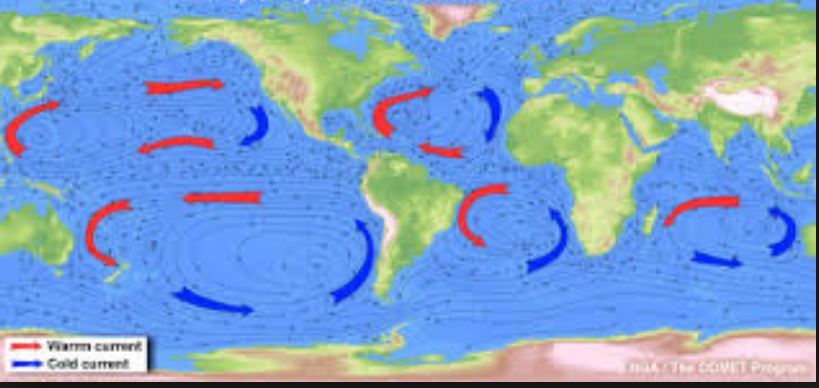
Analyze the image. The red arrows represent warm water rising and the blue arrows represent cold water sinking. What type of heat transfer is responsible for this movement?
a)
conduction
b)
convection
c)
radiation
115.
Analyze the image. What could explain why certain parts of the ocean have warmer temperatures?
a)
the uneven heating of the Earth's surface
b)
the rising of cold air and the sinking of warm air
c)
hurricanes
116.
How do warm-water currents affect the coastal areas along which they flow?
a)
Cool the coast
b)
Warm the coast
c)
Cause snow to fall
d)
Cause higher tides
117.
What happens to a current when it comes in contact with a continent or landmass?
a)
It continues over the continent
b)
It stops
c)
It changes direction
d)
It is absorbed by the land
100 %

