wayground logo

Free Printable Worksheets

Font size

S
M
L
XL
Worksheets

Earth and Universe Moon phases and earth layers class 4

Total questions: 119

Worksheet time: 1hrs 29mins

Name
Class
Date
1.
Changes in the moon's appearance are
a)
phases
b)
eclipses
c)
stages
d)
cycle
2.

What causes the moon's phases

a)

Where you are standing on Earth

b)

the amount of sunlight reflected onto the moon from the sun

c)

The tilt of Earth

d)

how fast the moon is moving

3.
Define Waxing
a)
Moon is increasing and light part appears to be growing
b)
Completely illuminated
c)
dark side is facing earth
d)
Moon is decreasing and light part appears to be shrinking
4.
How many phases does the moon go through?
a)
4
b)
8
c)
10
d)
16
5.
As the moon's shape appears to get smaller, we say that the moon is _.
a)
swelling
b)
waxing
c)
waning
d)
disappearing
6.
The cycle of the moon lasts about a _.
a)
day
b)
year
c)
week
d)
month
7.

The spinning of the earth on its axis that causes day and night is called

a)

orbit.

b)

axis.

c)

rotation.

d)

revolution.

8.

The path of an object in space around another object is a(n)

a)

orbit.

b)

axis.

c)

rotation.

d)

revolution.

9.

It takes about _____ for the earth to complete one rotation.

a)

28 days

b)

24 hours

c)

365 hours

d)

365 days

10.
If the last full moon was on April 4th, when can you expect to see the next full moon? 
a)
April 29th
b)
July 4th
c)
May 4th
d)
September 12th
11.
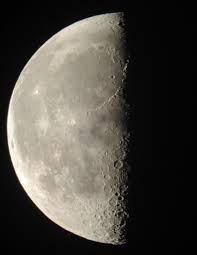
Name the moon phase
a)
First Quarter
b)
Last Quarter
c)
New Moon
d)
Full Moon
12.
How much of the moon is always lit?
a)
can't tell
b)
always changes
c)
half
d)
3/4
13.
What moon phase came right BEFORE this one?
a)
First Quarter
b)
Last Quarter
c)
New Moon
d)
Full Moon
14.
The cycle of the moon lasts about a _.
a)
day
b)
year
c)
week
d)
month
15.
The moon ____________ around the Earth.
a)
revoloves
b)
rotates
c)
up
d)
down
16.
What part of the moon do we see from Earth?
a)
all of it
b)
the same side
c)
none of it
d)
only one quarter
17.
The moon seems to change shape from day to day in a cycle that lasts about a month as it goes through _.
a)
revolutions
b)
phases
c)
rotations
d)
eclipses
18.
Which of the following words describe the phases of the moon?
a)
none, quarter, half, three quarters, full
b)
new, crescent, quarter, gibbous, full
c)
dark, light, half, quarter, blue
d)
first quarter, second quarter, third quarter, fourth quarter
19.

What is the source of the moon's light?

a)

Earth

b)

the sun

c)

the moon

d)

Mars

20.

During which phase does the moon appear as a bright round circle?

a)

First Quarter

b)

New Moon

c)

Third Quarter

d)

Full Moon

21.

What causes the phases of the moon?

a)

Earth's movement around the sun

b)

the moon's movement around Earth

c)

Earth's movement around the moon

d)

the sun's movement around the moon

22.

The moon phase cycle repeats about every

a)

365 days

b)

20 days

c)

29 days

d)

15 days

23.
Name the moon phase
a)
waning crescent
b)
first quarter
c)
waning gibbous
d)
waxing gibbous
24.
Name the moon phase
a)
First Quarter
b)
Last Quarter
c)
New Moon
d)
Full Moon
25.
Name the moon phase
a)
Waning Crescent
b)
Last Quarter or (third quarter)
c)
New Moon
d)
Full Moon
26.
CHALLENGE
When the moon is lined up exactly between the sun and Earth, it is called a ______ ______. 
a)
Solar Eclipse
b)
Lunar Eclipse
27.
TRUE or FALSE
We can see the moon during the day. 
a)
True
b)
False
28.
A ________ is when a small section of the Moon facing Earth is lighted. 
a)
New Moon
b)
Crescent Moon
c)
Full Moon
d)
Moon Phases
29.
Which of the following choices has the moon phases in the correct order? 
a)
Full moon, new moon, waxing gibbous, first quarter, waxing crescent, waning gibbous, waning cresent, last quarter
b)
waxing gibbous, new moon, first quarter, waxing crescent, full moon, waning crescent, third/last quarter, waning gibbous
c)
New Moon, Waxing Crescent, First Quarter, Waxing Gibbous, Full Moon, Waning Gibbous, Third/last quarter, Waning Crescent
d)
New Moon, Waning Crescent, First Quarter, Waning Gibbous, Full Moon, Waxing Gibbous, Third/Last Quarter, Waxing Cresecent 
30.
Why does the Moon have phases? 
a)
The moon reflects light from the sun. Sometimes there is a shadow on the moon and we only see part of it. 
b)
Only part of the moon is turned on and shining at a time. 
c)
The Earth is blocking the moon when we don't see it. 
d)
The moon moves out of sight. 
31.

The spinning of the earth on its axis that causes day and night is called

a)

orbit.

b)

axis.

c)

rotation.

d)

revolution.

32.

The imaginary line running through the center of the earth is the

a)

orbit.

b)

rotation.

c)

axis.

d)

revolution.

33.

The path of an object in space around another object is a(n)

a)

orbit.

b)

axis.

c)

rotation.

d)

revolution.

34.

When the earth travels around the sun on its orbit, it's called

a)

orbit.

b)

axis.

c)

rotation.

d)

revolution.

35.

In this picture, the earth is _______ around the sun.

a)

rotating

b)

seasons

c)

day and night

d)

revolving

36.

When the earth revolves around the sun it causes _______ on earth.

a)

rotating

b)

seasons

c)

day and night

d)

revolving

37.

In this picture, the earth is ________ on its axis.

a)

seasons

b)

revolving

c)

rotating

d)

day and night

38.

Rotating causes ________ on earth.

a)

seasons

b)

revolving

c)

rotating

d)

day and night

39.

Waxing means to _______.

a)

get smaller

b)

get larger

40.

Waning means to _______.

a)

get smaller

b)

get larger

41.

It takes about _____ for the earth to complete one rotation.

a)

28 days

b)

24 hours

c)

365 hours

d)

365 days

42.

It takes about ____ for earth to complete one revolution around the sun.

a)

28 days

b)

24 hours

c)

365 hours

d)

365 days

43.

It takes about ______ for the moon to go through all of its phases.

a)

28 days

b)

24 hours

c)

365 hours

d)

365 days

44.

This phase is _____.

a)

full moon

b)

waxing crescent moon

c)

first quarter

d)

waning gibbous

45.

This phase is ______.

a)

full moon

b)

waxing crescent moon

c)

first quarter

d)

waning gibbous

46.

This phase is _______.

a)

full moon

b)

waxing crescent moon

c)

first quarter

d)

waning gibbous

47.

This phase is ______.

a)

full moon

b)

waxing crescent moon

c)

first quarter

d)

waning gibbous

48.
Which layer is the layer we walk on?
a)
Core
b)
Mantle
c)
Crust
49.
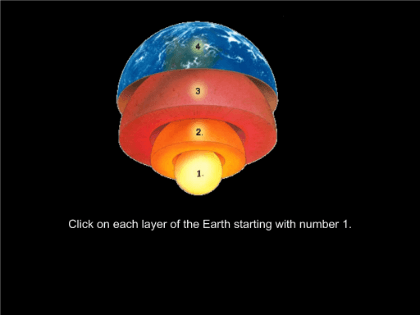
Which layer is the OUTER CORE?
a)
1
b)
2
c)
3
d)
4
50.
Which layer is the INNER CORE?
a)
1
b)
2
c)
3
d)
4
51.
Which layer is the THICKEST layer?
a)
Core
b)
Mantle
c)
Crust
52.
Which layer is the MANTLE?
a)
1
b)
2
c)
3
d)
4
53.
Which layer is the CRUST?
a)
1
b)
2
c)
3
d)
4
54.
Which layer is the INNER CORE?
a)
1
b)
2
c)
3
d)
4
55.
The core is made up of which 2 metals?
a)
Iron and Nickel
b)
Iron and Bronze
c)
Nickel and Steel
d)
Iron and Steel
56.
Which layer is the THINNEST?
a)
Core
b)
Mantle
c)
Crust
57.
Which layer is the MANTLE?
a)
1
b)
2
c)
3
d)
4
58.
Which layer is the HOTTEST layer?
a)
Core
b)
Mantle
c)
Crust
59.
Which layer is the OUTER CORE?
a)
1
b)
2
c)
3
d)
4
60.
Which layer is the CRUST?
a)
1
b)
2
c)
3
d)
4
61.

Which section of Earth is composed primarily of liquid metal?

a)

crust

b)

mantle

c)

outer core

d)

inner core

62.

Earth is made of different layers that have varying characteristics. Which is the thickest layer?

a)

the mantle

b)

the inner core

c)

the outer core

d)

the crust

63.

A student uses clay to construct a model of Earth. Which layer of the model should be the thinnest layer?

a)

the layer representing the mantle

b)

the layer representing the outer core

c)

the layer representing the inner core

d)

the layer representing the crust

64.

True or False:

Earth is the only planet in the solar system with liquid water.

a)

True

b)

False

65.

True or False:

The earth’s surface is covered by 60% water and 40% land

a)

True

b)

False

66.

Where is most of the water on earth?

a)

oceans

b)

rivers

c)

lakes

d)

swimming pools

67.

Ozone layer is in the atmosphere which protects us from the harmful rays of the sun called

a)

Ultraviolet Rays (UV)

b)

Alien invaders

c)

Lightning

68.

What layer of the Earth do we live on?

a)

mantle

b)

inner core

c)

crust

d)

outer core

69.

What layer makes up 85% of the total weight of the Earth?

a)

crust

b)

mantle

c)

outer core

d)

inner core

70.

What layer has super-heated liquid molten lava?

a)

crust

b)

mantle

c)

outer core

d)

inner core

71.

What layer of the Earth is labeled A?

a)

inner core

b)

outer core

c)

mantle

d)

crust

72.

Which layer is made (mostly) of LIQUID iron and nickel?

a)

crust

b)

mantle

c)

outer core

d)

inner core

73.

Which layer of the Earth is the THINNEST?

a)

crust

b)

mantle

c)

outer core

d)

inner core

74.

Which layer of the earth is the hottest?

a)

crust

b)

mantle

c)

outer core

d)

inner core

75.

What is the correct order (starting from the surface) of Earth's layers?

a)

crust, outer core, inner core, mantle

b)

mantle, outer core, inner core, crust

c)

crust, mantle, outer core, inner core

d)

outer core, inner core, crust, mantle

76.

This layer is made of soil and rocks.

a)

crust

b)

mantle

c)

core

77.

This layer in the center of the Earth.

a)

crust

b)

mantle

c)

core

78.
This layer is directly below the crust.
a)
Crust
b)
Mantle
c)
Outer Core
d)
Inner Core
79.
This layer is directly below the mantle.
a)
Crust
b)
Mantle
c)
Outer Core
d)
Inner Core
80.
This layer is the innermost layer of the Earth.
a)
Crust
b)
Mantle
c)
Outer Core
d)
Inner Core
81.
This layer is the thinnest layer and is made of solid rock.
a)
Crust
b)
Mantle
c)
Outer Core
d)
Inner Core
82.
This layer is partly made up of solid rock, and the other part of this layer is thick, liquid rock (kind of like syrup).
a)
Crust
b)
Mantle
c)
Outer Core
d)
Inner Core
83.
This layer is completely made up of liquid metal.
a)
Crust
b)
Mantle
c)
Outer Core
d)
Inner Core
84.
This layer is a solid ball of metal.
a)
Crust
b)
Mantle
c)
Outer Core
d)
Inner Core
85.
This layer includes all dry land and the Ocean floor.
a)
Crust
b)
Mantle
c)
Outer Core
d)
Inner Core
86.
This layer contains a small amount of metal.
a)
Crust
b)
Mantle
c)
Outer Core
d)
Inner Core
87.
This layer surrounds the inner core.
a)
Crust
b)
Mantle
c)
Outer Core
d)
Inner Core
88.
This layer is the hottest layer of the Earth.
a)
Crust
b)
Mantle
c)
Outer Core
d)
Inner Core
89.
Which layer of the Earth is shown in BROWN?
a)
Crust
b)
Mantle
c)
Inner Core
d)
Outer Core
90.
Which layer of the Earth is shown in YELLOW?
a)
Crust
b)
Mantle
c)
Inner Core
d)
Outer Core
91.
Which layer of the Earth is shown in ORANGE?
a)
Crust
b)
Mantle
c)
Inner Core
d)
Outer Core
92.
Which layer of the Earth is shown in RED?
a)
Crust
b)
Mantle
c)
Inner Core
d)
Outer Core
93.
This layer is the outermost (TOP) layer of the Earth.
a)
Crust
b)
Mantle
c)
Outer Core
d)
Inner Core
94.

This type of rock forms when layers of sediment are "glued" together by dissolved minerals.

a)

Igneous rock

b)

Metamorphic rock

c)

Sedimentary rock

d)

Hard rock

95.

This type of rock forms when existing rock is changed to new rock by extreme heat and pressure.

a)

Igneous rock

b)

Metamorphic rock

c)

Sedimentary rock

d)

Hard rock

96.

This type of rock forms when molten (melted) rock from beneath Earth's surface cools and hardens.

a)

Igneous rock

b)

Metamorphic rock

c)

Sedimentary rock

d)

Hard rock

97.
The order of the planets is:
a)
Mars,Venus,Earth,
Mercury,Saturn
Jupiter, Uranus, Neptune
b)
Earth,Venus,Mars
Jupiter, Neptune,
Mercury,Saturn,
Uranus
c)
Mercury,Venus,Earth
Mars,Jupiter,
Saturn,Uranus
Neptune
98.
Which planet is the largest?
a)
Jupiter
b)
Saturn
c)
Uranus
d)
Neptune
99.
This is the smallest planet in the solar system
a)
Mercury
b)
Venus
c)
Earth
d)
Mars
100.
Only planet known to have life
a)
Earth
b)
Mars
c)
Venus
d)
Mercury
101.
True or False
The Earth is the center of the solar system.
a)
True
b)
False
102.
Which planet is covered in water?
a)
Mercury
b)
Venus
c)
Earth
d)
Mars
103.
Which planet has the biggest rings?
a)
Jupiter
b)
Saturn
c)
Uranus
d)
Neptune
104.
Which planet is seventh from the sun?
a)
Saturn
b)
Earth
c)
Venus
d)
Uranus
105.

A constellation is...

a)

a planet

b)

a natural object that circles the planet

c)

a group of stars

106.
Which planet doesn't have a moon?
a)
Earth
b)
Mars
c)
Mercury
d)
Jupiter
107.
Which planet has very visible rings?
a)
Jupiter
b)
Saturn
c)
Earth
d)
Neptune
108.
Which planet is known for it's red, rust covered surface?
a)
Venus
b)
Mercury
c)
Mars
d)
Jupiter
109.
How many planets are there?
a)
7
b)
8
c)
9
d)
10
110.
The difference between a moon and a planet is...
a)
A moon is made of rock, a planet is made of gas
b)
Moons can only be seen with a telescope
c)
Moonss revolve around a planet, planets revolve around a sun
d)
That's no moon... ITS A SPACE STATION!
111.

Our galaxy is called

a)

Centaurus A

b)

Andromeda

c)

the Milky Way

d)

Triangulum

112.

True or False: The hotter the star, the MORE LIKELY it is to have a greater brightness

a)

true

b)

false

113.
Which planet is the largest?
a)
Jupiter
b)
Saturn
c)
Uranus
d)
Neptune
114.

It revolves in 365 1/4 days.

a)

Mercury

b)

Venus

c)

Earth

d)

Mars

115.

How many stars are there in the universe?

a)

thousands

b)

millions

c)

hundreds

d)

ten

116.

A star is luminous because

a)

It gives off light

b)

It gives off heat

c)

It is bright

d)

It gives off light and heat

117.

The fourth closest planet to the sun is called

a)

Jupiter

b)

Earth

c)

Mars

d)

Mercury

118.

Pluto is a..

a)

Star

b)

Asteroid

c)

Planet

d)

Dwarf planet

119.

A moon revolves around

a)

The sun

b)

Planets

c)

Other moons

d)

Stars