wayground logo

Free Printable Worksheets

Font size

S
M
L
XL
Worksheets

Science RISE Review

Total questions: 118

Worksheet time: 1hrs 22mins

Name
Class
Date
1.
The water that falls from the sky can be _______ or collected, and stored in rivers, lakes, and oceans.
a)
accumulated
b)
runoff
c)
ground water
d)
transpiration
2.
Water from rain or snow that flows over the surface of the land into streams, rivers, and lakes is called...
a)
accumulation
b)
runoff
c)
ground water
d)
surface water
3.
The process by which plants release water through the pores in their leaves is called...
a)
accumulation
b)
dormancy 
c)
photosynthesis 
d)
transpiration
4.
The transformation of water vapor back into liquid water by cooling is called...
a)
condensation
b)
evaporation
5.
If a rain drop lands in the ocean, it will eventually _______, and return to the clouds.
a)
condense
b)
evaporate
6.
After liquid water turns into water vapor, it goes into the air where it becomes a...
a)
glacier
b)
cloud
c)
surface water
d)
ground water
7.
Water vapor is the _______ form of water.
a)
solid
b)
liquid
c)
gaseous
8.
The higher water vapor rises in the atmosphere the _______ it gets.
a)
warmer
b)
colder
9.
Any form of water that falls from clouds and reaches Earth's surface as rain, snow, sleet, or hail is called...
a)
surface water
b)
precipitation 
c)
ground water
d)
runoff
10.
All of the water we see in lakes, rivers, and oceans is called...
a)
runoff
b)
surface water
c)
ground water
11.
What collects in cracks and spaces in the rocks and sediments beneath Earth's surface?
a)
runoff
b)
surface water
c)
ground water
d)
water vapor
12.
What can carry pollutants from the soil into rivers and streams?
a)
runoff water
b)
sunlight and heat
c)
water vapor
13.
What can cause surface water to evaporate forming water vapor?
a)
runoff water
b)
wind and heat
c)
pollutants 
d)
clouds
14.
The energy that drives the water cycle comes from the...
a)
Sun
b)
Moon
c)
Clouds
15.
When precipitation hits the ground, it can flow over the surface of the Earth, or...
a)
be absorbed into the ground
b)
immediately turn into a cloud
16.
The mass of air surrounding the Earth.
a)
atmosphere
b)
clouds
c)
water cycle
d)
weather
17.
The water cycle plays a key role in _______ around the world.
a)
weather
b)
climate
18.
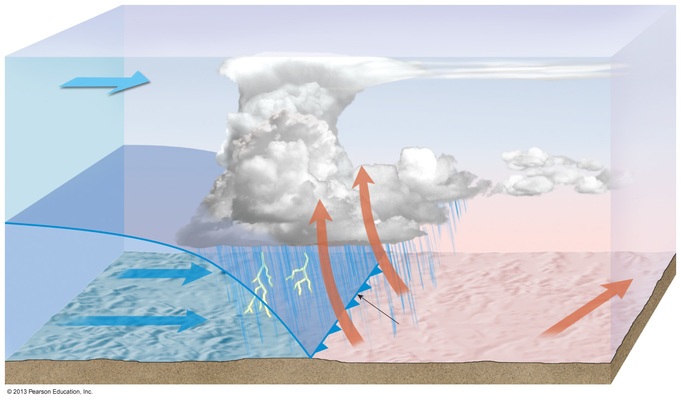
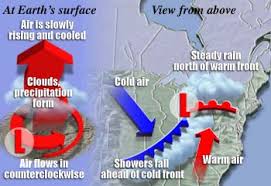
What type of storm front is this? 
a)
warm front
b)
cold front
c)
stationary front
d)
occluded front
19.
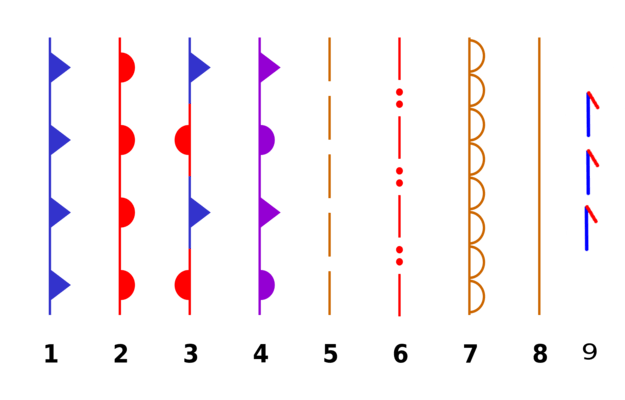
What does symbol # 3 mean?
a)
stationary front
b)
occluded front
c)
warm front
d)
cold front
20.
A front is
a)
where warm air is cooling at earth's surface
b)
a line where hot and cold air are separating
c)
a line where two different air masses meet
d)
where cold air is rising and forming rain clouds
21.
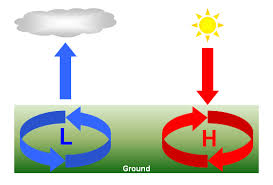
Which most likely produces clear, cool weather?
a)
zero air pressure
b)
stable air pressure
c)
a low pressure system
d)
a high pressure system
22.
_____________ air is more dense and tends to sink
a)
cold
b)
warm
c)
moist
d)
dry
23.
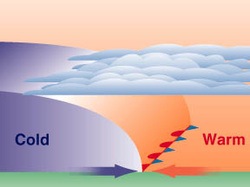
Which type of front is pictured?
a)
Cold front
b)
Warm front
c)
Occluded front
d)
Stationary front
24.
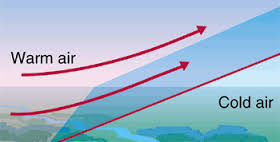
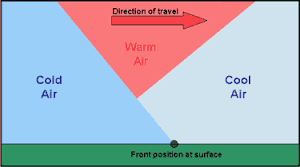
Which type of front is pictured?
a)
Cold front
b)
Warm front
c)
Occluded front
d)
Stationary front
25.
What symbol is this?
a)
warm front
b)
cold front
c)
stationary front
d)
occluded front
26.
Which system results in rainy or stormy weather?
a)
high pressure
b)
low pressure
c)
hurricane
d)
weather system
27.
Which system results in drier, fairer weather?
a)
high pressure
b)
low pressure
c)
hurricane
d)
weather system
28.
When a cold front is approaching, what happens?
a)
warm air is pushing under cold air causing humid weather and lower temperatures
b)
warm air is pushing under cold air causing humid weather and higher temperatures
c)
warm air rises, cools, and causes rain and thunderstorms
d)
cold air is pushed over warm air causing rain and thunderstorms
29.
The symbol on a weather map for a cold front is what?
a)
a line with triangles on it
b)
a line with semi-circles on it
c)
a line with squares on it
d)
a line with circles on it
30.
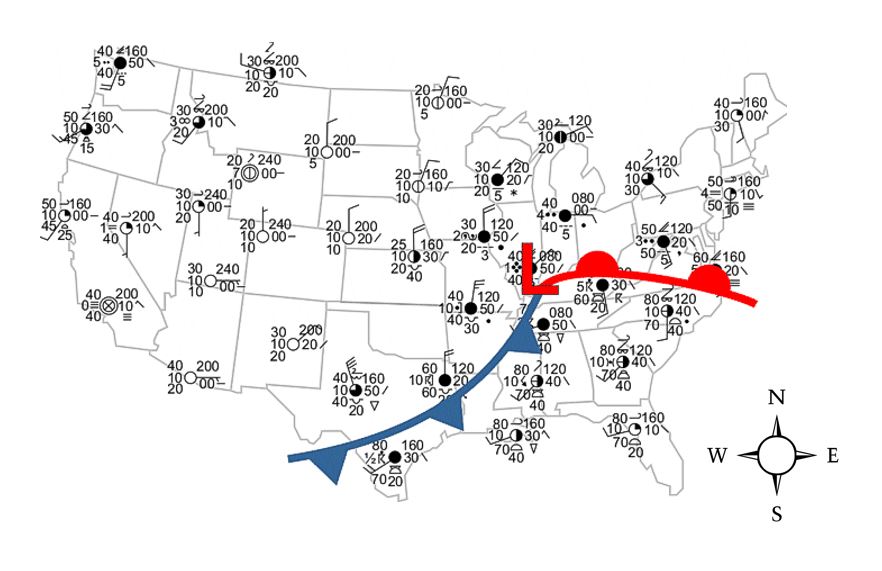
Which type of front is near Seattle?
a)
cold front
b)
warm front
c)
occluded front
d)
stationary front
31.
Which front is located near San Diego?
a)
cold front
b)
warm front
c)
occluded front
d)
stationary front
32.
What direction is the cold front moving on the map? 
a)
Southwest
b)
Northwest
c)
Southeast
d)
Northeast
33.

Which one shows a warm front?

a)
b)
c)
d)
34.
Which type of front is pictured?
a)
Cold front
b)
Warm front
c)
Occluded front
d)
Stationary front
35.

How do plants most commonly break large rocks into smaller pieces?

a)

Seeds from plants fall onto rocks and release acidic compounds.

b)

Plant roots grow into cracks in rocks.

c)

Stems of plants surround and squeeze rocks.

d)

Plant protects surrounding rocks from extreme temperatures.

36.

Hillsides are sometimes terraced to grow plants. What is the purpose of using terraces?

a)

to keep roots from spreading

b)

to increase wind erosion

c)

to retain soil and water

d)

to provide protection from animals

37.

Which of the following statements does NOT illustrate the effects of human activity in creating erosion problems?

a)

Building roads can increase erosion due to the change in drainage patterns.

b)

Terracing along a mountainside can lead to erosion

c)

Building on steep slopes can lead to landslides.

d)

soil can be washed away from new construction sites due to clearing trees and brush

38.

Which of the following causes of the Dust Bowl were due to HUMAN IMPACT?

  1. Over-tilling the land
  2. Severe heat and drought for almost a decade
  3. Overgrazing of farm animals
  4. High winds in the area
a)

All answer options

b)

1 and 3

c)

1, 2, and 3

d)

1 and 2

39.

Which soil conservation practice aims to keep nutrients in the soil?

a)

no-tilling farming

b)

crop rotation

c)

contour plowing on hillsides

d)

terracing hillside farms

40.

The rate of soil erosion will be higher in a field of crops planted in rows than in a field covered with grass because

a)

grass grows lower to the ground than most crops

b)

more soil is exposed to wind and water

c)

most crops grow lower to the ground than grass

d)

less soil is exposed to wind and water

41.

Which of the following soil types would contain the most nutrients?

a)

soil that has many large rock particles

b)

soil that allows water to drain very quickly through it

c)

soil with a lot of decomposed organic material

d)

soil with a bedrock that is very close to the surface

42.

The layer in the soil profile that has the most humus is

a)

2

b)

4

c)

1

d)

3

43.

A scientist is studying geologic formations in deserts. During the study, the scientist draws a diagram of a canyon that has a unique shape.

Which of these BEST explains why the canyon has a unique shape?

a)

The layers of the canyon are composed of different rocks and erode at different rates

b)

The canyon is located in an area next to a river; the bottom layers experience more erosion than the upper layers

c)

All layers of the canyon erode at the same time

d)

The canyon is located in an area that receives heavy rainfall; erosion occurs more quickly due to the constant exposure of water

44.

Which geologic processes have changed the landscape of Georgia the most during the last 10,000 years?

a)

continental drift and plate movement

b)

glacial erosion and deposition

c)

water erosion and deposition

d)

volcanoes and faulting

45.

The picture shows a kind of glacier that can be many meters thick. In this landscape, which of the following is most likely directly affected by this kind of glacier?

a)

The average height of plants on the mountainside

b)

the average mass of trees near the lake

c)

the shape of clouds that form above the glacier

d)

the shape of the valley between the mountains

46.

In Spring 2003, a natural rock outcropping in New Hampshire called the Old Man of the Mountain collapsed. Which of the following most likely loosed the rock and caused it to fall?

a)

oxygen reacting with iron on the surface of the rock

b)

heat turning sedimentary rock into metamorphic rock

c)

volcanic activity producing pressure at the rock's base

d)

water freezing and thawing inside cracks in the rock

47.
The growth of plant roots and animal activity may result in ________________.
a)
erosion
b)
mechanical weathering
c)
chemical weathering
d)
abrasion
48.
The definition of weathering is _______________________.
a)
the carrying away of rock
b)
the leaching of rock
c)
the breaking down of rock
d)
the permeability of rock
49.
The agent of mechanical weathering in which rock is worn away by the grinding action of other rock particles is called _______________.
a)
plant growth
b)
oxygen
c)
abrasion
d)
ice wedging
50.
The most important factors in determining the rate of weathering are _____________________.
a)
carbon dioxide and acid rain
b)
abrasion and acids from plant roots
c)
animal actions and oxygen
d)
rock type and climate
51.
In the fall, Winston noticed a small crack on a boulder where he played in his backyard. The following spring, he saw that the small crack was much larger than he remembered. What most likely caused the change?
a)
gravity had caused the rock to shift
b)
acid rain had caused the crack to erode
c)
winds had caused the rock to break down
d)
water had frozen and thawed inside the rocks
52.
What is the relationship between wind erosion and plant cover?
a)
More plants means less erosion
b)
More plants means more erosion
c)
There is no relationship
d)
Less plant cover means less erosion
53.
Rock samples brought back from the moon show absolutely no evidence of weathering. This is MOST LIKELY due to ______________________________.  
a)
the lack of atmosphere on the moon
b)
extremely low surface temperatures on the moon
c)
lack of biological activity on the moon
d)
lack of running water on the surface of the moon
54.
Which layer of soil has more dead things in it?
a)
Top Soil
b)
Sub soil
c)
Parent materials
d)
Bed rock
55.
What layer has lots of rocks?
a)
Top soil
b)
sub soil
c)
Parent materials
d)
Bed rock
56.
Which BEST describes the rock cycle?
a)
New rocks form from older rocks.
b)
Lunar rocks change into terrestrial rocks.
c)
Rocks in the ocean become rocks on land.
d)
Layers of rock are broken by faults.
57.
How are sedimentary rocks, such as shale and sandstone, formed?
a)
Particles are changed into liquids.
b)
Particles are compressed into layers.
c)
Particles are melted together by magma.
d)
Particles are heated by the Sun.
58.
In order for sediments to become rock, the sediments are generally
a)
liquefied.
b)
compacted.
c)
returned to their origins.
d)
mixed with organic material.
59.
One condition necessary to produce diamonds is
a)
low temperatures
b)
quick cooling
c)
intense pressure
d)
high altitude
60.
Which of these substances is a mineral?
a)
sandstone
b)
granite
c)
quartz
d)
coal
61.
Which processes must occur in order for an igneous rock to change into a metamorphic rock?
a)
heating and pressure
b)
compaction and cementation
c)
melting and cooling
d)
uplift and erosion
62.
Which process forms the mineral halite?
a)
the slow crystallization of magma deep in the crust
b)
the cementing together of sediment particles
c)
the hardening of lava in seawater
d)
the evaporation of seawater
63.
Which process forms both metamorphic and sedimentary rock?
a)
recrystallization
b)
heating
c)
weathering
d)
compacting
64.
Which processes change magma into igneous rock?
a)
weathering and erosion
b)
heat and pressure
c)
compaction and cementation
d)
cooling and crystallization
65.
Gneiss is a rock because it
a)
is hard and round.
b)
has crystals.
c)
is made of minerals.
d)
has mass.
66.
Which statement is true about rocks?
a)
Magma is made of solid rock.
b)
Rocks are made of one or more minerals.
c)
Crystals are made of rocks.
d)
Minerals are made of one or more rocks.
67.
Minerals are made of one or more
a)
minerals.
b)
sediments.
c)
elements.
d)
rocks.
68.
One rock was formed from rapidly cooling lava and is smooth and glassy. The other rock was formed from slow-cooling magma, so has large crystals. Which rock property is represented by these characteristics?
a)
color
b)
texture
c)
fracture
d)
hardness
69.
Which sentence BEST describes a process in the rock cycle?
a)
Sedimentary rocks can melt to become metamorphic rocks.
b)
Volcanoes can deposit sedimentary rock to form mountains.
c)
Metamorphic rocks can form by the weathering process.
d)
Igneous rocks can become metamorphic and sedimentary rocks.
70.
Which process causes sand grains to stick together to form sandstone?
a)
cementation
b)
abrasion
c)
combustion
d)
erosion
71.
Sedimentary rock forms when rock is first
a)
broken down by weathering.
b)
melted into liquid magma.
c)
exposed to great temperature.
d)
crystallized into natural glass.
72.
Minerals are formed by which process?
a)
sedimentation
b)
metamorphosis
c)
fault lines moving
d)
magma cooling
73.
Rock that forms when sediment from older rocks get pressed and cemented together.
a)
Sedimentary Rock
b)
Metamorphic Rock
c)
Igneous Rock
74.
The process by which igneous rocks are formed...
a)
heat and pressure
b)
melting and cooling
c)
weathering and erosion
75.
The process by which metamorphic rocks are formed...
a)
heat and pressure
b)
erosion and deposition
c)
melting and cooling
76.
Rock that forms when pressure and temperature change existing rock.
a)
Igneous Rock
b)
Sedimentary Rock
c)
Metamorphic Rock
d)
Rock Cycle
77.
_______ rock forms from magma/lava
a)
Metamorphic
b)
Sedimentary
c)
Igneous
78.
This rock was another type of rock that was heated and compressed over time. What type of rock is this?
a)
Sedimentary
b)
Igneous
c)
Metamorphic
79.
This rock started as molten magma. What type of rock is this?
a)
Sedimentary
b)
Igneous
c)
Metamorphic
80.
This rock was formed by smaller pieces of rock that settled at the bottom of a lake millions of years ago. What type of rock is this?
a)
Sedimentary
b)
Igneous
c)
Metamorphic
81.
The process when rocks break into smaller pieces due to exposure to natural elements is called
a)
erosion
b)
weathering
c)
sediments
82.

Where are most fossils found?

a)

Igneous rock

b)

Metamorphic rock

c)

Sedimentary Rock

83.

What type of fossil is this?

a)

Mold fossil

b)

Cast fossil

c)

True Form fossil

d)

Trace Fossil

84.

What kind of fossil is this?

a)

Mold Fossil

b)

Cast Fossil

c)

True Form Fossil

d)

Trace Fossil

85.

What kind of fossils are these?

a)

Mold fossils

b)

Cast fossils

c)

True Form fossils

d)

Trace fossils

86.

What kind of fossil is this?

a)

Mold fossil

b)

Cast fossil

c)

True Form fossil

d)

Trace fossil

87.

This kind of fossil leaves behind evidence of an animal's behavior or activity.

a)

Mold fossil

b)

Cast fossil

c)

Trace fossil

d)

True Form fossil

88.

Footprints, nests, and eggs are all examples of what kind of fossils?

a)

Mold fossil

b)

Cast fossil

c)

Trace fossil

d)

True Form fossil

89.

What can NOT become a fossil?

a)

plants

b)

animals

c)

soft body parts

d)

rocks

90.

What might a paleontologist conclude about an animal who's fossil footprints were far apart?

a)

It could swim.

b)

It was walking.

c)

It was able to fly.

d)

It ran fast.

91.

Eras are

a)

a type of fossil

b)

evidence that shows behavior of plants and animals

c)

time periods in which scientists measure when events took place

d)

clocks that show time in history

92.

A mold fossil is

a)

evidence of animal's behavior such a footprints or nests

b)

the positive image of a fossil that was formed by sediments and minerals

c)

the entire preserved organism

d)

the impression of the animal or plant left after it decomposed

93.

A scorpion found in amber is an example of

a)

Mold fossil

b)

Cast fossil

c)

True Form fossil

d)

Trace fossil

94.

What do fossils teach us about?

a)

Everything we need to know about a plant or animal.

b)

They teach us about the past and the environment.

c)

Everything single living thing will become a fossil when it dies.

d)

That wooly mammoths are not extinct.

95.

What could you NOT conclude by looking at this dinosaur fossil?

a)

It has sharp teeth so it probably ate meat.

b)

It had long legs so it probably ran fast.

c)

It had a long tail which it probably used for defense.

d)

It had claws so it was probably a great swimmer.

96.

Fossils found in different layers of the earth likely came from the same era or time period.

a)

True

b)

False

97.

Fossils today are most likely found

a)

close to the surface of the earth

b)

in the middle layer of the earth

c)

in the deepest layers of the earth

d)

fossils are only found in bodies of water

98.

The deeper the layer the fossil is found, the older the fossil will likely be.

a)

True

b)

False

99.

Extinct means

a)

A dead animal has become fossilized.

b)

There is no more of a species left.

c)

Permineralization has occured within the fossil.

d)

The fossil has become petrified.

100.

Which of the following can we NOT learn from fossils?

a)

how animals communicated with each other

b)

how the environment has changed

c)

how species have changed

d)

extinct species

101.
Clouds are made up of tiny drops of ______ or ice. The moisture in the cloud affects the weather.
a)
dust
b)
water
c)
cloud particles
d)
precipitation
102.
They are highest clouds in the sky. They look curly, white and feathery. Usually mean good weather.
a)
Cumulus
b)
Cumulonimbus
c)
Cirrus
d)
Stratus
103.
This is sometimes called a thunderhead cloud. It looks very tall like mountains and heavy rain comes from it. 
a)
Cumulus
b)
Cirrus
c)
Stratus
d)
Cumulonimbus
104.
They are low in the sky and look soft and fluffy. 
a)
Cirrus
b)
Cumulonimbus
c)
Cumulus 
d)
Stratus
105.
Which cloud brings nice weather?
a)
Cumulonimbus
b)
Cumulus
c)
Stratus
106.
what type of cloud is shown?
a)
cumulus
b)
cirrus
c)
stratus
107.
Low clouds (like fog), that are thick, cover the sky, and block the sun.  Usually bring continuous precipitation (rain or snow).
a)
stratus
b)
cumulus
c)
cirrus
d)
nimbo
108.
what type of cloud is shown?
a)
cumulus
b)
cirrus
c)
stratus
109.
Dew is most likely to form 
a)
after heavy rain on a humid day
b)
when humid air contacts cold ground
c)
when the snow on the ground melts
d)
during windy nights when it rains
110.
During which part of the water cycle does a cloud form?
a)
Evaporation
b)
Precipitation
c)
condensation
d)
Run off
111.
Clouds form when...
a)
liquid water is heated and evaporates to become water vapor in the atmosphere.
b)
water vapor in the atmosphere cools and condenses becoming water droplets in the atmosphere
c)
water droplets float upwards and gather together in the atmosphere to form a cloud.
112.
Clouds are classified by their
a)
color and size
b)
color and shape
c)
height and size
d)
height and shape
113.
Clouds form with 
a)
atmospheric dust, low pressure, and moist air
b)
high pressure, high temperatures, and condensation nuclei
c)
low temperatures, zero dust particles, and dry air
d)
dry air, condensation nuclei, and low pressure 
114.
The phase change from water vapor to liquid water is known as
a)
evaporation
b)
precipitation
c)
condensation
d)
sublimation
115.
What is an example of gas in the atmosphere?
a)
Ice Crystals
b)
Water Droplets
c)
Water Vapor
116.
_____________ is the temperature to which air must be cooled to reach saturation.
a)
Humid point
b)
Temperature index
c)
Relative Humidity
d)
Dew Point
117.
The amount of water vapor in the atmosphere compared to how much it could hold.
a)
Saturation
b)
Vaporicity
c)
Humidity
d)
Relative Humidity
118.

What is an example of a liquid in the atmosphere?

a)

Ice Crystals

b)

Water Droplets

c)

Water Vapor