
NEW
Font size
 Worksheets
Atoms, Atomic Structure, and Electrostatics
Total questions: 29
Worksheet time: 22mins

What is true about an atom?
Most of the space in an atom is taken up by the nucleus
Atoms are mostly empty space
Atoms have no mass
Electrons have much more mass that protons or neutrons.

The atomic nuclei of almost all elements consists of
protons
protons and electrons
protons and neutrons
only neutrons

What part of the atom is show by the red sphere?
nucleus
electron cloud
electrons
neutrons

Which of these phrases best describes an atom?
a positive nucleus surrounded by a hard negative shell
a positive nucleus surrounded by a cloud of negative charges
a hard sphere with postive and negative charges on the outside
a negative nucleus surrounded by protons and neutrons

In a good conductor, electrons are usually
free to move around
free to move around after an impurity has been added
semi-free to move around
tightly bound in place
In a good insulator, electrons are usually
free to move around
free to move around after an impurity has been added
semi-free to move around
tightly bound in place
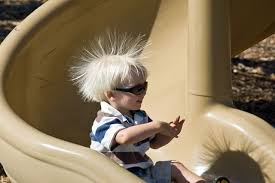
What method of static charging is shown in this picture
Contact
Friction
Grounding
Electron Shifting

The reason a charged balloon will stick to a wall is that
the charge is slightly sticky and acts like glue
electrons transfer back and forth between the wall and the balloon
the positively charged surface is due to electrons being moved, now attracts to a negatively charged balloon
balloon material simply sticks to walls

Which of the following is FALSE based on the element Boron?
It's AMU is 11
It has 5 electrons in its valence shell/orbital
It has 5+ and 5e-
Boron has a neutral charge as it occurs naturally

Rutherford's gold foil experiment provided evidence that...
negative and positive charges are spread evenly throughout the atom.
alpha particles have a positive charge.
gold is not a dense as previously thought.
there is a dense positively charged nucleus at the center of an atom.

Which of the following particles has the smallest mass?
neutron
proton
nucleus
electron

The AMU of an isotope is equal to the number of ______ in an atom.
Protons
Neutrons
Protons + Neutrons
Electrons

When the distance between two charges is halved, the electrical force between the charges
quadruples
reduces to one fourth
halves
doubles

According to Coulomb's law, you can do all of the following to increase the electric force of repulsion EXCEPT
Increase charge 1
Increase charge 2
Decrease the distance
Increase the distance

Which electrostatics phenomena is shown in this picture?
Contact
Friction
Grounding
Charge polarization
After grounding, how will objects interact?
Both will have the same charge, so they attract one another
Both will be neutral, so they will attract one another
Botn will be neutral, so they will repel one another
Both will be neutral, so they will not attract nor repel


Grounding happens when...
A neutral object comes into contact with another neutral object
A charged object is rubbed against another charged object
A neutral object touches a MASSIVE conductive object
A charged object is relieved of its net charge (can either add or remove electrons)

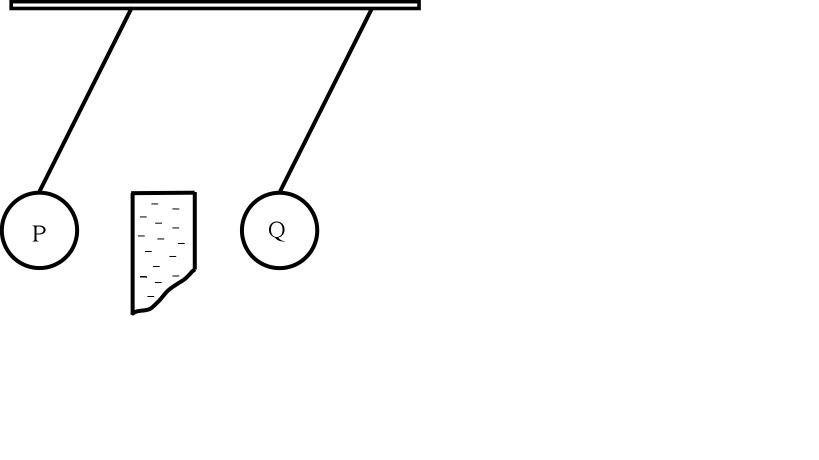
Which statement is true?


What is the purpose of lightning rods ?
to decorate the home
to create a path for the electricity to get to the ground
to direct the electricity to the power grid of the house
to deflect the electricity back into the cloud

A rubber rod is rubbed against a rabbit fur and gains 5 electrons. Which of the following is true?
the fur lost 5 electrons
the fur also gained 5 electrons
the fur gained 5 protons
The fur and rubber rod now are neutrally charged

Assume a rubber rod acquires a Net negative charge after it is rubbed against a rabbit fur. Which is true?
The fur lost electrons
The fur gained electrons
The fur gained protons
The fur is now neutrally charged


