
 Worksheets
Chemistry of Matter
Total questions: 52
Worksheet time: 53mins
Name
Class
Date
1.

Based on the information in the table, which of the four substances below is a compound?
a)
CO
b)
Si
c)
He
d)
Fe
2.
Which term is not a form of matter?
a)
atom
b)
compound
c)
element
d)
energy
3.
Atoms are made of particles. These include:
a)
protons only
b)
protons and electrons only
c)
protons and neutrons only
d)
protons, neutrons, and electron
4.
Lithium has three protons, four neutrons, and three electrons. Which describes its nucleus?
a)
three protons and four neutrons
b)
three protons and three electrons
c)
three protons, four neutrons, and three electrons
d)
four neutrons and three electron
5.
Which pair correctly matches the atomic particle to its electric charge?
a)
proton, neutral
b)
electron, negative
c)
neutron, negative
d)
electron, positive
6.
Which of the following describes an atom which is neutral?
a)
11 protons, 12 neutrons, and 12 electrons
b)
11 protons, 12 neutrons, and 11 electrons
c)
11 protons, 11 neutrons, and 12 electrons
d)
11 protons, 12 neutrons, and 6 electrons
7.
Elements are arranged on the Periodic Table according to
a)
density
b)
phase of matter
c)
number of protons
d)
abundance on Earth
8.
Which set of terms describes a non-metal?
a)
shiny, malleable, good conductor
b)
dull, malleable, poor conductor
c)
dull, brittle, poor conductor
d)
shiny, brittle, poor conductor
9.
Which group of elements will not react with other elements?
a)
metals
b)
metalloids
c)
non-metals
d)
noble gases
10.
Which term describes a chemical property of matter?
a)
temperature
b)
density
c)
reactivity
d)
mass
11.
The following equation, H2O (liquid) + heat → H2O (gas), describes a
a)
physical change
b)
mixture
c)
chemical change
d)
solution
12.
The following equation, N2 + 3 H2 → 2 NH3 .describes a
a)
physical change
b)
mixture
c)
chemical change
d)
element
13.
Which describes a physical change followed by a chemical change?
a)
cutting wood then painting it green
b)
taking ice cream out of the freezer then letting it melt
c)
putting gasoline in the car then starting the engine
d)
crushing a sugar cube then dissolving it in water
14.
A sample of unknown composition was tested in a laboratory. The sample could not be broken down by physical or chemical means into simpler substances. On the basis of this research, the laboratory reported that this sample was most likely a(n):
a)
compound
b)
element
c)
mixture
d)
solution
15.
The compound calcium carbonate, commonly known as chalk, has the chemical formula of CaCO3. How many different elements are in chalk?
a)
one
b)
two
c)
three
d)
five
16.
In the formula for glucose, C6H1206, how many atoms of hydrogen are indicated?
a)
one
b)
six
c)
twelve
d)
twenty-four
17.
Which group of elements will not react with other elements?
a)
metals
b)
metalloids
c)
non-metals
d)
noble gases
18.
Hydrochloric acid is added to a beaker containing a piece of zinc. As a result, zinc chloride is formed and hydrogen gas is released. This is an example of
a)
a chemical reaction
b)
a physical change
c)
photosynthesis
d)
evaporation
19.

Some common substances and their chemical formulas are listed in the chart. Which of these substances are elements?
a)
hydrochloric acid and carbonic acid
b)
carbon dioxide and water
c)
oxygen and helium
d)
water and oxygen
20.
The Statue of Liberty was originally made of Copper. Why is it green now?
a)
It got moldy
b)
It was painted green, which is a physical change
c)
It experienced a chemical change and rusted
d)
The sun caused it to change color
21.
Which of the following is a sign that a chemical reaction has occurred?
a)
change in shape
b)
melting
c)
formation of a gas
d)
dissolving
22.
Is hammering wood together to build a house a chemical or physical change?
a)
chemical
b)
physical
23.
When you break a cracker into pieces it is a
a)
Chemical change
b)
Physical change
c)
Chemical Weathering
d)
Physical Weathering
24.
Which is a Chemical property?
a)
Thermal Conductivity
b)
Density
c)
Malleability
d)
Flammability
25.
Molecules are
a)
2 atoms bound together
b)
2 elements bound together
c)
2 or more atoms mixed together
d)
2 or more atoms bound together
26.
What is the total number of atoms in CH4 (Methane)
a)
2
b)
4
c)
1
d)
5
27.
Which of these is NOT a sign that a chemical change has occurred?
a)
A loss of transparency
b)
An unexpected color change
c)
A temperature change
d)
The formation of a precipitate
28.
How many Al atoms are there in total in this compound? Al2O3
a)
2
b)
5
c)
6
d)
4
29.
The reactants are on the left side of the chemical equation.
a)
True
b)
False
30.
In which of these compounds are there twice as many oxygen atoms as hydrogen atoms?
a)
H3PO4
b)
H2SO4
c)
HCIO3
d)
H20
31.
Which point of evidence DOES NOT support the claim that the elephant toothpaste experiment was a chemical reaction?
a)
The foam had streaks of hilighter fluid
b)
The formation of a Gas
c)
The cylinder felt hot
d)
The foam changed color to brown
32.
Which is a compound?
a)
Ca
b)
I
c)
NaCl
d)
He
33.
One cup of water is left outside for two days when it was checked there was only half a cup left. What happened?
a)
evaporation; chemical change
b)
condensation; physical change
c)
evaporation; physical change
d)
condensation; chemical change
34.
Which of the following properties is a physical property?
a)
magnetism
b)
reactivity with oxygen
c)
flammability
d)
non-reactive
35.
Jayden asked Gabe what she could do to an egg for a chemical change. Gabe answered correctly and said...
a)
You can drop the egg.
b)
You can cook the egg.
c)
You can crack the egg.
d)
You can paint the egg.
36.
Why did the balloon inflate when the baking soda was put into the vinegar in your experiment?
a)
The vinegar evaporated, a physical change
b)
Carbon Dioxide was released from a chemical reaction
c)
The temperature increased
d)
The pressure decreased
37.
What could cause a fire to go out by stopping the chemical reaction?
a)
Covering it and cutting off the oxygen
b)
Adding salt to it
c)
Blowing on it
d)
Shouting at it
38.
In which state of matter do the molecules have the highest energy
a)
Solid
b)
Gas
c)
Liquid
d)
Solid and Liquid
39.
Which of the following terms identifies the change from a liquid to gas?
a)
Vaporization
b)
Condensation
c)
Deposition
d)
Sublimation
40.
When the temperature of matter increases the particles...
a)
speed up and move closer
b)
speed up and move farther apart
c)
slow down and move closer together
d)
slow down and move farther apart
41.
The opposite phase of melting is
a)
freezing
b)
sublimation
c)
condensation
d)
deposition
42.
Melting point and freezing point of water are
a)
100 C
b)
The same for a particular substance
c)
Always 0 C
d)
Not depending on pressure
43.
Alcohol is flammable. This is an example of a
a)
Chemical property
b)
Physical property
c)
Boiling point
d)
Form of matter
44.

What is happening between points B and C?
a)
Evaporation
b)
The temperature rises
c)
Melting
d)
Boiling
45.

Why does the temperature stay the same between points D and E?
a)
There is no phase change taking place
b)
Ice is melting
c)
There is no heat being added
d)
There is a phase change taking place
46.

Which process takes the longest to occur?
a)
melting
b)
boiling
c)
freezing
d)
heating the solid
47.
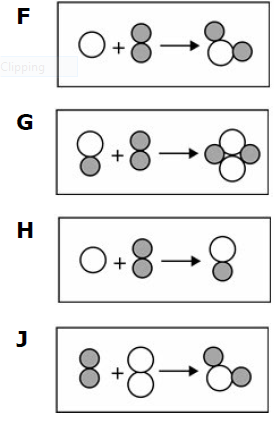
Which of the following models best demonstrates a chemical reaction that occurred. Hint: must satisfy the Conservation of Mass Law.
a)
F
b)
G
c)
H
d)
J
48.

Based on the law of conservation of mass. What is the mass of H2O in the reaction above?
a)
70.01
b)
24.11
c)
21.44
d)
48.22
49.
Which of the following BEST describes a chemical reaction?
a)
A compound is crushed into a fine powder.
b)
Atoms break apart into even smaller particles.
c)
chemical bonds break and new ones form.
d)
Molecules move faster until they fly apart from each other
50.

A scientist performed four investigations using eight different liquids. In each investigation, the scientist combined two of the liquids under a fume hood and recorded observations in the table below.In which investigation is it least likely that the liquids reacted chemically?
a)
1
b)
2
c)
3
d)
4
51.
Coal contains carbon and other elements. Carbon dioxide forms when coal burns in the presence of oxygen. Which of these is the best evidence that a chemical reaction occurs when coal burns?
a)
The shape of the coal changes
b)
Oxygen is present
c)
A new substance is produced
d)
Coal is made up of more than one element
52.
Two clear colorless solutions were combined.
The student observed that the temperature changed from 25 •C to 23 •C when the solutions were combined and that a white substance rapidly formed and settled to the bottom of the container. What most likely happened to produce these results?
The student observed that the temperature changed from 25 •C to 23 •C when the solutions were combined and that a white substance rapidly formed and settled to the bottom of the container. What most likely happened to produce these results?
a)
One of the original compounds came out of solution
b)
The solutions reacted chemically
c)
Some of the water froze into ice crystals
d)
Rapid evaporation of water occurred, leaving a solid
100 %

