
 Worksheets
Weather Practice
Total questions: 50
Worksheet time: 3590secs
Name
Class
Date
1.
rapidly moving cold air mass runs into a warm air mass the cold air slides under the warm air. This is called a .....
a)
cold front
b)
warm front
c)
stationary front
2.
When a warm air mass gently slides on top of a cold air mass, and you have drizzly rain and then warmer weather, what type of front is it?
a)
warm front
b)
cold front
c)
occluded front
d)
stationary front
3.
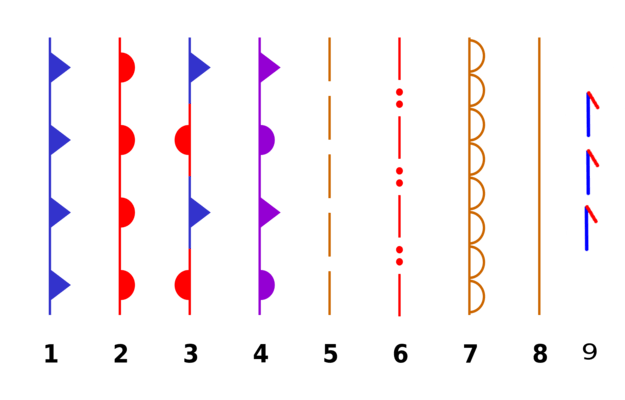
What does symbol # 3 mean?
a)
stationary front
b)
occluded front
c)
warm front
d)
cold front
4.
The symbol on a weather map for a cold front is what?
a)
a line with triangles on it
b)
a line with semi-circles on it
c)
a line with squares on it
d)
a line with circles on it
5.
The symbol on a weather map for a warm front is what?
a)
a line with triangles on it
b)
a line with circles on it
c)
a line with semi-circles on it
d)
a line with circles on it
6.
A front is
a)
where warm air is cooling at earth's surface
b)
a line where hot and cold air are separating
c)
a line where two different air masses meet
d)
where cold air is rising and forming rain clouds
7.
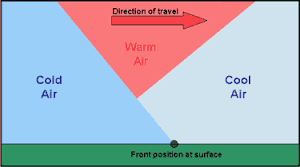
Which type of front is pictured?
a)
Cold front
b)
Warm front
c)
Occluded front
d)
Stationary front
8.
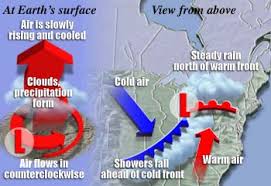
Which system results in rainy or stormy weather?
a)
high pressure
b)
low pressure
c)
hurricane
d)
weather system
9.
Clouds are made up of tiny drops of ______ or ice. The moisture in the cloud affects the weather.
a)
dust
b)
water
c)
cloud particles
d)
precipitation
10.
They are highest clouds in the sky. They look curly, white and feathery. Usually mean good weather.
a)
Cumulus
b)
Cumulonimbus
c)
Cirrus
d)
Stratus
11.
This is sometimes called a thunderhead cloud. It looks very tall like mountains and heavy rain comes from it.
a)
Cumulus
b)
Cirrus
c)
Stratus
d)
Cumulonimbus
12.
They are low in the sky and look soft and fluffy.
a)
Cirrus
b)
Cumulonimbus
c)
Cumulus
d)
Stratus
13.
These clouds are the closest to the ground. Their name means layer- or sheet like. They bring rain or snow and cover most of the sky.
a)
Cirrus
b)
Stratus
c)
Cumulonimbus
d)
Cumulus
14.

what type of cloud is shown?
a)
cumulus
b)
cirrus
c)
stratus
15.

what type of cloud is shown?
a)
cumulus
b)
cirrus
c)
stratus
16.

what type of cloud is shown?
a)
cumulus
b)
cirrus
c)
stratus
17.

What does this tool measure?
a)
Wind speed
b)
Wind direction
c)
Air pressure
d)
Temperature
18.

This weather instrument is a...
a)
anemometer
b)
Christmas ornament
c)
wind vane
d)
barometer
19.

What is the name of this tool?
a)
Barometer
b)
Hygrometer
c)
Rain Gauge
d)
Thermometer
20.

This weather instrument is a...
a)
anemometer
b)
barometer
c)
wind vane
d)
thermometer
21.
A rain gauge measures what?
a)
Air pressure
b)
Wind speed
wind speed
wind speed
c)
Amount of rain fall
d)
Wind direction
22.

This weather instrument is an...
a)
wind vane
b)
anemometer
c)
barometer
d)
thermometer
23.
Which tool measures humidity or the amount of moisture in the air?
a)
wind vane
b)
barometer
c)
anemometer
d)
hygrometer
24.
Which tool measures air pressure?
a)
Thermometer
b)
Barometer
c)
Wind Vane
d)
Hygrometer
25.
Which tool measures wind speed?
a)
Anemometer
b)
Hygrometer
c)
Barometer
d)
Wind Vane
26.
Temperature is measured in...
a)
degrees
b)
inches
c)
centimeters
d)
feet
27.
A high pressure system means we might have this weather.
a)
Snow blizzard
b)
Sunny and dry
c)
Rain storm
d)
Tornado
28.
A low pressure system means we might have this weather.
a)
Sunny
b)
A clear sky
c)
Dry day
d)
Stormy or wet
29.
_______ pressure systems are characterized by sinking air.
a)
High
b)
Low
30.
_______ pressure systems are characterized by rising air.
a)
High
b)
Low
31.
What is caused by differences in air pressure?
a)
Time
b)
Precipitation
c)
Clouds
d)
Wind
32.
____________ are connected lines of equal pressure.
a)
Isobars
b)
Isopleths
c)
Isotherms
d)
Isochrons
33.
Where you will find the ozone layer.
a)
stratosphere
b)
thermosphere
c)
exosphere
d)
mesosphere
34.
Where weather occurs.
a)
stratosphere
b)
thermosphere
c)
troposphere
d)
mesosphere
35.
The only layer that contains water vapor and carbon dioxide.
a)
stratosphere
b)
thermosphere
c)
troposphere
d)
mesosphere
36.
Where we live.
a)
stratosphere
b)
thermosphere
c)
troposphere
d)
mesosphere
37.
The hottest layer.
a)
troposphere
b)
thermosphere
c)
exosphere
d)
mesosphere
38.
The most common gas in the atmosphere (78%).
a)
Nitrogen
b)
Oxygen
c)
Carbon Dioxide
d)
Trace gases
39.
What two gases are found throughout all layers of the atmosphere?
a)
Nitrogen and carbon dioxide
b)
Nitrogen and oxygen
c)
Oxygen and carbon dioxide
d)
Trace gases and water vapor
40.
What does the earth's atmosphere do?
a)
help to regulate the temperature on Earth
b)
Help UV rays to reach the Earth's surface
c)
Creates meteors in the sky
d)
Keep ocean waters cold
41.
What happens to the air pressure the higher up in space you go?
a)
the air pressure increases
b)
the air pressure decreases
c)
the air pressure stays the same
d)
there is no air pressure
42.
As you go higher in the mesosphere, the temperature _______________.
a)
decreases
b)
increases
c)
stays the same
43.
As you go higher in the stratosphere, the temperature _______________.
a)
decreases
b)
increases
c)
stays the same
44.
As you go higher in the thermosphere, the temperature _______________.
a)
decreases
b)
increases
c)
stays the same
45.
What is the greenhouse effect?
a)
The warming of a planet due to trapped radiation.
b)
The cooling of Earth due to air pollution.
c)
The heating of a solid, such as a rock.
46.
What gas from the list below is a cause for global warming?
a)
Urethane
b)
Oxygen
c)
Carbon Dioxide
47.
What do greenhouse gases do in our atmosphere?
a)
They absorb radiation given off by the Earth
b)
They block harmful radiation from reaching the Earth
c)
They keep all the air within the Earth
d)
They make the Earth cooler
48.
What do scientists think the effect will be of having more greenhouse gases in our atmosphere?
a)
More warming of the atmosphere
b)
More cooling of the atmosphere
c)
More air in the atmosphere
d)
Less air in the atmosphere
49.
What do humans do that releases greenhouse gases into the atmosphere?
a)
Burn fossil fuels (like gas and coal)
b)
Build cement buildings
c)
Ride bikes and use solar energy
d)
Compete in the Olympics
50.
Which of the following is an example of a greenhouse gas?
a)
Carbon Dioxide
b)
Nitrogen
c)
Oxygen
d)
Neon
100 %

