
 Worksheets
Electricity and Magnetism Review
Total questions: 50
Worksheet time: 2hrs 42mins
The charge produced by rubbing (wiping) two objects together like feet on the carpet or a balloon on a sweater is called ______________.
conduction
induction
friction
reduction
When static energy is lost as the charges move off of an object like bringing your finger near a door knob and seeing the spark is called _____________________.
current
lightning
conduction
electric discharge
When you bring your hand near the Van de Graaf generator and a spark jumps to your hand. This is charging by ______________.
induction
conduction
friction
Law of Electric Charges
Like charges repel and opposite charges attract is what Law?
Conservation of Mass
Conservation of Energy
Electric Charges
Static Charges


What two forces are required for generators and electric motors to work?
magnetism and thermal
electricity and thermal
electricity and magnetism
magnetism and radiant

The image depicts two bar magnets immersed in oil that contains small needle-like particles of iron. What is the BEST interpretation of the pattern created by the iron particles?
The pattern of iron particles is created by the north pole of one magnet facing the south pole of the other magnet.
The pattern of iron particles is created by the south pole of one magnet facing the south pole of the other magnet because south poles attract each other.
The pattern of iron particles is created by the repulsion of like magnetic poles, we cannot determine if the poles are north or south polarization.
The pattern of iron particles is created by the north pole of one magnet facing the north pole of the other magnet because north poles attract each other.

A group of students carried out an investigation in which they caused the surface of a balloon to become electrically charged by rubbing the balloon on a piece of wool. They then brought the charged portion of the balloon close to a classmate’s hair and watched as the hair stuck to the balloon. The teacher explained that this was due to the negative charge on the hair. What was the charge on the balloon?
negative
neutral
no charge
positive
What is the charge of an electron?
Positive
Negative
Neutral
With electricity and magnetism we typically say like charges _________ and opposite charges ___________.
repel; attract
attract; repel
increase; decrease
decrease; increase

What happens when two north poles of a magnet are placed together?
they repel
they attract
they cancel each other out
the strength of the magnet is doubled

Materials that electrons can flow through easily.
Insulator
Conductor
Electrons
Protons
For lightning to occur, negative charges build up in the bottom of the cloud and opposite charges build up on the ground, When the difference is great enough, electric discharge occurs.
True
False
A _____________ must be replaced when too much current flows through it and a _____________ can be reset.
fuse, transformer
circuit breaker, galvanometer
circuit breaker, fuse
fuse, circuit breaker


Isabella was standing directly below a power line, and her compass failed to give an accurate reading. How could she explain why her compass was not working?
A compass works with a magnetic field, and the electric current running through the lines above it would interfere with the magnetic field.
The compass works because of an electric field, and the electric current running through the lines above would interfere with the electric field.
The compass works because of a gravitational field, and the magnetic current running through the lines above would interfere with the gravitational field.
A compass works because of a magnetic field, and the magnetic current running through the power lines above it would interfere with the magnetic field below it.
After completing an investigation of how distance affects the strength of electric forces, you graphed your data. Imagine your graph shows that the longer the distance, the strength of the electric field is minimal. What conclusion can you draw from your data?
The strength of the electric field is strongest at a long distance.
The strength of the electric field is strongest at a short distance.
The strength of the electric field is weakest at both ends of the graph.
The strength of the electric field is strongest at both ends of the graph.
Students conducted an investigation to compare the strength of two electromagnets by determining how many paper clips they could pick up. They constructed the two electromagnets shown, Electromagnet A (9V) and Electromagnet B (3V), and used each of them to pick up paper clips for 10 seconds.
Conclusion: Electromagnet A is stronger than Electromagnet B.
Once the students completed the investigation they replaced the 3V battery on Electromagnet B with a 9V battery and repeated the experiment; however, Electromagnet A had more coils around its nail.
What will the results be when the students repeat the experiment?
Electromagnet B will pick up more paper clips than Electromagnet A.
Electromagnet A will pick up more paper clips than Electromagnet B.
Electromagnet A will pick up twice as many paper clips as Electromagnet B.
Electromagnet A and Electromagnet B will pick up the same number of paper clips.
You and your sister both have a small camping tent set up in the backyard. You each have two strings of lights to hang inside the tent. You power your lights with a 9-volt battery and your sister uses an extension cord and powers her lights from an electrical outlet on the deck.
What is the BEST conclusion the you can make about this situation?
Your lights shine the brightest because your battery produces less power.
Your lights shine the brightest because your battery produces more power.
Your sister’s lights shine the brightest because the electrical outlet has less power.
Your sister’s lights shine the brightest because the electrical outlet has more power.

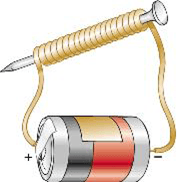
A group of students built an electromagnet using a 9-volt battery, an iron nail and copper wire.
What can the students do to make the electromagnet stronger?
Increase the thickness of wire used.
Replace the iron nail with a smaller iron nail.
Decrease the number of turns in the wire coil.
Replace the battery with a higher voltage battery.

How can levitating trains support the claim that magnetic fields exist between objects exerting magnetic force on each other even when there is no physical contact?
Levitating trains are controlled by the attraction of two similar magnetic poles being brought close together.
Levitating trains are controlled by the repulsion of two similar magnetic poles being brought close together.
Levitating trains are controlled by the attraction and connection of magnets on the train to magnets on the train tracks.
Levitating trains are controlled by the repulsion and connection of magnets on the train to the magnets on the train tracks.

A student rubs a neutral balloon with a cloth on a cool, dry day. The balloon gains electrons.
Which of the following is an accurate description of what occurred, and why?
The balloon gains a positive charge through conduction.
The balloon gains a negative charge through friction.
The balloon gains a negative charge through conduction.
The balloon gains a positive charge through friction.

CONSTRUCTED RESPONSE QUESTION: What could you do in order to prevent the static electric shock from metal objects? (Think of how you prevent lightning from hitting your house.)
ground yourself to drain off those excess static charges
rubbing your feet on wool carpet
wearing shoes with rubber soles
wearing polyester materials

If two objects, both with negative charges, come into close contact with one another, what would you expect to see happen?
They will repel.
They will attract.
They will divorce.
They will unite.

How are electromagnets different from permanent magnets?
magnets can be turned on/off
you can turn an electromagnet on/off
magnets are more powerful
magnets have a North and South pole

