Worksheets
Planet Earth Topic 3
Total questions: 47
Worksheet time: 24mins


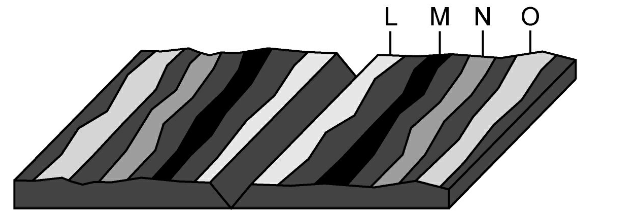
What is this a picture of?
plate tectonics
continental drift
pangaea
glacier scaring
Scientists think that the continents once formed a giant landmass that broke apart, and then slowly drifted apart. What is the name given to this hypothesis?
sea-floor Spreading
plate tectonics
continental drift
Pangaea
Most geologist think that the movement of Earth's tectonic plates is caused by
the rotation of the Earth.
the Earth's magnetic field.
subduction.
convection currents.
Most tectonic plates have both oceanic and continental crust. How are they different?
Oceanic is thinner and less dense than continental.
Continental is thinner than more dense than oceanic.
Continental is thicker and less dense than oceanic.
Oceanic is thicker and more dense than continental.
Rocks and structures on both sides of the ____________ Ocean are very similar.
Pacific
Atlantic
Indian
Antarctic
When all the continents are together, it is called a(n) ____________ continent.
massive
gigantic
enormous
super
The remains or traces of ancient life are called ____________.
bones
remanents
fossils
none of the above


Plates slide past each other at _________________ boundaries.
divergent
convergent
transform
universal
Breaks in the crust called __________ form where plates meet.
mountains
rift valleys
faults
trenches
Earth's plates meet at ____________.
plate tectonics
plate boundaries
continental drift
oceans
________________ currents drive Earth's plate movement.
ocean
atmosphere
wind
convection
What is the motion of Earth's plates like?
fast and in stages
slow and in stages
fast and constant
slow and constant
The San Andreas fault is an example of which type of boundary?
transform
divergent
convergent
universal
Which feature forms at convergent boundaries?
trench
rift valley
mountain range
mid-ocean ridge
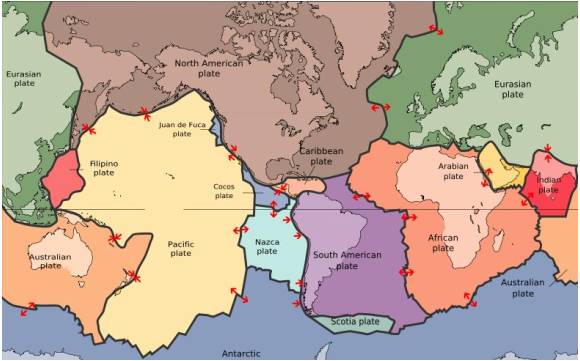
The map in the picture shows tectonic plate boundaries. This map would be useful in predicting the location of future
droughts
hurricanes
earthquakes
tornadoes
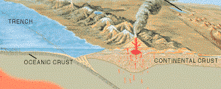
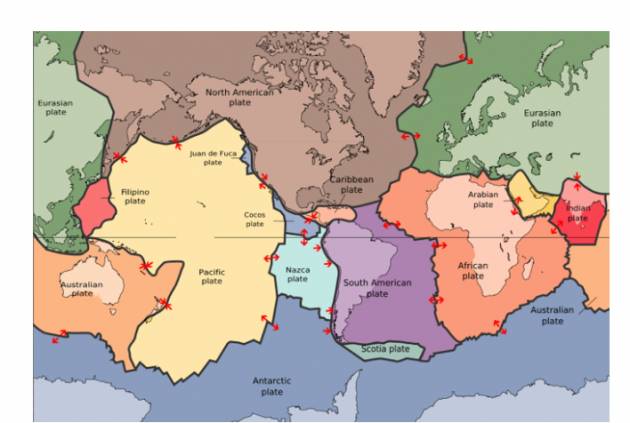
Where are earthquakes MOST LIKELY to occur?
close to the equator
close to the center of tectonic plates
at divergent or convergent plate boundaries
at transform plate boundaries
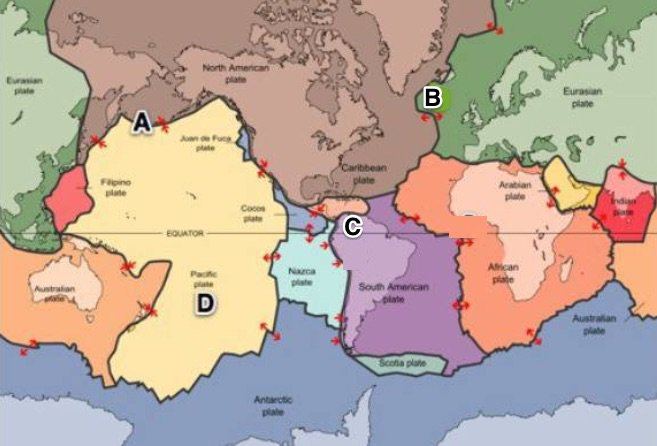
Where would sea floor spreading most likely occur?
At convergent boundaries (oceanic vs. oceanic)
At convergent boundaries (oceanic vs. continental)
At divergent plate boundaries (oceanic vs. oceanic)
At transform plate boundaries

The process by which the ocean floor sinks beneath a deep-ocean trench and back into the mantle is known as _______
convection.
continental drift.
subduction.
conduction.
The geological theory of _______ states that pieces of Earth’s lithosphere are in constant, slow motion.
subduction
plate tectonics
deep-ocean trenches
sea-floor spreading
A place where two plates slip past each other, moving in opposite directions, is known as a _______
transform boundary
divergent boundary.
convergent boundary.
rift valley.

Below is a picture of sea-floor spreading. How are the ocean crusts moving?
Converging
Diverging
Sliding
No movement