wayground logo

Free Printable Worksheets

NEW

Font size

S
M
L
XL
Worksheets

Unit 1 Test Review- Waves

Total questions: 50

Worksheet time: 17mins

Name
Class
Date
1.

How are electromagnetic waves different from other waves?

a)

They have very short wavelengths

b)

They transmit energy instead of matter

c)

They can change directions by reflection when they strike an object

d)

They can travel through a vacuum(space) and matter

2.

The _____________ is the distance between 2 crests.

a)

wave length

b)

amplitude

c)

frequency

d)

wave speed

3.

This illustration shows a transverse wave. Which bar measures the wavelength?

a)

X

b)

Z

c)

Y

d)

W

4.

This illustration shows a transverse wave. Which bar measures the Amplitude?

a)

X

b)

Z

c)

Y

d)

W

5.

This illustration shows a transverse wave. Which bar measures the Amplitude?

a)

X

b)

Z

c)

Y

d)

W

6.

The part of a longitudinal wave that is being squeezed or pressed together

a)

rarefaction

b)

trough

c)

wavelength

d)

compression

7.

The number of waves that pass a given point per second 

a)

wavelength

b)

medium

c)

frequency

d)

amplitude

8.

What is the wave part for C

a)

Crest

b)

Trough

c)

Wavelength

d)

Amplitude

9.

What is the wave part for D

a)

Crest

b)

Trough

c)

Wavelength

d)

Amplitude

10.

What explains the cause of windows rattling during a thunderstorm?

a)

sound energy

b)

electrical energy

c)

light energy

d)

heat energy

11.

The purpose of the ________ is to receive light that the lens has focused and convert the light into neural signals to send to the brain.

a)

Retina

b)

Iris

c)

Cornea

d)

Pupil

12.

Light moves in a straight line unless its path is interrupted. How would light behave if it meets a smooth surface?

a)

reflection

b)

absorption

c)

refraction

d)

diffusion

13.

Observing a straw in a glass of water, a student noticed the straw looked broken at the water line. What causes the light to bend?

a)

refraction

b)

reflection

c)

diffusion

d)

absorption

14.

Why should you not wear a black shirt on a summer afternoon?

a)

The absorption makes it hot

b)

The reflection makes it hot

c)

the transmission makes it see through

d)

It reflects off it

15.

When you see an object, what type of light behavior are you witnessing?

a)

absorbed light

b)

reflected light

c)

refracted light

16.

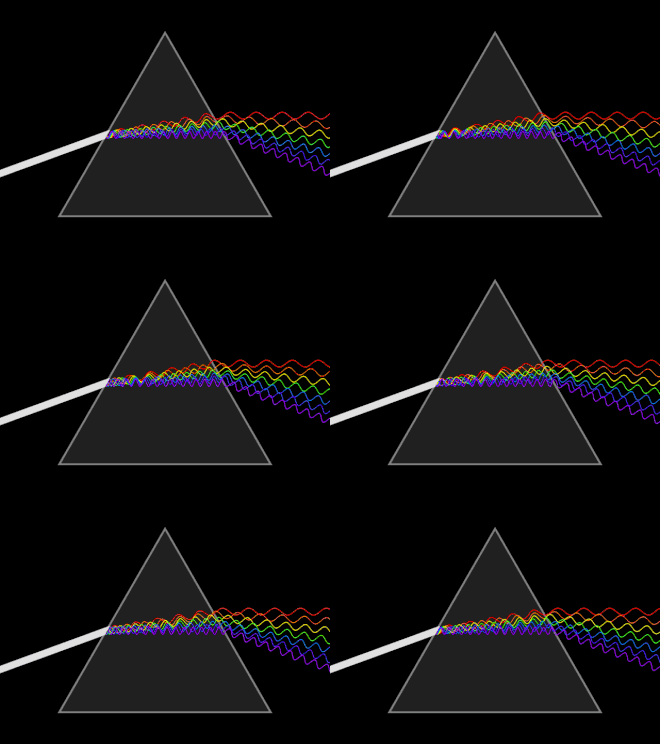
The visible light spectrum is produced when light goes through a _____________, which the slows down and bends the light into the separate colors of the rainbow.

a)

mirror

b)

opaque objects

c)

windows

d)

prism

17.

If the diagrams were taken from the visible light spectrum, which one could possibly be identified as red?

a)

A

b)

B

c)

C

18.

Which is an example of a translucent object?

a)

wax paper

b)

mirror

c)

book

d)

window

19.

Why does sound travel faster through a solid object than in the air?

a)

The atoms in the solid object are closer together than the atoms in the air

b)

The atoms in the solid object are farther apart than the atoms in the air

c)

The atoms in the solid object are smaller

d)

The atoms are larger in the solid object

20.

The human ear is constructed to pull vibrating air particles through a tube for recognition by our brains.  Which part of the ear converts these vibrations into understandable electrical impulses sent to our brain?

a)

auditory nerve

b)

auditory canal (ear canal)

c)

tympanic membrane (eardrum)

d)

pinna/auricle

21.

What allows the human eye to see different colors?

a)

differences in temperature

b)

differences in pitch

c)

differences in wavelengths

d)

differences in crests

22.
How do mirrors work?
a)
Absorption
b)
Refraction
c)
Reflection
d)
Transmission
23.
What would I do if I wanted to increase the temperature of my cup of water outside?
a)
Put a thermometer in the cup
b)
Wrap the cup in plastic
c)
Paint the cup white
d)
Black material around the glass
24.
What part of the electromagnetic spectrum do NASA astronauts use in space?
a)
Infrared
b)
Microwave
c)
Ultraviolet
d)
Visible
25.
Why is the sky blue?
a)
Absorption
b)
Scattering
c)
Transmission
d)
Reflection
26.
Why does the grass look green outside?
a)
The grass absorbs green light from the sun
b)
Grass produces its own green light
c)
Grass uses green light to make food
d)
Grass absorbs all other colors and reflects green light
27.
What type of energy is transferred from the sun to Earth?
a)
Kinetic energy
b)
Potential energy
c)
Electromagnetic energy
d)
Heat energy
28.
Why can I see you clearly through a clear glass window but not through a frosted glass window?
a)
Clear glass reflects light, but frosted glass absorbs light.
b)
Clear glass transmits light, but frosted glass scatters light.
c)
Clear glass transmits some light, but frosted glass absorbs all light.
d)
Clear glass scatters some light, but frosted glass transmits all light.
29.
In what way is every instrument alike?
a)
They all make sound waves when two objects strike one another.
b)
They all make sound waves with the same amplitude.
c)
They all send sound waves in only one direction
d)
They all use a vibration to make sound waves.
30.
Why does sound travel faster in a solid?
a)
The atoms are closer together
b)
The atoms are further apart
c)
The atoms are smaller
d)
The atoms are larger
31.
Which is true about visible light?
a)
Humans can see the entire electromagnetic spectrum
b)
Humans can see visible light only as white light
c)
Humans cannot see any of the electromagnetic spectrum
d)
Visible light makes up a small part of the electromagnetic spectrum
32.
Which is the only part of the electromagnetic spectrum that humans can see?
a)
Visible light
b)
microwaves
c)
x-rays
d)
radio waves
33.
Longitudinal waves are ______.
a)
Parallel
b)
Perpendicular
c)
Crazy
34.
Transverse waves are ___.
a)
Parallel
b)
Perpendicular
c)
Weird
35.
The pitch of the sound depends on
a)
frequency
b)
amplitude
c)
wavelength
36.
Which EM wave is used to treat cancer?
a)
gamma
b)
radio
c)
xray
d)
infrared
37.
Which electromagnetic wave is responsible for cell phones?
a)
gamma
b)
xray
c)
microwaves
d)
radio
38.
Which EM wave has the lowest frequency?
a)
radio
b)
xray
c)
gamma
d)
infrared
39.
Is refracting light bending or bouncing?
a)
bending
b)
bouncing
40.
Light hits the ____ in your eyes telling your brain which color you see.
a)
Cones
b)
Retina
c)
Pupil
d)
Cornea
41.
Rainbows are ______ light.
a)
Refracting
b)
Reflecting
c)
Diffracting
d)
Absorbing
42.

You can't hear sounds in outer space because there is no

a)

medium

b)

light

c)

energy

d)

heat

43.
In a longitudinal wave, the parts where the coils are close together are called what?
a)
longitudes
b)
rarefactions
c)
compressions
d)
contractions
44.
The action of a wave bouncing off a surface is called __________________.
a)
rarefaction
b)
refraction
c)
reflection
d)
diffraction
45.
This is what you get when sound waves are reflected, or bounce back, off of a hard surface.
a)
Amplitude
b)
Pitch
c)
Volume
d)
Echo
46.
When light hits a black object, like the one in the picture, what will happen to the different colors?
a)
All colors of light will bounce off
b)
All colors of light pass through it
c)
All colors of light will be absorbed
d)
None of the above
47.
When light hits something like a raindrop or a prism, it will...
a)
Be absorbed
b)
Refract, or bend
c)
Neither 
48.

What part of the eye is this?

a)

The pupil

b)

The iris

c)

The cornea lens

d)

The optic nerve (cord)

49.

What part of the eye is this?

a)

The pupil

b)

The iris

c)

The retina

d)

The cornea lens

50.

What part of the eye is this?

a)

The iris

b)

The pupil

c)

The cornea lens

d)

The retina