wayground logo

Free Printable Worksheets

NEW

Font size

S
M
L
XL
Worksheets

Motion and Newton's Laws Test Study Quizizz

Total questions: 50

Worksheet time: 52mins

Name
Class
Date
1.
If net force acting on object is 0, then the force is considered to be..
a)
Balanced
b)
Unbalanced
c)
Equal in Direction
d)
Distance/Time
2.
This equation goes with which law?
a)
Newton's first law of motion
b)
Newton's second law of motion
c)
Newton's third law of motion
d)
None of these
3.

Two equal forces acting in opposite directions on an object

a)

Inertia

b)

Balanced Force

c)

Push

d)

Unbalanced Force

4.

Forces are measured in:

a)

Inertia

b)

Grams

c)

Tons

d)

Newtons

5.

Speed plus direction:

a)

Inertia

b)

Velocity

c)

Acceleration

d)

Force

6.

A change in speed or direction; a change in velocity

a)

Acceleration

b)

Force

c)

Inertia

d)

Net force

7.

The sum (total) of all forces acting on an object:

a)

Unbalanced Force

b)

Balanced Force

c)

Newtons

d)

Net Force

8.

An object in motion will stay in motion until acted on by an unbalanced force. An object at rest will stay at rest until acted on by an unbalanced force.

a)

Newton's 1st Law of Motion

b)

Newton's 2nd Law of Motion

c)

Newton's 3rd Law of Motion

9.

For every action, there is an equal and opposite reaction

a)

Newton's 1st Law of Motion

b)

Newton's 2nd Law of Motion

c)

Newton's 3rd Law of Motion

10.
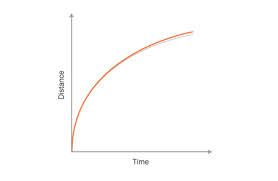
What is this graph showing?
a)
Constant Speed
b)
Acceleration (speeding up)
c)
Deceleration (slowing down)
d)
No motion
11.
Which graph shows the object standing still?
a)
A
b)
B
c)
C
d)
D
12.
Which graph represents zero acceleration (constant velocity)?
a)
A
b)
B
c)
C
d)
D
13.

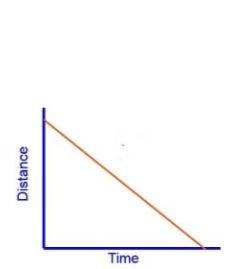
What is the line on this graph showing?

a)

moving away from starting point at a constant speed

b)

moving back towards the starting point at a constant speed

c)

acceleration (getting faster)

d)

deceleration (getting slower)

14.

What is this line of this graph showing?

a)

moving away from starting point at a constant speed

b)

moving back towards the starting point at a constant speed

c)

acceleration (getting faster)

d)

deceleration (getting slower)

15.
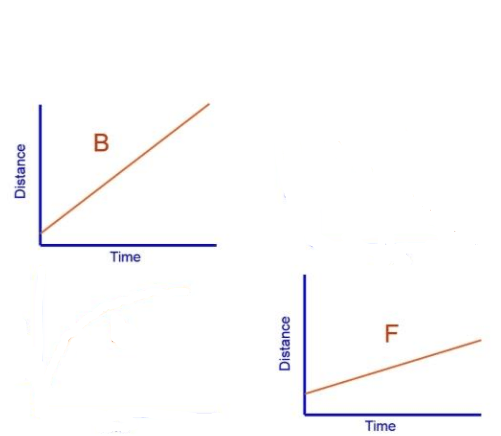
Which graph is showing a faster constant speed?
a)
B
b)
F
c)
They show the same speed
16.
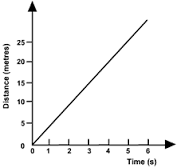
How long did it take this object to travel 10 m?
a)
0 s
b)
10 s
c)
15 s
d)
20 s
17.
At 60 seconds, how far had this object traveled? 
a)
0 m
b)
10 m
c)
20 m
d)
40 m
18.
Acceleration is
a)
increasing speed
b)
decreasing speed
c)
changing direction
d)
all of the above
19.

What is happening between 3 seconds and 4 seconds?

a)

The object is moving in a negative direction.

b)

The object is returning to its starting position.

c)

The object is slowing to a stop.

d)

The object is changing direction.

20.
Which runner had a head start?
a)
A
b)
B
c)
C
21.
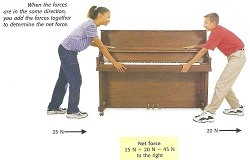
What is the net force?
a)
5 N
b)
45 N to the left
c)
5 N to the right
d)
45 N to the right
22.
What is a force?
a)
the PUSH or PULL on an object 
b)
The MOTION an object creates
c)
The objects HITTING one another
d)
Going REALLY FAST
23.
If there are two forces going in the SAME direction, you would ...?
a)
(-) Subtract the forces
b)
(+) Add the forces
c)
Neither
d)
(x) Multiply
24.

In referring to how much matter a body contains, we use the term:

a)

Volume

b)

Weight

c)

Mass

25.
Name the missing force....
a)
weight force
b)
normal force
c)
frictional force
d)
tension force
26.

Which is an example of the law of inertia?

a)

A rocket taking off from Earth

b)

A crash test dummy flies through the windshield in a collision

c)

A small rock skips on a pond faster than a large rock

27.

Which is an example of the law of action/reaction?

a)

A rocket taking off from Earth

b)

A crash test dummy flies through the windshield in a collision

c)

A small rock skips a pond faster than a large rock

28.
Newton's third law states that any action will have a(n) _______ and ______ reaction
a)
Equal and similar
b)
Equal and opposite
c)
Equal and different
d)
Greater and opposite
29.
It takes more force to accelerate the iron man on the left than the iron man on the right because the iron man on the left has more mass. This best describes
a)
Newton's first law, the law of inertia
b)
Newton's second law, the law of acceleration
c)
Newton's third law, the law of action reaction 
d)
The law of universal gravitation
30.
One object has twice as much mass as another object. The first object also has also twice as much...
a)
velocity
b)
gravitational acceleration
c)
inertia
d)
all of these
31.

We wear seat belts in cars because _________ will cause us to move forward in a crash.

a)

mass

b)

speed

c)

inertia

32.

An object in motion will stay in motion unless acted upon by ____________

a)

a wall

b)

friction

c)

air resistance

d)

all of the above

33.

The more mass an object has, the _______ force it takes to accelerate it.

a)

more

b)

less

34.
What is the tendency of an object to resist a change in motion?
a)
coffee
b)
motion
c)
inertia
d)
gravity
35.

An archer pulls the bowstring back, then releases the string and the arrow flies forward. Pulling the string back is the...

a)

action force

b)

reaction force

c)

net force

d)

inertia

36.
What is the magnitude (size) and direction of the net force?
a)
15 N to the left
b)
15 N to the right
c)
1 N to the left
d)
1 N to the right
37.
According to Newton's second law, if you increase the force applied to an object :
a)
it accelerates more
b)
it doesn't move
c)
you get more inertia
d)
it decelerates
38.

The head of a hammer is often made of steel. This makes the head heavy, which helps create a strong force for driving nails. Steel is also strong. The head of a hammer must be strong to resist what force?

a)

The force of the air resistance on the moving hammer

b)

The force of the person using the hammer

c)

The force of gravity pulling down on the hammer

d)

The force of the nail pushing in the opposite direction

39.

Students are investigating how mass affects the force needed to move an object. They attached a wooden block to a spring scale and placed a 10 g mass on top of the block and pulled it 50 cm across the table. Which of the following changes to their set-up would result in a larger force reading on the spring scale?

a)

Sliding the block 60 cm

b)

Attaching a larger spring scale

c)

Using a 20g mass

d)

Using a circular piece of wood

40.

Using what you know about F=ma, which ball would have the greater force if traveling at the same acceleration? Tennis ball=1 ounce and the baseball=5 ounces

a)
b)
41.

An object's inertia depends on its mass.

a)

true

b)

false

42.
Pushing  a child on a swing is easier than pushing an adult on the same swing. 
a)
1st Law 
b)
2nd Law
c)
3rd Law 
43.
A wheeled cart is moving to the right at a constant speed.  Two forces of equal magnitude are acting upon the cart. Which of the following best describes the forces and motion of the cart?
a)
Balanced Forces, Constant Speed
b)
Balanced Forces, Acceleration
c)
Unbalanced Forces, Constant Speed
d)
Unbalanced Forces, Acceleration
44.
What is the net force?
a)
40 N left
b)
0 N Balalnced
c)
400 N right
d)
40 N right
45.
Which answer choice best explains why tractor trailers take more time to speed up & slow down than regular cars?
a)
Tractor trailers have less mass and require less force to move.
b)
Tractor trailers have more mass and require more force to move.
c)
Tractor trailers have less mass and require more force to move.
d)
Tractor trailers have more mass and require less force to move. 
46.
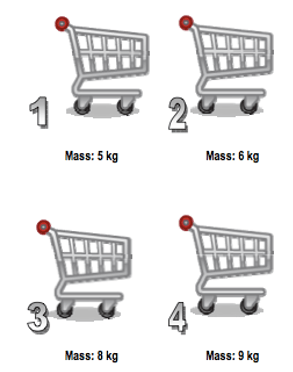
A force of 90N is applied to each cart below, which one will accelerate the fastest?
a)
Cart 1
b)
Cart 2
c)
Cart 3 
d)
Cart 4
47.
This person bought coffee and put it on the seat next to them. If they stopped quickly and the coffee spilled which law would that represent?
a)
Newton's 1st Law
b)
Newton's 2nd Law
c)
Newton's 3rd Law
48.
When you step on a Lego. You push on the Lego and the Lego pushes back on you.
a)
Newton's 1st Law
b)
Newton's 2nd Law
c)
Newton's 3rd Law
49.
Force and acceleration are _______________ proportional
a)
Inversely
b)
Directly
c)
Not
d)
Almost
50.
Mass and acceleration are _________________ proportional.
a)
Directly
b)
Not
c)
Inversely
d)
Somewhat