
 Worksheets
ES Weather and Climate
Total questions: 55
Worksheet time: 42mins
Which organism is most likely to experience the early negative effects of global warming?
a tree frog living in the Amazon jungle
a snake living in the desert in Africa
phytoplankton drifting in ocean currents
a polar bear living on ice in the Arctic
Most scientists believe that one factor contributing to global warming is ________.
the changing tilt of Earth's axis
changes in Earth's orbit around the sun
increased sunspot activity
the burning of fossil fuels
In winter, cold dry air blows from west to east over the Great Lakes. This causes heavy snows to fall__________.
on the lakes
on the east side of the lakes
on the west side of the lakes
all around the lakes
Most of the United States is located in which climate zone?
temperate
polar
tropical
humid
Which biome is characterized by significant precipitation and contains more than 50 percent of all the species on Earth?
deciduous forest
tropical rain forest
taiga
temperate grassland
Which of the following atmospheric components is beneficial to humans at higher altitudes, but dangerous near ground level?
carbon dioxide
sulfuric acid
oxygen
ozone
Which of the following correctly describes the greenhouse effect?
Air temperatures increase due to increased amounts of carbon dioxide in the atmosphere.
Earth's atmosphere heats naturally when solar radiation is absorbed.
Air pollution causes the release of greenhouse gases into the atmosphere.
The greenhouse effect and global warming are the same processes.
What would you expect to happen to the air pressure as a storm approaches?
It would increase.
It would decrease.
It would remain steady.
It would increase and decrease wildly.
When a mass of air is cooling, what will happen when the air temperature reaches the dew point?
The skies will clear up.
It will always start to rain or snow.
Puddles of water will evaporate.
Water vapor in the air will begin to condense.
What must the relative humidity be if it is foggy outside?
0 percent
50 percent
90 percent
100 percent

How does groundwater get back into the water cycle?
It flows to a lower level and into a stream
It is drawn out by low pressure air masses.
It evaporates directly into the air.
It never returns to become part of the water cycle unless humans pump it out..

Where is groundwater found?
on the surface of Earth
in underground rock
in the top layer of soil
in ponds, lakes, and rivers
Where do hurricanes form?
in the arctic region
in the temperate regions
close to the polar regions
in the tropical regions
Most tropical storms develop_________.
in the polar regions
over land
over the ocean near the equator
along the edges of tectonic plates
Which of the following is NOT believed to produce long-term climate change?
changes in Earth's orbit around the sun
changes in the tilt of Earth's axis
movement of the continents
dust storms
Identify the true statement regarding Earth's seasons.
Seasons are caused by the sun's cycle of heating and cooling.
Seasons are caused by the tilt of Earth's axis.
Seasons change because Earth gets closer to the sun at certain times of year.
Seasons are caused by the shape of the orbit of Earth.
In which layer of the atmosphere do most clouds form?
troposphere
They form in all layers.
stratosphere
mesosphere
As a front passes through your area, thunderstorms occur, winds shift from southeast to northwest, and the temperature changes from 85 to 65 degrees F. What kind of front was this?
cold front
warm front
stationary front
occluded front
An El Niño is caused when winds shift and push warm surface water toward the west coast of South America. The warm water replaces the cold water that usually rises from the deep ocean near the coast. When an El Niño occurs, what effect does it have on weather patterns?
It sets off a series of events that can influence weather around the world.
It only affects the weather in South America.
It only affects the weather over the ocean along the coast.
It has very little to no effect on weather patterns anywhere.
How do rain droplets form?
evaporation of water vapor
condensation of water vapor
transpiration of water vapor
respiration of water vapor
Raindrops that freeze before striking the ground are called _________.
sleet
freezing rain
snow
drizzle
A weather map is often used to illustrate the boundary that separates warmer and cooler air. What is this boundary called?
a thermal line
a conduction line
the jet stream
a front
What is the effect of the unequal heating of Earth's surface?
wind
ocean tides
the greenhouse effect
the Coriolis effect
If there is a period of many sunspots, which is NOT a possible effect?
Earth will emit less radiation.
More sunlight will be emitted.
The warming of Earth will release heat into space.
The climate will warm as greenhouse gases absorb more radiation.
An explosive volcano can affect Earth’s climate. Which of the following is the correct order of effects of an explosive volcano?
Less light reaches land and oceans; Earth’s climate cools; there is an increased amount of reflected sun.
There is an increased amount of reflected sun; less light reaches land and oceans; Earth’s climate cools.
There is an increased amount of reflected sun; Earth’s climate cools; less light reaches land and oceans.
Earth’s climate cools; less light reaches land and oceans; there is an increased amount of reflected sun.
How would Earth be different without the presence of greenhouse gases within the atmosphere?
Earth would be more dangerous without greenhouse gases because greenhouse gases block UV radiation from the sun.
Earth would be much warmer without greenhouse gases because greenhouse gases absorb the sun's energy and prevent it from reaching Earth.
Earth would be much colder without greenhouse gases because greenhouse gases trap and reradiate heat energy back toward Earth.
Earth would be the same because greenhouse gases in the atmosphere don't have any impact on the conditions on Earth.
What gas is necessary for humans to breathe? What percentage of Earth's atmosphere does this gas constitute?
nitrogen, 21%
nitrogen, 78%
oxygen, 78%
oxygen, 21%
Within which atmospheric layer is the highest concentration of ozone found?
the troposphere
the exosphere
the thermosphere
the stratosphere
List the layers of Earth's atmosphere in order of increasing altitude.
exosphere, thermosphere, mesosphere, stratosphere, troposphere
troposphere, stratosphere, mesosphere, thermosphere, exosphere
troposphere, stratosphere, ozone layer, mesosphere, thermosphere, exosphere
stratosphere, mesosphere, thermosphere, exosphere, troposphere
The physical features of the land in a region make up its __________.
climatology
topography
meteorology
biology
What would you expect to happen to the air pressure as a storm approaches?
It would increase.
It would decrease.
It would remain steady.
It would increase and decrease wildly.
How much of the water that evaporates from a salty ocean is fresh water?
100 percent
none—ocean water is very salty
about 10 percent
about 70 percent
As a front passes through your area, thunderstorms occur, winds shift from southeast to northwest, and the temperature changes from 85 to 65 degrees F. What kind of front was this?
cold front
warm front
stationary front
occluded front
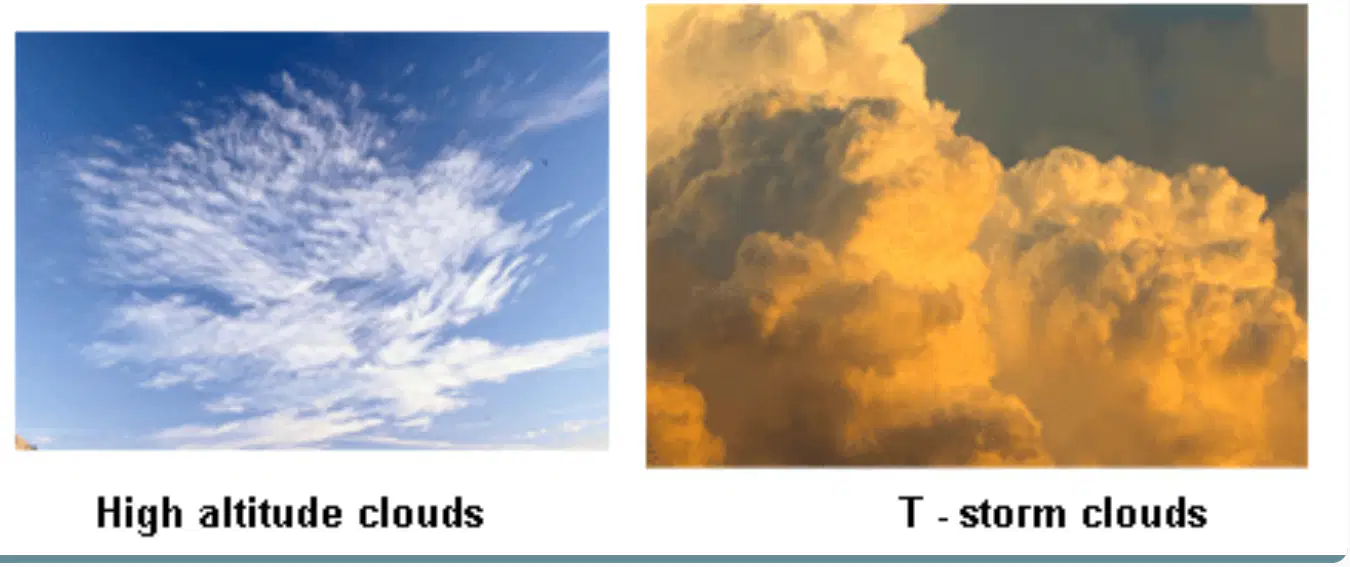
Identify the type of clouds that usually produce thunderstorms.
cirrus clouds
lenticular clouds
cumulonimbus clouds
cumulus clouds
An El Niño is caused when winds shift and push warm surface water toward the west coast of South America. The warm water replaces the cold water that usually rises from the deep ocean near the coast. When an El Niño occurs, what effect does it have on weather patterns?
It sets off a series of events that can influence weather around the world.
It only affects the weather in South America.
It only affects the weather over the ocean along the coast.
It has very little to no effect on weather patterns anywhere.
Why is the air close to the ground much warmer than the air at higher elevations?
There is less ice in the lower atmosphere.
Heat from volcanoes warms the lower atmosphere.
There is less wind close to the ground.
Terrestrial radiation warms the lower atmosphere.
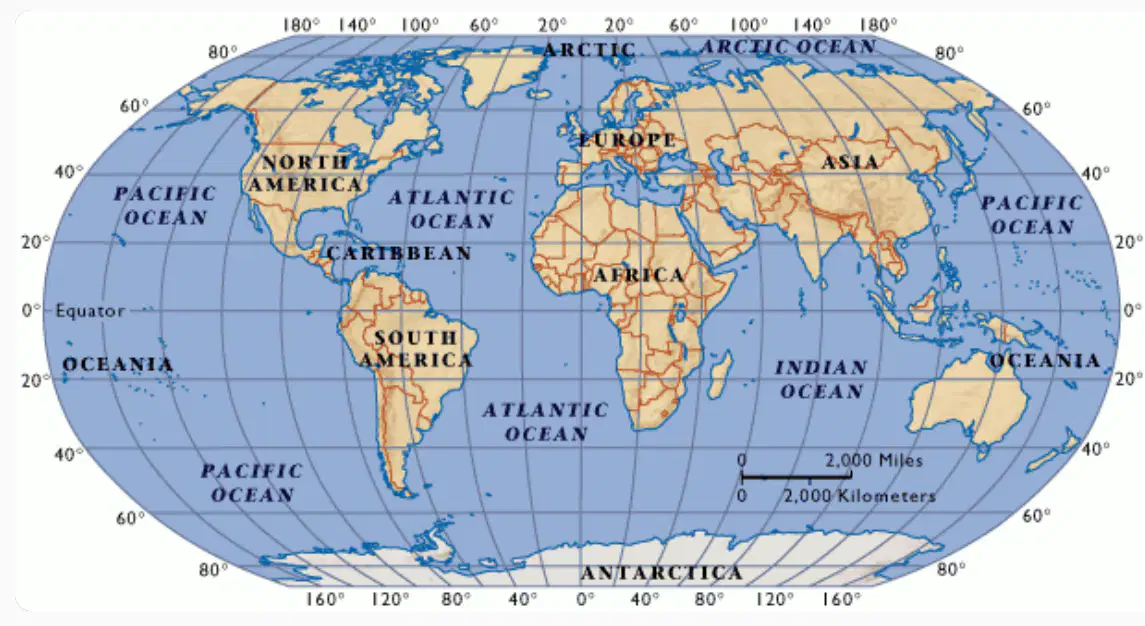
Why are regions near Earth's equator always warmer than the polar regions?
Equatorial regions receive less intense sunlight.
Equatorial regions have fewer clouds.
Equatorial regions receive more intense sunlight.
Equatorial regions have more clouds.
The seafloor is characterized as _____________.
flat
deeper and flatter farther in the sea
having hills and valleys
shallow along the shore and flat deeper in the sea
What is the major difference between a small meteorite impact and a large meteorite impact on Earth?
Small meteorite impacts do not create a crater, but large meteorite impacts do.
Small meteorites create a massive reflective dust cloud, but large meteorites do not.
Small meteorites have a long-term effect on Earth’s climate, while large meteorites have a short-term effect on Earth’s climate.
Small meteorites have little effect on Earth’s climate, but large meteorites have a dramatic effect
Which set of factors would be most important in predicting the destructive power of a meteorite impact?
the direction, size, color, and temperature of the meteorite
the shape, mass, origin, and density of the meteorite
the speed, size, mass, and composition of the meteorite
the age, composition, amount of spin, and speed of the meteorite
An explosive volcano can affect Earth’s climate. Which of the following is the correct order of effects of an explosive volcano?
Less light reaches land and oceans; Earth’s climate cools; there is an increased amount of reflected sun.
There is an increased amount of reflected sun; less light reaches land and oceans; Earth’s climate cools.
There is an increased amount of reflected sun; Earth’s climate cools; less light reaches land and oceans.
Earth’s climate cools; less light reaches land and oceans; there is an increased amount of reflected sun.
Which is NOT a factor affecting short-term climate change?
the creation of rain shadows by mountains
the amount of radiation that is emitted by the sun
the amount of radiation that reaches Earth’s surface
the transportation of heat around the globe by oceans
Which data would be useful to collect to predict the effects of a volcanic eruption on nearby plant life?
the latitude and longitude of the volcano
the amount of light that passes through the volcanic plume
the temperature of the magma inside the volcano
the distance from the volcano from which the sound of the eruption was reported
Which one of these events is most likely to have a significant impact on world climate?
an earthquake
a hurricane
a volcanic eruption
a tsunami
A student in Earth science class stated that large volcanic eruptions can have a cooling and warming effect on the climate. Which of the following provides evidence of this?
The ash blocks the sun’s radiation, and the carbon dioxide released is a greenhouse gas.
The carbon dioxide blocks the sun’s radiation, and the sulfur dioxide absorbs radiation.
The ash blocks the sun’s radiation, and the sulfur dioxide absorbs the radiation.
The carbon dioxide blocks the sun’s radiation, and the ash absorbs the radiation.
Maria says that catastrophes can cause short term climate change. Which evidence supports her claim?
Hurricanes that strike the Gulf Coast cause widespread flooding.
When large sections of icebergs break off and fall into the ocean, more fresh water enters the world's oceans.
Air temperatures cool after the eruption of a major volcano.
Earthquakes sometimes cause major structural damage of buildings.
Michael said to his friends "Pollution and deforestation have no effect on Earth's climate." Which is the most accurate critique of Michael's statement?
Michael is correct. Pollution and deforestation have no effect on Earth's climate.
Michael should be saying something about trash and smoke affecting Earth's climate.
It would be better if Michael talked about the effect of hurricanes and volcanoes on Earth's climate.
Michael would be more accurate to say "Pollution and deforestation are probably contributing to a change in Earth's climate."
Increased levels of carbon dioxide in the atmosphere in the past century is causing ______.
acid rain
ozone depletion
global warming
smog
Global warming occurs because carbon dioxide _________.
traps heat in the atmosphere
reflects sunlight
is a hot gas
destroys ozone
Most scientists believe that one factor contributing to global warming is ________.
the changing tilt of Earth's axis
changes in Earth's orbit around the sun
increased sunspot activity
the burning of fossil fuels
What is the relationship between altitude and air density within Earth's atmosphere?
As altitude increases, air density decreases.
As altitude increases, air density increases.
As altitude increases, air density remains the same.
There is no relationship between altitude and air density within Earth's atmosphere.
How would Earth be different without the presence of greenhouse gases within the atmosphere?
Earth would be more dangerous without greenhouse gases because greenhouse gases block UV radiation from the sun.
Earth would be much warmer without greenhouse gases because greenhouse gases absorb the sun's energy and prevent it from reaching Earth.
Earth would be much colder without greenhouse gases because greenhouse gases trap and reradiate heat energy back toward Earth.
Earth would be the same because greenhouse gases in the atmosphere don't have any impact on the conditions on Earth.
Which of the following is the only list representing natural components of the atmosphere?
dust, argon, and smog
pollen, oxygen, and carbon dioxide
pollen, sulfuric acids, smog
dust, oxygen, and sulfuric acids
Which of the following atmospheric components is beneficial to humans at higher altitudes, but dangerous near ground level?
carbon dioxide
sulfuric acid
oxygen
ozone
How are the components of air related to the water cycle?
Dust and sand absorb moisture in the air.
Nitrogen and oxygen are taken out of the air by rain.
Water vapor in the air condenses and falls as rain.
Ozone helps clouds remain high in the atmosphere.

