
 Worksheets
Continental Drift & Plate Tectonics
Total questions: 60
Worksheet time: 41mins

What is this a picture of?
Plate Tectonics
Continental Drift
Pangaea
Ocean Crust
Another piece of evidence in the theory of Continental Drift is __________ evidence of a giant fern named Glossopteris.
geologic
fit/shape
glacial
fossil/climate
Because Glossopteris seeds cannot travel across the ocean and grow in warm, swampy climates, these fossils are evidence of ...
Pangea existing
Continental Drift
changing climates
all of the above

Wegner used the following as pieces of evidence...
fit/shape of continents
geologic and fossil
climate
all of the above

Earthquakes are most common around plate boundaries.
True
False
Rocks and structures on both sides of the ____________ Ocean are very similar.
Pacific
Atlantic
Indian
Arctic

What type of evidence was NOT used by Alfred Wegener to support his continental drift hypothesis?
evidence from landforms
evidence from fossils
evidence from human remains
evidence from climate

When we observe the same reptile fossil in two places, we infer ___.
The reptile flew to a new habitat.
The habitats used to be near each other.
Someone buried the fossils in a new place to trick us.

When I observe that the green lizard fossil is on many continents, I infer ____.
The lizard can fly.
The continents moved.
Someone is trying to trick us.
When a continent moves, we call it ____.
Tectonics
Drift
Transfer
True or False: The continents have always been in the same place they are today.
True
False
True or False: Scientists predict that the continents will keep drifting in the future.
True
False
What was Wegener’s continental drift idea?
The continents have moved slowly apart to their current locations.
The continents have always been located at their current locations.
The continents are moving slowly together from their current locations.
None of these
True or False-Similar fossil records across continents was evidence for continental drift.
True
False
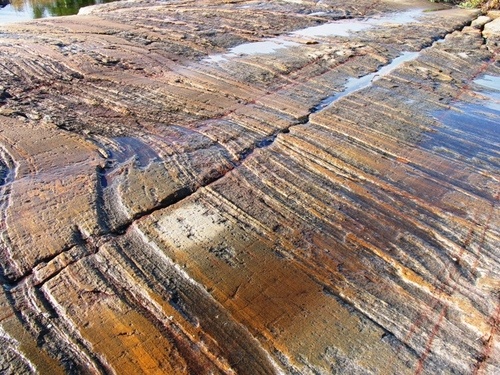

What does the theory of continental drift state?
The continents were once joined in a super-continent and have moved over time
Continents are stationary and do not move
The Earth is broken into lithospheric plates that move due to convection currents
none of the above

Wegener observed scratches from glaciers in Africa and India where it is currently too hot for glaciers to form. This is considered...
Fossil Evidence
Rock Formation Evidence
Climate Evidence
Objective Evidence
_______ are mountain chains on the ocean floor.
Sea-floor ridges
Mid-ocean ridges
Tectonic plates
Photosynthesis

___________ is the process by which
new oceanic lithosphere (sea floor) forms as magma rises to Earth’s surface and solidifies at a mid-ocean ridge.
Continental drift
Sea-floor spreading
Plate tectonics
Mid-ocean range
___________ is the hypothesis that states that the continents once formed a single landmass, broke up, and drifted to their present locations.
Continental drift
Sea-floor spreading
Plate tectonics
Mid-ocean range
Most geologists think that the movement of Earth's plates is caused by __________________.
conduction
earthquakes
convection currents in the mantle
Earth's magnetic field
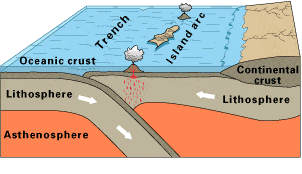
Observe this diagram of a plate boundary. One statement BEST describes what is happening. It is that
the oceanic crust is melting.
the denser ceanic crust is subducting under the less dense oceanic crust
volcanic islands are forming.
the tectonic plates are moving away from each other.

An _________ is a natural phenomenon when the Earth’s surface suddenly shakes or trembles.
fault
earthquake
plate
When two plates slide past each other, they create a _________.
fault
flood
fire
The vibration of Earth produced by the rapid release of energy within the lithosphere
Earthquake
Tsunami
Any of the many processes (such as eruptions or lava flows) in which gas, lava, and ash are pushed out on the surface of Earth
volcanic activity
eruption
geyser
earthquake
A natural spring that sends hot water and steam suddenly into the air from a hole in the ground
geyser
volcano
landform
mid-ocean rift

What type of island is pictured here?
Coral atoll
Coral island / raised coral island
Volcanic island
Continental island

The area outlining the Pacific is nicknamed the "Ring of Fire" because...
the Sun heats up these outer areas.
there are burning forest fires in the areas.
of the high volcanic activity in these regions.
the earthquakes cause damage and fire.


The ___________ Trench is the lowest point on Earth and has been created by converging oceanic plates.
Marshallese
Macedonia
Mariana
Marquesas
Which Newton's Law best describes this statement, for every action there is an equal and opposite reaction?
Newton's 1st Law
Newton's 2nd Law
Newton's 3rd Law

How is this an example of Newton's 3rd Law?
Only the ball is applying force to the soccer player's head.
Only the soccer player's head is applying force to the ball.
An equal force are being applied by the ball and the soccer player's head on each other.
Newton's 3rd Law of Motion states...
An object at rest will remain at rest unless acted upon by an outside force and causes a change in motion
Force is equal to the mass and acceleration of an object.
For every action there is an equal and opposite reaction.
An object in motion will remain in motion at a constant speed and same direction unless an unbalanced force causes a change in motion.
Which law best describes the following statement: when a tennis ball hits the ground, then bounces back up into your hand.
Law of Inertia
Law of Acceleration
Law of Action-Reaction

A person steps out of the boat and onto the dock. As the person moves forward onto the dock, the boat moves backward. Which statement best describes the backward motion of the boat as the person steps forward?
For every action there is an equal and opposite reaction.
Every mass exerts a force on every other mass.
An object at rest tends to stay at rest.
Friction opposes the motion of an object.
The rocket engines ignite and push the gases downward, what is the movement of the rocket?
The rocket moves upward
Mass of the rocket decreases
The gases cause a reduction in air resistance
The rocket moves downward
The nozzle of a rocket is pointed downward so that as fuel is ignited, the exhaust pushes downward. Why is this arrangement necessary for a rocket to function properly?
The rocket is protected from the heat of the exhaust.
Burned fuel can be collected on the ground.
As fuel is combusted, the rocket pushes the gases backward and the gases push the rocket forward.
This allows the rocket to be steered properly.
Which is an example of the law of action/reaction?
A rocket taking off from Earth
A crash test dummy flies through the windshield in a collision
A small rock skips a pond faster than a large rock
What is another name for Newton’s 3rd law?
Law of Inertia
Law of Acceleration
Law of Action/Reaction

