
 Worksheets
Unit 2 EARTH review
Total questions: 55
Worksheet time: 2hrs 50mins
Which test of minerals tells the hardness on the MOHS scale?
streak
luster
scratch
acidity
What is the Ring of Fire?
an area where there are many faults due to transforming boundaries along all 7 major plates
an area where the North American and Eurasian plates collide and create mountains
an area of many forest fires due to explosions
an area around the Pacific Plate where there are many volcanoes and earthquakes
Which layer of the atmosphere do we live in?
Troposphere
Mesosphere
Thermosphere
Stratosphere
Which layer of the atmosphere protects living things from the sun's UV radiation?
Troposphere
Mesosphere
Thermosphere
Stratosphere
In which atmospheric layer does weather occur?
Exosphere
Troposphere
Mesosphere
Stratosphere
Which elemental gas makes up around 80% of the Earth's atmosphere?
Hydrogen
Nitrogen
Oxygen
Helium
Which atmospheric layer contains the ozone layer?
Stratosphere
Troposphere
Mesosphere
Exosphere
The hottest layer of the atmosphere:
Troposphere
Stratosphere
Mesosphere
Thermosphere
What is the 2nd most abundant (occurs in large amounts) gas in the atmosphere?
Oxygen
Carbon Dioxide
Neon
Helium
What is the LEAST DENSE layer of the atmosphere?
exosphere
troposphere
thermosphere
stratosphere
What order of atmospheric layers are you listing with the phrase "Exit The Mall Safely On Tuesdays"?
from outer space to where I am
from where I am to outer space
from where I see the exit sign in the mall
from how much oxygen is in the atmosphere
Going from outer space towards Stiles, what is the 2nd layer of the atmosphere called?
thermosphere
troposphere
stratosphere
mesosphere

Name this boundary type
Convergent collisional
Divergent
Transform
Subduction


What type of boundary creates trenches?
transform
divergent
convergent subduction
convergent
What boundary is where two plates collide into each other?
convergent boundary
divergent boundary
transform boundary
accidental boundary
A divergent boundary is a boundary between two plates that ____
move toward each other
undergo subduction
move away from each other
slide along each other
What geologic process formed the Himalayan Mountains?
two continental plates converging or colliding
an earthquake in a subduction zone
a tectonic plate moving over a hot spot
movement at a transform fault boundary

The Mid Atlantic Ridge was formed from what type of plate boundary movement?
transform
divergent
convergent
convergent subduction
Transform boundaries are most likely to produce what geological feature and phenomenon?
volcanoes
deep sea trenches
underwater mountain ranges
faults and earthquakes
What process is responsible for Earth's plates moving?
convection currents in the outer core
convection currents in the inner core
convection currents in the mantle
conduction currents in the lithosphere

Number 3 refers to what tectonic plate?
North American Plate
African Plate
Eurasian Plate
Pacific Plate

Number 12 refers to what tectonic plate?
South American
North American
African
Indo-Australian

Number 13 refers to what tectonic plate?
South American
Australian
Pacific
African

Eurasian
Indo-Australian
Antarctic
Pacific
The layer of the Earth that is a solid made of iron and nickel is...
Outer Core
Lithosphere
Inner Core
Mantle
Atmosphere
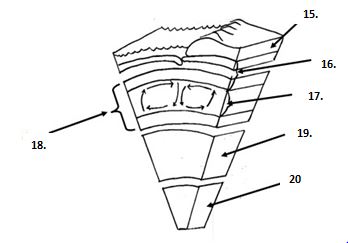
Identify layer #18.
mantle
asthenosphere
inner core
outer core
How do scientists know about the composition of the layers of the Earth?
by studying earthquakes (seismic waves)
by studying meteors
by studying weather
by studying radio waves
True or False: The most abundant elements in the Earth's crust are aluminum, silicon and oxygen.
True
False
The layer of the mantle that is responsible for convection currents is the
lithosphere
asthenosphere
core
mesosphere
This layer of the Earth is made up of soft solid rock that flows in convection currents.
The asthenosphere is part of which compositional layer?
Inner core
Outer Core
Mantle
Crust
The liquid layer of the Earth is the
Asthenosphere
Inner Core
Outer Core
Lithosphere
Identify layer #19.
mantle
asthenosphere
inner core
outer core
What happens to the density of the atmosphere as you move up toward the exosphere?
density increases
density decreases
density stays the same
density disappears
How would you describe the consistency of the asthenosphere?
Jelly or Putty like
Watery
Brittle
Rough
Deposition
Erosion
Weathering
Cementation
Type of rock that forms when minerals form from solutions or sediment from older rocks get pressed and cemented together.
Sedimentary Rock
Metamorphic Rock
Igneous Rock
Magma
Rock that forms when pressure and heat are applied and change a rock
Igneous Rock
Sedimentary Rock
Metamorphic Rock
Sediments
The process by which igneous rocks are formed...
heat and pressure
cooling of magma
compaction and cementation
weathering and erosion
The name for pieces of rock that have been broken down into smaller pieces.
magma
metamorphic
sediment
igneous
What does it mean for a rock to be extrusive?
Has layers
Formed from magma below ground
Formed from lava above ground
Form by sediment being compacted
True or False: Igneous rocks form DIRECTLY from sediment.
True
False
The process by which sediment is moved from one place to another
Weathering
Uplift
Deposition
Erosion

This rock cooled on the outside of a volcano and contained air bubbles when it was forming. What type of rock is this?
Sedimentary
Extrusive Igneous
Metamorphic
Intrusive Igneous
What is the difference between INTRUSIVE and EXTRUSIVE igneous rocks?
Intrusive forms from magma outside of the Earth, extrusive forms from magma inside the Earth.
Intrusive forms from lava outside the Earth, Extrusive forms from magma inside the Earth.
Intrusive forms from lava inside the mantle, extrusive forms from lava inside the moon.
Intrusive forms from magma inside the Earth, extrusive forms from lava outside of the Earth.

