
 Worksheets
6th EOY Review
Total questions: 50
Worksheet time: 32mins
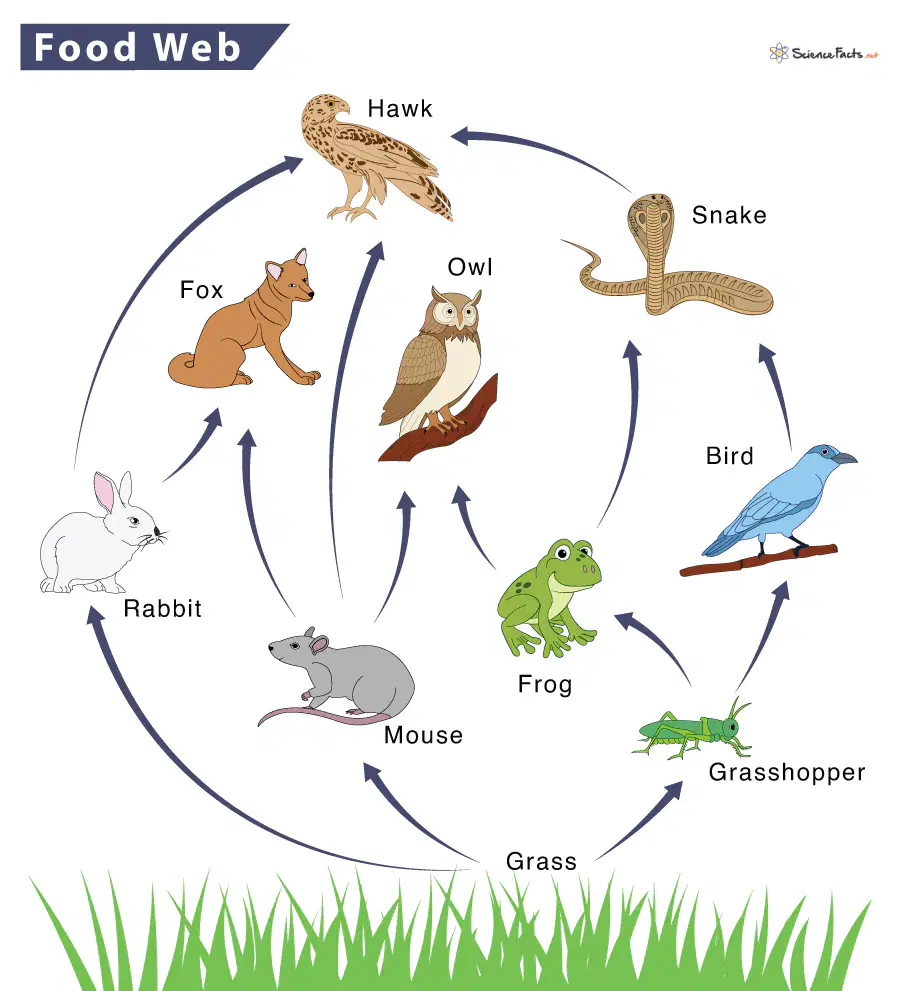
Based on the food web, which animal gets most of its energy from grass?
hawk
bird
mouse
frog
Why are producers important to food webs?
They are the largest organisms in the ecosystem.
They are the smallest organisms in the ecosystem.
They use the sun′s energy to complete photosynthesis and transfer the energy to consumers.
They use the sun′s energy to grow, and block out the sunlight for consumers and decomposers.
How would a lack of water most likely affect grass growing in a grassland?
The grass blades would grow taller.
More grass seeds would be produced.
Fewer grass seeds would be produced.
The grass blades would become greener.
Which statement best explains why a deciduous forest biome has more vegetation than a desert biome?
The deciduous forest has richer soil.
The deciduous forest receives less rainfall.
The deciduous forest receives less sunlight.
The deciduous forest has cooler temperatures.
Which structures on a flowering plant are involved with fertilization during reproduction?
pistil, petal, roots
leaf, ovary, anther
anther, stalk, petal
ovary, anther, pistil
Which is the best example of tropism in plants?
roots growing toward water in the soil
pollen fertilizing the ovules to create seeds
water moving through vascular tissue in the stem of a plant
carbon dioxide being released from the stomata
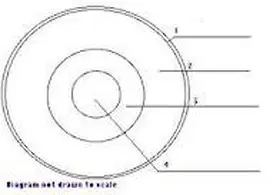
Which part of the diagram represents the mantle?
1
2
3
4
Which statement best explains the relationship between Earth’s outer core and inner core?
The outer core is less dense and closer to Earth’s surface than the inner core.
The outer core is more dense and closer to Earth’s surface than the inner core.
The outer core is less dense and farther from Earth’s surface than the inner core.
The outer core is more dense and farther from Earth’s surface than the inner core.
Where do most of Earth′s earthquakes occur?
in the desert
along the coastline
along plate boundaries
in the center of continents
Which is the starting material of soil?
organic matter
parent rock
debris
silt
Which processes most contribute to soil formation?
heating and cooling
melting and pressure
weathering and erosion
compaction and cementation
How are the sun, Earth, and moon positioned during a solar eclipse?
The sun, Earth, and moon are lined up with Earth in the middle.
The sun, Earth, and moon are lined up with the sun in the middle.
The sun, Earth, and moon are lined up with the moon in the middle.
The sun, Earth, and moon are not lined but form a 90° angle.
When the Earth, Moon, and Sun are lined up in a straight line, what effect does this arrangement have on the tidal range?
The tide is larger than normal because the gravitational forces of the sun and moon pull in the same direction.
The tide is larger than normal because the gravitational forces of the sun and moon pull in opposite directions.
The tide is smaller than normal because the gravitational forces of the sun and moon pull in the same direction.
The tide is smaller than normal because the gravitational forces of the sun and moon pull in opposite directions.
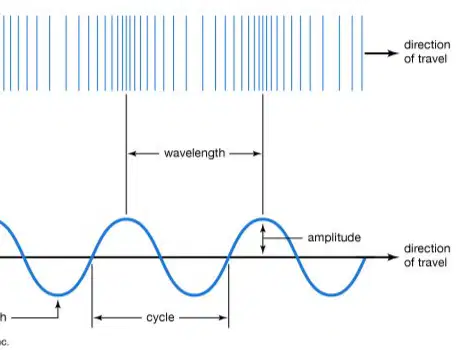
Which statement best compares the two waves?
Both waves are transverse waves.
Both waves are transverse waves.
The top wave is a transverse wave and the bottom is a longitudinal wave.
The top wave is a longitudinal wave while the bottom wave is a transverse wave.
Why does grass appear green?
Green light waves, along with all other colors, are reflected off the grass.
Green light waves are absorbed by the grass, while all other colors are reflected.
Green light waves are reflected off the grass, while all other colors are absorbed.
Green light waves, along with all other colors, are absorbed by the grass.
Which material should an electric company use for power lines to ensure that the electricity travels efficiently?
rubber, because its thickness can be controlled
copper, because it is an insulator
copper, because it is a conductor
rubber, because it can expand and contract
Which phase change causes an increase in the motion of atoms?
liquid to solid
gas to liquid
liquid to gas
gas to solid
How do the rotation and distance of Earth from the sun support life?
by creating water needed for life
by providing humans with oxygen for life
by providing energy and temperatures needed for life
by creating gravity to hold life on Earth
As planets revolve around distant stars, they block some of the light from reaching the Kepler space telescope. The telescope measures changes in the brightness of stars as planets move in front of them. How has the Kepler telescope improved our understanding of the universe?
It has aided in the discovery of planets outside the solar system.
It has aided in the discovery of planets inside the solar system.
It has aided in the discovery of life outside the solar system.
It has aided in the discovery of life inside the solar system.
Why is the distance between Earth and the sun most important?
The distance prevents solar flares from reaching Earth’s atmosphere.
The distance is the source of Earth’s magnetic field.
The distance causes the different seasons on Earth.
The distance contributes to Earth’s ability to support life.
Where would the Hubble Telescope be found?
on a mountain
in a desert
in the ocean
in space
How does repeated use of a field most likely affect the soil over time?
Soil particle size increases.
Soil nutrients become depleted
Soil converts from thick clay to loose sand
Soil becomes moister and its temperature increases.
Why do sound waves travel faster through a solid than through a gas?
The atoms in a gas are closer together than in a solid.
The atoms in a solid are closer together than in a gas.
A gas has more mass than a solid.
A solid has more mass than a gas.
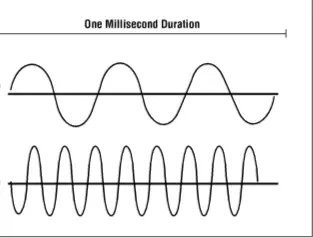
Which statement best explains how the top wave compares with the bottom wave?
The top wave has a louder sound.
The top wave has a softer sound.
The top wave has a higher pitch.
The top wave has a lower pitch.
Which example demonstrates positive tropism?
A flowering plant, sitting on a table, is unable to grow.
A flowering plant, sitting on a table, is growing straight up.
A flowering plant, sitting on a table, is growing toward an adjacent window.
A flowering plant, sitting on a table, is growing away from an adjacent window.
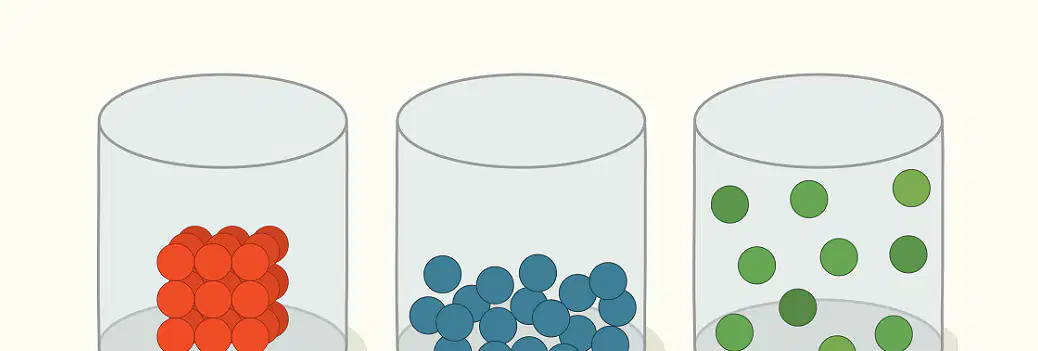
What state of matter does the first container most likely exhibit?
solid
liquid
gas
plasma

Using food web which of the following is a secondary consumer?
snake
worm
butterfy
squirrel
How are flowering plants naturally fertilized to reproduce?
Humans must rub two flowers together.
Wind or insects carry pollen from plant to plant.
Bugs move nutrients when they crawl around roots.
Pollen is deposited when water drops fall on the plant.
Which two actions occur during photosynthesis?
taking in energy and producing sugar
collecting sugar and releasing energy
moving toward light and collecting oxygen
taking in oxygen and releasing carbon dioxide
How is photosynthesis related to cellular respiration in plants?
They both use the same reactants
They both produce the same products
The products of one become the reactants of the other
They are not related to each other
Where would a volcano most likely form?
on flat land under the ocean
where two tectonic plates meet
where two different oceans meet
at the bottom of a high mountain
How are earthquake, sound, and light waves alike?
They move at the same speed through air.
They move matter from one location to another.
They move energy from one location to another.
They move faster through water than through air.
How is human eyesight related to the electromagnetic spectrum?
Human eyes can detect all parts of the spectrum.
Human eyes can only detect the visible light portion of the spectrum.
Human eyes can only detect the portions of the spectrum that have the highest frequencies
Human eyes can only detect the portions of the spectrum that have the lowest frequencies.
Which statement explains the difference between conduction and convection?
Convection occurs when solid objects touch, and conduction occurs as energy currents rise and fall in a liquid or gas.
Conduction occurs when solid objects touch, and convection occurs as energy currents rise and fall in a liquid or gas.
Convection occurs when electromagnetic waves interact, and conduction occurs when objects move through a liquid or gas.
Conduction occurs when electromagnetic waves interact, and convection occurs when objects move through a liquid or gas.
Which type of energy transfer is occurring when sunlight streams through a large window and heats up a black rug in the middle of the room?
conduction
convection
electrical
radiation
Why do highway bridges have gaps built into their surfaces?
The gaps allow the bridge to radiate more heat as it cools.
The gaps allow thermal expansion when the bridge warms and contraction when the bridge cools.
The gaps allow thermal expansion when the bridge cools and contraction when the bridge warms.
The gaps allow the bridge to radiate more heat as it warms.
Isabelle has two samples of metal with similar properties. What is the most likely reason that the two samples have similar properties?
The samples contain the same element.
The samples contain different types of atoms.
The samples are composed of different elements.
The samples have been formed into similar shapes
Which statement describes carbon atoms and oxygen atoms?
They form the same element.
They have the same properties.
The have the same properties.
They form different elements.
Which property of a substance most likely affects whether it will float or sink?
color
density
odor
temperature
Which factor would most likely increase the solubility of sugar in water?
an increase in the amount of sugar
a decrease in the amount of water
an increase in water temperature
a decrease in water temperature
Why is it important to practice soil conservation methods?
to maintain the fertility and moisture of the soil
to prevent soil erosion and keep the bedrock in place
to maintain the fertility of the soil and prevent soil erosion
to maintain the moisture of the soil and keep the bedrock in place
Which choice describes a characteristic of the visible spectrum?
can be detected by the human eye
provides energy to digest food
has a heating effect
causes sunburn
How are atoms affected when temperature decreases?
Their motion slows down and they move closer together.
Their motion speeds up and they spread farther apart.
Nothing changes.
They stop moving.
How do sound waves compare to earthquakes?
Both travel through solids.
Both travel through a vacuum.
Earthquakes travel as electromagnetic waves, while sound waves do not.
Sound waves travel as electromagnetic waves, while earthquakes do not.
Sunlight shines on a pebble. Some of the sunlight is reflected, and some is absorbed. How does the absorbed portion affect the pebble?
The pebble’s atoms will split apart.
The pebble’s atoms will join together.
The pebble’s temperature will increase.
The pebble’s temperature will decrease.
Why do plants perform transpiration?
to release energy
to release water vapor which regulates the plants temperature
to take in carbon dioxide for photosynthesis
to absorb solar energy for photosynthesis


