wayground logo

Free Printable Worksheets

NEW

Font size

S
M
L
XL
Worksheets

Ecology

Total questions: 51

Worksheet time: 1hrs 4mins

Name
Class
Date
1.
What is the original source of almost all energy in most ecosystems?
a)
carbohydrates
b)
sunlight
c)
water
d)
carbon
2.
An organism that produces its own food supply from inorganic compounds is called a(an)
a)
heterotroph
b)
consumer
c)
detritivore
d)
autotroph
3.
What is the term for each step in the transfer of energy and matter within a biological community?
a)
energy path
b)
food web
c)
trophic level
d)
food pyramid
4.
which symbiosis is this 
a)
parasitism 
b)
mutualism
c)
commensalism
d)
nonalism 
5.
symbiotic relationship in which both organisms benefit
a)
competition
b)
Mutualism
c)
nitrogen fixation
d)
energy pyramid
6.
The energy at each trophic level in the pryamid of energy decreases by a factor of ____.
a)
10
b)
1
c)
100
d)
2
7.
What does a food web represent?
a)
All connections of energy flow throughout all organisms in a habitat.
b)
The specific ways that mutualism is carried out.
c)
A single pathway or energy flow between organisms. 
d)
How carnivores get their food. 
8.
diagram that shows the energy available to each trophic level in an ecosystem; 10% is passed on to upper levels, the rest is lost as heat
a)
succession 
b)
cellular respiration
c)
energy pyramid
d)
biochemical cycle
9.
a relationship between two in which one species, the predator, feeds on the other species, the prey
a)
chemosynthesis
b)
predation
c)
cellular respiration 
d)
commensalism
10.
symbiotic relationship in which one organisms benefits and the other organism is not affected
a)
invasive (non-native) species
b)
mutualism 
c)
nitrogen fixation
d)
commensalism
11.
Study of interactions between organisms and their environment 
a)
niche
b)
community 
c)
ecology
d)
ecosystem
12.
Members of a species in a defined area
a)
Ecosystem
b)
community
c)
biodiversity
d)
population
13.
Where an organism lives
a)
habitat
b)
niche 
c)
heterotrogh
d)
biosphere
14.
Non-living factor that affects an ecosystem
a)
biotic factor
b)
abiotic factor
c)
food chain 
d)
biome
15.
Organisms that breaks down and absorbs nutrients from dead organisms 
a)
consumer
b)
trophic level
c)
decomposer
d)
species
16.
A food chain is illustrated below:
The arrows represented most likely indicate
a)
A. Energy released from metabolism into the environment as heat.
b)
B. Oxygen released from metabolism produced by cellular respiration.
c)
C. The absorption of energy from the environment that has been created.
d)
D. The transport of glucose away from the organism through photosynthesis.
17.
A pond ecosystem is shown in the diagram below. Which statement describes an interaction that helps maintain the dynamic equilibrium of this ecosystem?
Which statement describes an interaction that helps maintain the dynamic equilibrium of this ecosystem?
a)
The frogs make energy available to this ecosystem through the process of photosynthesis.
b)
The algae directly provide food for both the rotifers and the catfish.
c)
The green-backed heron provides energy for the mosquito larvae.
d)
The catfish population helps control the populations of water boatman and waterfleas.
18.
Consumer that eats plants
a)
heterotroph
b)
herbivore
c)
producer
d)
community
19.
Series of steps in which organisms transfer energy by eating and being eaten
a)
foodweb
b)
consumer
c)
food chain
d)
omnivore
20.
Organisms that relies on other organisms for food; consumer
a)
herbivore
b)
decomposer
c)
heterotroph
d)
species
21.
All the organisms in a particular location, including their nonliving environment
a)
ecosystem
b)
carnivore
c)
niche
d)
population
22.
What does fungi do to dead plants and animals?
a)
Leave them there
b)
Decompose them
c)
Wait for other animals to eat them
d)
Move away
23.
What may happen if the snowshoe hare was removed from the food web pictured?
a)
The insects in the habitat would increase.
b)
The shrew population would decrease due to being only hawk food source.
c)
The willow tree population would decrease.
d)
Foxes would dies due to no food source. 
24.
In the energy pyramid here, how much of the energy in the producers gets passed to the herbivores?
a)
10%
b)
20%
c)
80%
d)
90%
25.
In the food web shown, the snail would be considered...
a)
primary consumer
b)
secondary consumer
c)
tertiary consumer
d)
producer
26.
Which biome, because of its climate and amount of rainfall, has the largest number of species of plants and animals?
a)
Tundra
b)
Rainforest
c)
Desert
d)
Pineforest
27.
An individual belonging to a specific species
a)
Biotic
b)
Community
c)
Organism
d)
Reptile
28.
The living part of an ecosystem
a)
Biotic
b)
Abiotic
c)
Mother Earth
d)
Flowers
29.
Organisms that look similar and can produce fertile offspring
a)
Species
b)
Fish
c)
Community
d)
Trees
30.
Different populations living and interacting with each other in the same area
a)
Biome
b)
Ecosystem
c)
Community
d)
Niche
31.
Example of a decomposer
a)
fungus
b)
mouse
c)
plants
d)
frogs
32.
Examples of a producer
a)
frog
b)
algae
c)
worm
d)
mouse
33.
What is a producer?
a)
an organism that gets energy from eating other organisms
b)
an organisms that uses sunlight to make its own food
c)
an organism that gets energy from eating dead organisms, non-living material or waste
d)
an organism that uses chemical energy to make its own food
34.
What is a carnivore?
a)
an animal that gets energy by eating other animals
b)
An animal that gets energy by eating only plants
c)
an animal that gets energy by eating both plants and animals
d)
an animal that makes its own energy through photosynthesis
35.
An animal that gets energy from eating both plants and animals is a 
a)
herbivore
b)
carnivore
c)
omnivore
d)
autotroph
36.
Which best describes what a food chain shows you?
a)
Energy flow through an ecosystem
b)
Food flowing through an ecosystem
c)
Consumers going into other consumers
d)
Who eats who
37.
relationship in which two species live closely together
a)
resource
b)
mutualism
c)
succession
d)
symbiosis
38.

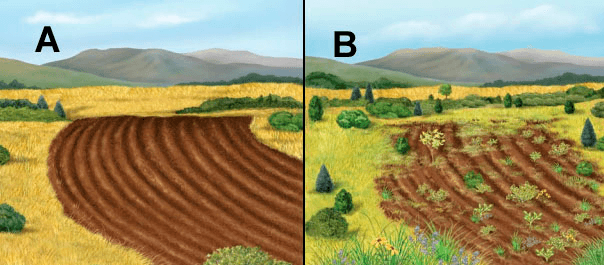
What type of succession is shown going from figure A to figure B?

a)

primary succession

b)

ecological succession

c)

secondary succession

d)

intermediate species

39.

What is the role of the pioneer species in Primary Succession?

a)

To kill any remaining organisms from before the disturbance

b)

To break down rock and rebuild soil

c)

To provide food for large animals

d)

To put fresh oxygen into the air

40.

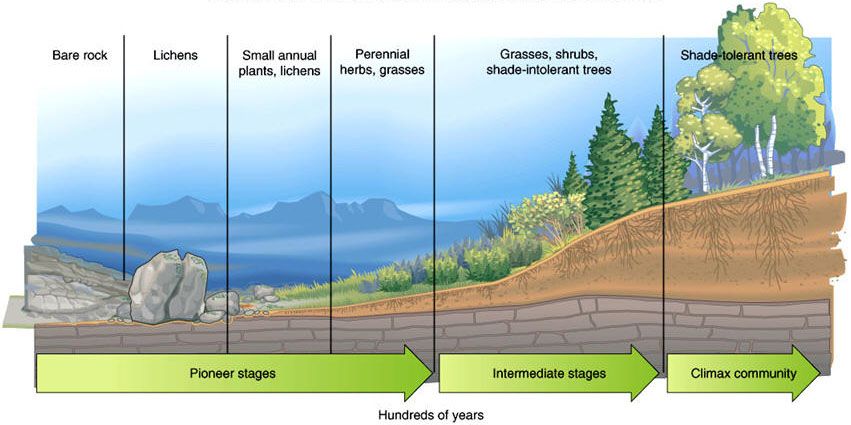
The picture shows what type of succession?

a)

primary

b)

secondary

c)

tertiary

d)

quadanary

41.
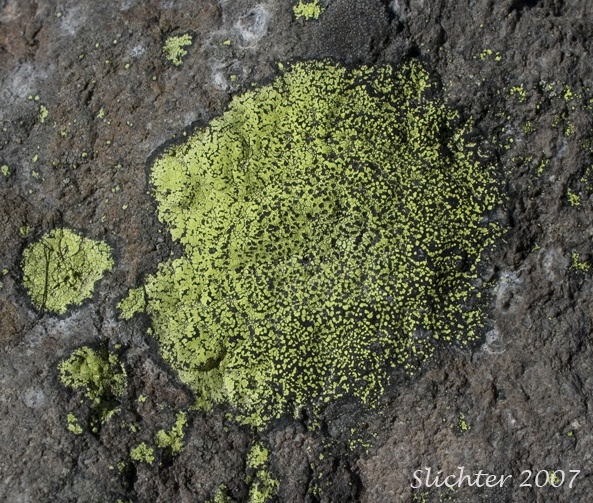
What is the name given to lichen or algae after a primary succession?
a)
pioneer species
b)
volunteer species
c)
founder species
d)
conqueror species
42.

After a volcanic eruption, lava covers the land. What is the order that plants grow to repopulate the area?

a)

Lichens → Shrubs → Grasses → Trees

b)

Lichens → tree → shrubs→Grasses

c)

Grasses → Lichens → Shrubs → Trees

d)

Lichens → Grasses → Shrubs → Trees

43.

The forest in panel #8 is a...

a)

pioneer species

b)

climax community

c)

tertiary community

d)

intermediate species

44.

Succession type?

a)

primary succession

b)

secondary succession

c)

tertiary succession

d)

variable succession

45.

Starts with BARE ROCK followed by lichen

a)

primary succession

b)

secondary succession

c)

both types of succession

46.

What does "organic matter" refer to in biology?

a)

Living and/or dead organisms

b)

Crops that don't use pesticides

c)

Carbon based chemicals

d)

Food that isn't genetically modified

47.
After a forest fire, an ecosystem would start regrowth through -
a)
primary succession
b)
secondary succession
c)
climax community
d)
limiting factors
48.
Which catastrophic event will most likely have the effect of returning an ecosystem to primary succession?
a)
A tornado
b)
A volcanic eruption
c)
A flood
d)
A drought
49.

What is a common characteristic among pioneer species?

a)

roots that break apart rocks

b)

long thick roots

c)

exposed surface roots

d)

soak up water quickly

50.

What term best relates to equilibrium?

a)

pioneer species

b)

primary succession

c)

secondary succession

d)

climax community

51.

Both primary and secondary succession start with...

a)

modify an area to allow more complex organisms to appear

b)

lichens and moss

c)

never reach climax community

d)

start from a volcano always