wayground logo

Free Printable Worksheets

NEW

Font size

S
M
L
XL
Worksheets

Q3 Exam Review

Total questions: 55

Worksheet time: 40mins

Name
Class
Date
1.

Region A is the _______________________

a)

Polar zone

b)

Temperate zone

c)

Tropical zone

2.

Region B is the _______________________

a)

Polar zone

b)

Temperate zone

c)

Tropical zone

3.

Which zone is 66-90 degrees latitude N and S

a)

polar

b)

temperate

c)

tropical

4.
The Gulf stream carries _____________ water from the east coast of The United States to the West coast of Europe.
a)
Cold
b)
Warm 
c)
Freezing
d)
Fresh
5.
The California Current (west coast) carries _________ water from canada
a)
Cold 
b)
Warm
c)
Freezing
d)
Fresh
6.
Ocean currents have an affect on which two things
a)
climate and weather
b)
temperature and density
c)
land and sea
d)
equator and poles
7.
In which layer of the atmosphere do we live and weather occurs?
a)
stratosphere
b)
thermosphere
c)
mesosphere
d)
troposphere
8.
What percentage of our atmosphere is made of oxygen? 
a)
1%
b)
21%
c)
78%
d)
25%
9.
Where is the ozone layer, which absorbs UV radiation, located in our atmosphere?
a)
stratosphere
b)
thermosphere
c)
mesosphere
d)
troposphere
10.

As you ascend (go up) in the troposphere what happens to the temperature?

a)

It increases steadily

b)

It decreases steadily

11.
This is the layer where meteors, or shooting stars, burn up.
a)
Troposphere
b)
Stratosphere
c)
Mesosphere
d)
Thermosphere
12.

Name the cloud

a)

Cumulus

b)

Cirrus

c)

nimbus

d)

stratus

13.

Name this cloud

a)

nimbus

b)

stratus

c)

cumulus

d)

cirrus

14.

Clouds are a mix dust and water vapor

a)

True

b)

False

15.

What does the stem "nimbus" mean?

a)

fog

b)

heavy

c)

rain

d)

cloud

16.
Air travels
a)
from high pressure to low pressure
b)
from low pressure to high pressue
17.
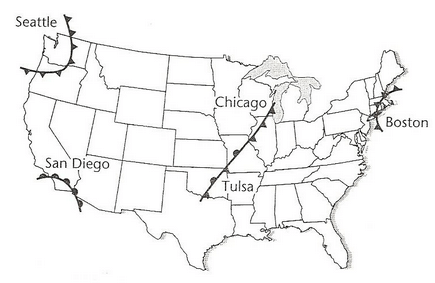
Which type of front is located near Boston?
a)
warm front
b)
cold front
c)
stationary front
d)
occluded front
18.
Which front is located near San Diego?
a)
cold front
b)
warm front
c)
occluded front
d)
stationary front
19.
What is a boundary area where air masses meet but do not mix?
a)
low pressure system
b)
super cell
c)
front
d)
high pressure system
20.
What type of storm front is this? 
a)
warm front
b)
cold front
c)
stationary front
d)
occluded front
21.
What type of storm front is this?
a)
warm front
b)
cold front
c)
stationary front
d)
occluded front
22.

Which is the correct symbol for a stationary front?

a)
b)
c)
d)
23.

Which is the correct symbol for an occluded front?

a)
b)
c)
d)
24.
What is it called when WATER is FORMED from an LIQUID to a WATER VAPOR Oor an [GAS]?
a)
EVAPORATION
b)
PRECIPITATION
c)
TRANSPIRATION
25.
What is the next stage after EVAPORATION in the water cycle?
a)
CONDENSTATION
b)
GROUNDWATER
26.
What is it called when plants give off water vapor as a waste product?
a)
condensation
b)
evaporation
c)
sublimation
d)
transpiration
27.
fair weather
a)
High Pressure 
b)
Low Pressure
28.
The barometer shows the air pressure is dropping.  What kind of weather will likely pass through our area in the coming days?
a)
clear, fair weather
b)
cloudy, rainy weather
29.
The scientific name for an organism is made from the:
a)
class and family name
b)
genus and species name
c)
domain and kingdom name
d)
kingdom and phylum name
30.
Term given to describe the 2 name naming system is:
a)
dichotmous key
b)
binomial nomenclature
c)
2 scientific names
d)
binomial key
31.
Which 2 organisms have the fewest characteristics in common?
a)
2 organisms in the same kingdom
b)
2 organisms in the same genus
c)
2 organisms in the same species
d)
2 organisms in the same family
32.
How does this protist move? 
a)
Pseudopods 
b)
Cilia 
c)
Flagellum
33.
A protist that can not make its own food is called what? 
a)
Autotroph
b)
Heterotroph 
34.
A protist that can make its own food is called what? 
a)
Heterotroph
b)
Autotroph
35.
A pseudopod literally means...
a)
small hair
b)
long tail
c)
no nucleus
d)
false foot
36.

Most protists can be found in ______________ environments.

a)

wet or damp

b)

dry or dusty

c)

hot

d)

cold

37.
Fungi obtain water and nutrients through hyphae.  What are hyphae?
a)
Hair-like structures to gather food in water environments
b)
Structures that help fungi to gather light.
c)
Structures that produce spores.
d)
Fibrous strands that will grow toward food or water.
38.
A collective mass of hyphae are referred to as ------------
a)
Parasitic
b)
Fruiting
c)
Mycelium
d)
Spores
39.
What term is used for fungi that feed on living organisms but cause harm to the organism?
a)
Saprophytic
b)
Parasitic
c)
Cilia
d)
ymbiotic
40.
Which describes fungi that are symbiotic in obtaining energy?
a)
Absorbing energy from dead or decaying organic matter
b)
Feeding on organisms in a way that benefits the host organism
c)
Using light to produce its own food.
d)
Capturing organisms and ingesting it. 
41.
What terms describes protists and fungi that gain their energy by feeding off dead and decaying organic matter?
a)
decomposers
b)
heterotrophs
c)
autotrophs
d)
symbiotic
42.
Fungi do respond to the stimulus of light.  This response to light is called---
a)
Gravitropism
b)
Hydrotropism
c)
Thigmotropism
d)
Phototropism
43.
Which group of fungi obtain their energy from dead, decaying organic matter?
a)
Saprophytic
b)
Parasitic
c)
 Cilia
d)
Symbiotic
44.
Which part of the plant makes the food?
a)
roots
b)
stem
c)
leaf
d)
flower
45.
What  anchor plants to the ground and absorb water and nutrients?
a)
Roots
b)
Stem
c)
Xylem
d)
Leaves
46.
What is the tissue that is used to transport necessary materials throughout the plant?
a)
Circulatory tissue
b)
Transport tissue
c)
Vascular tissue
d)
Pathway tissue
47.

___ is a type of plant tissue that moves food from the leaves and stems to other parts of the plant.

a)

xylem

b)

phloem

48.

___ is a type of plant tissue that transports water and minerals up from the roots throughout the plant.

a)

xylem

b)

phloem

49.

The food that a plant makes is ______

a)

glucose

b)

water

c)

oxygen

d)

carbon dioxide

50.
A ______ plant does not have any tubes.
a)
angiosperm
b)
gymnosperm
c)
vascular
d)
nonvascular
51.
Which of the following is an example of a non-vascular plant?
a)
grass
b)
corn
c)
trees
d)
moss
52.
Vascular plants reproduce through ___________.
a)
cells
b)
photosynthesis
c)
seeds
d)
leaves
53.
A _______ plant has true roots, stems and leaves.
a)
Vascular
b)
Nonvascular
54.

What hair-like structure do paramecium have to help them move through their watery environment?

a)

Cilia

b)

Flagella

c)

Pseudopod

d)

False foot

55.
What structure do amoebas have to help them move through their watery environment?
a)
Cilia
b)
Flagella
c)
Pseudopod
d)
Hair-like