wayground logo

Free Printable Worksheets

NEW

Font size

S
M
L
XL
Worksheets

Chemistry Unit Test Review

Total questions: 50

Worksheet time: 42mins

Name
Class
Date
1.
The Periodic Table is arranged by _______ ____________.
a)
 Atomic Mass
b)
 Atomic Number
c)
  Atomic Volume
d)
  Atomic Symbol
2.
 ____________________ are a substances formed from 2 or more different elements chemically combined.
a)
     Electrons
b)
   Atoms
c)
   Mixtures
d)
 Compounds
3.
Which of the following is an example of a physical change?
a)
Metal Rusting 
b)
Toast Burning
c)
Ice Melting
d)
All are examples
4.

Which of the following provide evidence to support a chemical change?

a)

Gas Production

b)

Color Change

c)

Temperature Change

d)

All are evidence

5.
Which of the following is an example of a chemical change?
a)
 Toast Burning 
b)
Ice Melting
c)
 Cutting Wood
d)
All are examples
6.
Which of the following is an example of a mixture?
a)
Trail Mix
b)
Baking Soda and Vinegar 
7.

Which one of the following substances can be separated physically, but not chemically?

a)

Elements

b)

Compounds

c)

Mixtures

8.

Which of the following is the simplest form that a substance can take?

a)

Element

b)

Compounds

c)

Mixtures

9.

An element..

a)

Contains one type of atom

b)

Contains two types of atoms

c)

Is always made up of molecules

10.

Which of the following is true about electrons?

a)

They are found inside that nucleus of an atom and have no charge

b)

They are the heaviest subatomic particle

c)

They are negatively charged found orbiting outside of the nucleus

d)

They are positively charged and found inside the nucleus

11.

Which of the following would be considered a homogeneous mixture?

a)

Salad

b)

Salt water

c)

Pizza

d)

Italian Dressing

12.

The compound sucrose has a chemical formula of C12H22O11. How many elements are in one molecule of sucrose?

a)

3

b)

12

c)

11

d)

22

13.

Which of the following is a compound?

a)

N

b)

Na

c)

CO2

d)

O

14.

Is this an image of an element, a compound, or a mixture?

a)

Element

b)

Compound

c)

Mixture

15.

Is this an image of an element, a compound, or a mixture?

a)

Element

b)

Compound

c)

Mixture

16.

What is the charge of a proton?

a)

Negative

b)

Neutral

c)

Positive

d)

No charge

17.

A family or a group on the periodic table is

a)

Horizontal

b)

Vertical

c)

Left side

d)

Right side

18.

Metals make up the majority of the periodic table and are on which side of the periodic table?

a)

right

b)

left

c)

along staircase

d)

period 2

19.

H2O2 is considered a

a)

Element

b)

period

c)

compound

d)

Mixture

20.

What particles are found in the nucleus of an atom?

a)

proton, neutron

b)

neutron. electron

c)

electron, proton

d)

electron, neutron

21.

The elements on the picture all belong to the same

a)

period

b)

family

c)

group of gases

d)

group of metals

22.

Which of the following is NOT an element

a)

Potassium (K)

b)

Water (H20)

c)

Gold (Au)

d)

Carbon (C)

23.

The atomic number indicates the number of _____________ in an atom?

a)

neutrons

b)

electrons

c)

subatomic particles

d)

Protons

24.

What is not an indication that a chemical change has taken place?

a)

change in color

b)

change in temperature

c)

change in shape

d)

formation of a precipitate

25.

Mixtures can be

a)

physically separated

b)

not physically separated

c)

pure substances

d)

separated by a chemical reaction

26.

Which of the following can be considered an chemical property?

a)

Rust, burning

b)

melting point

c)

boiling point

d)

density

27.

What is an sign that a chemical change in this reaction.

a)

bubbles form

b)

two compounds mix in a bag

c)

a homogeneous mixture forms

d)

water dissolves powder

28.

Neutrons have a

a)

Negative charge

b)

No charge

c)

Positive charge

d)

valance charge

29.
This picture represents which of the following?
a)
element
b)
compound
c)
mixture
30.
This picture represents which of the following?
a)
element
b)
compound
c)
mixture
31.
This picture represents which of the following?
a)
element
b)
compound
c)
mixture
32.
How is a compound different from a mixture?
a)
Solids, liquids, and gases can form compounds
b)
Each substance in a compound loses its characteristic properties
33.
How many elements are represented in the compound?
Na2CO3
a)
1
b)
2
c)
3
d)
4
34.
What is a substance that is dissolved in another substance? 
a)
solution
b)
solute
c)
solvent
d)
compound
35.
Kool-Aid - Powder, sugar, and water
Identify the solvent 
a)
water
b)
powder
c)
sugar
d)
powder and sugar
36.
To make a solute dissolve more quickly i n a solvent which would you do?
a)
Put it in cold water and stir it
b)
Put it in warm water and stir it
37.
How many grams of K2Cr2O7, are soluble in 100 g of water at 95 ºC?
a)
83 grams
b)
75 grams
c)
40 grams
d)
12 grams
38.
Which solute is the most soluble at 10 ⁰C?
a)
KI
b)
KClO3
c)
NH4Cl
d)
NH3
39.
Which solute is the least soluble at 90 ⁰C?
a)
SO2
b)
KClO3
c)
KI
d)
HCl
40.

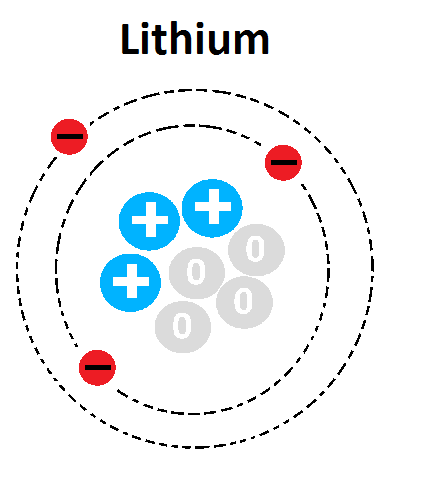
What element is represented in this Bohr Model?

a)

Carbon

b)

Hydrogen

c)

Aluminum

d)

Lithium

41.
What is the name of this element?
a)
Lithium
b)
Boron
c)
Carbon
d)
Neon
42.
What is the name of this element?
a)
Beryllium
b)
Boron
c)
Barium
d)
Bromine
43.
What is the mass number of this atom?
a)
1
b)
3
c)
4
d)
7
44.
What is the atomic number of this atom?
a)
2
b)
4
c)
6
d)
none of the above
45.
What group does this element belong to?
a)
Group 1: Alkali metals
b)
Group 18: Noble Gases
c)
Group 2: Alkaline-Earth Metals
d)
Group 17: Halogens
46.
How many valence electrons?
a)
2
b)
3
c)
5
d)
10
47.
What's a valence electron?
a)
electrons in the second energy level
b)
electrons in the outermost energy level
c)
the atomic number
d)
electrons in the first level
48.

The________are colorless and generally unreactive, mostly due to their full outer electron shells.

a)

Metalloids

b)

Nonmetals

c)

Halogens

d)

Noble Gases

49.

On the periodic table, Periods are

a)

Horizontal rows

b)

Vertical columns

50.

On the periodic table, Groups are

a)

Horizontal rows

b)

Vertical columns