
 Worksheets
Geomorphology Unit
Total questions: 47
Worksheet time: 1hrs 17mins
The outer layer of the Earth that is broken into plates. A thin layer between 0 - 60 km thick. The solid rock layer upon which we live. Either continental or oceanic.
inner core
outer core
mantle
crust
Two plates slide past each other at what boundary?
Convergent
Divergent
Transform
Two plates come together or collide at what boundary?
Convergent
Divergent
Transform
Two plates spread or move apart at what boundary?
Convergent
Divergent
Transform
What kind of igneous rock usually contains large crystals?
clastic
extrusive
organic
intrusive
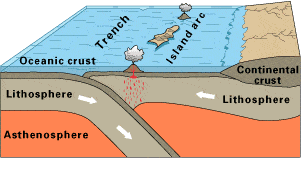
Observe this diagram of a plate boundary. One statement BEST describes what is happening. It is that
the oceanic crust is melting.
the denser ceanic crust is subducting under the less dense oceanic crust
volcanic islands are forming.
the tectonic plates are moving away from each other.
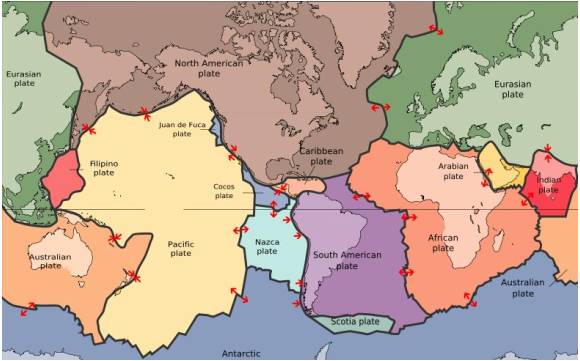
The map in the picture shows tectonic plate boundaries. This map would be useful in predicting the location of future
droughts
hurricanes
earthquakes
tornadoes
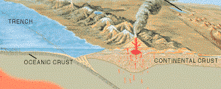
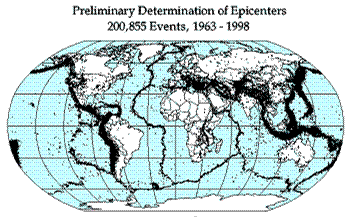
Earthquake epicenters (center of where the earthquakes started) were mapped for a 35 year period in the diagram above. The black dots indicate these epicenters. The black dots appear along what feature on Earth?
hot spots
plate boundaries
rift zones
sea floor spreading
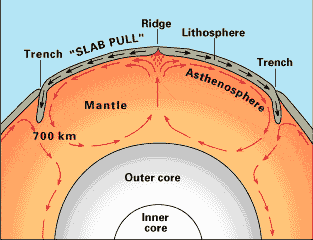
What is the source of energy that drives plate movement?
the subducton of the sea floor
the different densities of the oceanic and crustal plates
convection currents in the asthenosphere
the friction force between the plates that move past each other


In Seafloor Spreading, molten material rises from the mantle and erupts or flows out
along the edges of all the continents
in the deep ocean trenches
along mid-ocean ridges
in the north and south poles


Which of these BEST describes how an igneous rock forms?
cooling of magma
weathering of other rocks
colliding of tectonic plates
pressing together of smaller rocks
Which statement is the best description of what
happens in the rock cycle?
Rocks on old mountains are gradually weathered away, while mountain building and volcanism form new mountains.
Once formed, rocks stay in place until rocks above them are weathered away and they reach the surface.
As sedimentary rocks are buried deep below other rocks, they are changed by heat and pressure, eventually return to the surface, and are weathered again.
Younger sedimentary rocks are always deposited on top of older metamorphic or igneous rocks.
A group of students found metamorphic rocks near a campsite. The presence of metamorphic rocks is most likely evidence of
dinosaur activity
sediment deposition
high pressure
wind-borne sand

Which process is best illustrated by the diagram?
igneous rock formation
sedimentary rock formation
igneous rocks changing into metamorphic rocks
sedimentary rocks changing into metamorphic rocks
By what process are sediments moved?
Erosion
Deposition
Weathering
The process which sediments are laid down in new locations, building new landforms.
Erosion
Weathering
Deposition
Melting
A rock never stops changing.
True
False

What do 'plants' do with the carbon they receive?
They turn it into water
They don't need carbon
They turn it into food by photosynthesis
They keep it forever

How does carbon get from animals and back into the atmosphere? (CHOOSE ALL THAT APPLY)
Respiration (breathing)
After they die, they are broken down by decomposers
Photosynthesis
None of these

How do animals get carbon?
Photosynthesis
They absorb it from the atmosphere
The sun
They eat other plants and animals

What is CO2?
Air
Oxygen
Carbon Dioxide
Dioxide

All things are made out of carbon or need carbon to live.
True
False

What is causing global warming? (Choose All That Apply)
The earth is too close to the sun
There is too much carbon dioxide in the atmosphere
Because we're running out of water
Because we're cutting down all the trees and not planting more
Which is an example of a carbon sink?


What is a carbon sink?
Something that adds to the atmosphere.
Something that removes carbon from the atmosphere.
Something that adds carbon to the earth's crust.
Something that removes carbon from the earth's crust.

The graph shows us that
the earth temperature is always increasing
the earth's temperature has steadily increased since 1900
the earth's temperature is steadily rising since the 1960s
the earth's temperature decreased during the 19th and 20th centuries


The greenhouse effect is a natural process
true
false
Why does cutting down trees increase Global Warming?
Trees absorb the Sun’s energy without radiating back into the atmosphere.
Trees drain Greenhouse gases like methane from soil.
Trees provide shade which counteracts Global Warming.
Trees soak up Carbon dioxide.

In our Lake Nyos Carbon Dioxide Experiment the lowest candle went out first because?
Carbon Dioxide floats
Fire needs oxygen
Carbon Dioxide sinks
Carbon dioxide is denser than air and sinks to the bottom of the container and replaces the oxygen that is less dense and extinguishes the flame.

This experiment demonstrated the tragic event at Lake Nyos because.....
People need fire to survive and without it the people starved.
The air was replaced with carbon dioxide and people suffocated in their sleep.
Carbon dioxide is poisonous
Carbon dioxide caused warming and people couldn't survive the rise in temperature at Lake Nyos.

