wayground logo

Free Printable Worksheets

NEW

Font size

S
M
L
XL
Worksheets

Chapter 10, 11 and 12 Review

Total questions: 45

Worksheet time: 37mins

Name
Class
Date
1.

Rain and Snow are:

a)

Evaporation

b)

Condensation

c)

Run off

d)

Precipitation

2.

Water in the clouds is:

a)

Evaporation

b)

Condensation

c)

Run off

d)

Precipitation

3.

Water heated by the sun into vapor is:

a)

Evaporation

b)

Condensation

c)

Run off

d)

Precipitation

4.

Water going down into oceans and lakes:

a)

Evaporation

b)

Condensation

c)

Run off

d)

Precipitation

5.

Freshwater makes up how much of the Earth's water supply?

a)

87%

b)

75%

c)

6%

d)

3%

6.
The pressure increases as you get deeper in the ocean.
a)
true
b)
false
7.
Salt water is less dense than fresh water. 
a)
true
b)
false
8.
The concentration of a mixture can be increased in which of the following ways?
a)
Heating the mixture
b)
Adding more water “solvent”
c)
Adding more powder “solute”
d)
Stirring the mixture
9.
What is an underwater mountain formed by a volcano?
a)
trench
b)
rift zone
c)
seamount
d)
mid ocean ridge
10.
What is the steep slope at the edge of the continental shelf?
a)
seamount
b)
mid-ocean ridge
c)
continental slope
d)
rift zone
11.
What are underwater mountain ranges called?
a)
continental shelf
b)
mid-ocean ridges
c)
abyssal plains
d)
continental slopes
12.
What is the deepest part of the ocean basin?
a)
abyssal plains
b)
trenches
c)
rift zones
d)
mid-ocean ridge
13.

What happens to the temperature of the ocean as you go deep into it?

a)

increases

b)

descreases

c)

stays the same

d)

non of the above

14.
What happens to air pressure as you move upward into the atmosphere?
a)
increases
b)
decreases
c)
stays the same
15.
A device that is used to measure atmospheric pressure is a ___________.
a)
barometer
b)
thermometer
c)
kilometer
d)
micrometer
16.
Air pressure is greater _______.
a)
at the top of the mountain
b)
at the bottom of the mountain
c)
at the center of the mountain
17.
Density of air is greater ________.
a)
at the top of the mountain
b)
at the bottom of the mountain
c)
at the center of the mountain
18.
___________is the result of the weight of a column of air pushing on an area.
a)
air pressure
b)
density
c)
volume
d)
none of the above
19.
In what direction(s) does air exert pressure?
a)
everywhere
b)
no where
c)
there is no pressure
d)
downward
20.

What is altitude?

a)

how much something weighs

b)

the height above sea level

c)

how big something is

d)

how far away something is

21.

Which of the following are NOT units of pressure

a)

Bar

b)

millibar

c)

inches of mercury

d)

g/cm3

22.

Why is it difficult for humans to survive at high altitude?

a)

The density of the air is too low

b)

The density of the air is too high

c)

The pressure of the air is too high

d)

It's too hot when you get closer to the sun

23.

Gases in the atmosphere trap some of the heat near Earth's surface, while some go back to space.

a)

Electromagnetic wave

b)

Greenhouse effect

c)

Thermal energy

d)

Conduction

24.

What happens when the ozone layer gets damaged?

a)

It has no effect

b)

More UV rays will reach Earth's surface

c)

More UV rays will get absorbed by the atmosphere

d)

Other parts of the atmosphere make up for the damaged ozone layer.

25.

Energy from the sun travels to Earth in the form of _____

a)

rainbows

b)

electromagnetic waves

c)

sound waves

d)

light waves

26.

Electromagnetic waves are classified according to _____.

a)

the amount of light given off

b)

wavelength

c)

the height of the waves

d)

the amount of heat given off

27.

Infrared radiation has wavelengths that are ______

a)

longer than red light

b)

between visible and ultraviolet wavelengths

c)

shorter than violet light

28.

Infrared radiation is _____

a)

visible by humans.

b)

not visible by humans.

29.

Infrared radiation is ____.

a)

a mixture of all colors

b)

can be felt as heat

c)

the cause of sunburn, eye damage, and cancer

30.

Ultraviolet radiation ____.

a)

a mixture of all colors

b)

can be felt as heat

c)

is the cause of sunburn, eye damage, and cancer

31.

This image represents which form of electromagnetic energy?

a)

infrared radiation

b)

ultraviolet radiation

c)

visible light

32.

Which of the following correctly lists three forms of electromagnetic waves from shortest to longest?

a)

infrared, ultraviolet, visible light

b)

ultraviolet, visible light, infrared

c)

visible light, infrared, ultraviolet

33.

On a hot sunny day, what colour would you NOT want to wear?

a)

black

b)

white

c)

light blue

d)

light yellow

34.

Which surface would reflect the most light?

a)

asphalt

b)

fresh snow

c)

forest

d)

soil

35.
Which statement correctly defines wind?
a)
Wind is the movement of air from an area of low pressure to an area of high pressure
b)
Wind is the movement of air to a colder area in the atmosphere.
c)
Wind is the movement of air from an area of high pressure to an area of low pressure.
d)
Wind is the movement of air pushed around and bouncing off Earth's surface.
36.
Which statement correctly describes the properties of cold air?
a)
less dense and less pressure than warm air
b)
more dense and more pressure than warm air
c)
more dense and less pressure than warm air
d)
less dense and more pressure than warm air
37.
Where does the initial source of energy come from that creates winds?
a)
the moon
b)
the Sun
c)
the Earth's surface
d)
the rotation of the Earth
38.
Why does warm air rise?
a)
Warm air is more dense than cooler air.
b)
Warm air has more pressure than cooler air.
c)
Warm air is less dense than cooler air.
d)
Warm air has a higher dew point than cooler air.
39.
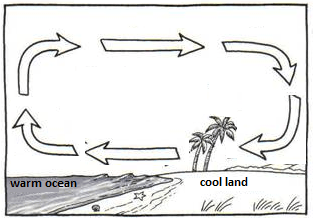
What kind of breeze is this and when would it form?
a)
Land breeze - daytime
b)
Land breeze - nighttime
c)
Sea breeze - daytime
d)
Sea breeze - nighttime
40.
Air always blows from 
a)
High pressure to low pressure
b)
 Hot air to cold air
c)
 low pressure to high pressure
d)
East to west
41.

What is the Coriolis Effect?

a)

Earth's rotation making wind follow a curved path

b)

The wind's path making the earth rotate

c)

The wind travelling in a straight line

42.
This is the symbol for a... 
a)
Cold Front
b)
Warm Front
c)
Stationary Front
d)
Occluded Front 
43.
This is the symbol for a... 
a)
Occluded Front
b)
Stationary Front
c)
Warm Front
d)
Cold Front 
44.
This weather tool measures wind speed 
a)
thermometer
b)
barometer
c)
anemometer
d)
psychrometer
45.

What are isobars?

a)

lines that connect places with the same pressure

b)

lines that connect places with the same temperature

c)

lines that connect places with the same altitude

d)

lines that connect places with the same longitude