
 Worksheets
Y9 Chemistry revision
Total questions: 50
Worksheet time: 25mins

Salts that are made with hydrochloric acid are called ______________.
chlorides
sulfates
nitrates
carbonates

What are the products if magnesium reacts with hydrochloric acid?
Magnesium chloride + Hydrogen
Magnesium sulfate + Hydrogen
Magnesium oxide + Hydrogen
Magnesium sulfide + Hydrogen

Which of the following preparation of salt is incorrect?
acid + alkali
acid + metal oxide
acid + carbonate
acid + acid
Which of the following reaction can produce sodium nitrate and water?
Sodium chloride solution and nitric acid.
Sodium sulphate solution and nitric acid.
Sodium hydroxide solution and nitric acid.
Sodium and dilute nitric acid.
Complete the following word equation:
Metal + Acid -->
Salt + water
Salt + hydrogen
Salt + Water + Carbon dioxide
Complete the following word equation:
Metalcarbonate + acid -->
Salt + Hydrogen
Salt + Water + Carbon Dioxide
Salt + Water
What colour does the solution turn when sulfuric acid is added to copper carbonate?
Blue
Green
Clear
Purple
How do you remove the water to leave solid copper sulfate crystals?
Filter
Evaporate
Distill
What does the word insoluble mean?
Does dissolve
Doesn't dissolve
Is part of a solid
What is the test for Hydrogen gas?
Squeaky pop
Lime water turning cloudy
Add pH paper
What is the test for Carbon Dioxide?
Add Litmus paper
Lime water turning milky
Squeaky pop
How do you separate an excess insoluble reactant from a solution?
Filtration
Precipitation
Crystalisation
Evaporation
When producing a soluble salt in a reaction between an acid and an alkali, how can you prepare dry solid crystals from the solution?
Filtration
Neutralisation
Condensation
Evaporation/crystallisation
A temperature increase causes the particles to ......
to slow down
move faster
collide higher
in the right order
Why does a higher concentration increase the rate of reaction?
it increases the amount of reactants
it lowers the activation energy
it increases the energy of particle collisions
it increases the frequency of particle collisions
Why does a higher temperature increase the rate of a reaction?
it increases both the frequency and energy of particle collisions
it only increases the frequency of particle collisions
it only increases the energy of particle collisions
it reduces the activation energy of the reaction
Breaking up a lump of potassium into smaller pieces increases the rate of reaction due to increased
concentration
surface area
temperature
reactants

Which factors increase the rate of a reaction?
increasing temperature
increasing concentration
increasing surface area
All of these
Increasing the temperature gives particles more __________.
Time
Energy
Space
Frequency
As the frequency of ______________ increases, the rate of reaction increases.
Hint: frequency means how often
Time
Reactions
Collisions
Reactants

You add more people into an enclosed space in hope for more collisions. You have increased:
temperature
concentration
pressure
catalyst
The word for a substance that you react at the start of a chemical reaction...
Reaction
Reactant
Product
The result
The word for a substance created in a chemical reaction...
Reaction
Reactant
Product
Mass
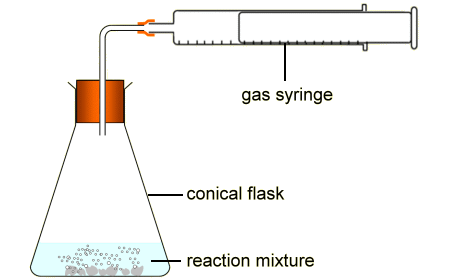
How is this equipment being used to measure the rate of reaction?
The gas syringe measures how much gas is produced in a certain time
The reaction mixture will increase in volume in a certain time


What can be measured in this experiment to show the rate of the reation?
The amount of magnesium
The amount of the hydrochloric acid
The amount of water in the trough
The amount of hydrogen gas produced
What can be measured in this experiment to show the rate of the reation?
The amount of magnesium
The amount of the hydrochloric acid
The amount of water in the trough
The amount of hydrogen gas produced

In an experiment to test the effect of particle size on rate of reaction, what should be changed?
The size of the marble chips
The amount of hydrochloric acid
The amount of marble chips
The size of the cotton wool
What is the formula for Volume?
Mass/Volume
Density x Volume
Mass/Density
What is the formula for Mass?
Mass/Volume
Density x Volume
Mass/Density

