
 Worksheets
Topic 1 - Lesson 4
Total questions: 60
Worksheet time: 33mins
How many chromosomes are in each human cell?
1
146
46
1,000,000

Select the correct description for the picture
Prophase: The cell PREPARES for cell division as chromosomes PAIR up.
Metaphase: Chromosomes line up in the MIDDLE
Anaphase: Chromosomes pull APART/AWAY to ends of the cell.
Teleophase: Chromosomes unwind to form chromatin and the cell starts to TEAR to form TWO new cells.
An organism has 35 chromosomes. If the organism's cells go through mitosis, then how many chromosomes will each daughter cell have?
70
35
17.5
20 in one and 15 in the other
Why does our body undergo mitosis?
fun and games
checks and balances
growth and repair
to build bigger muscles
What percentage of a cell's life is spent in interphase?
Approximately 10%
Approximately 75%
Approximately 90%
Approximately 50%

What stage of mitosis is this?
Interphase
Anaphase
Cytokinesis
Prophase

What stage of mitosis is this?
metrophase
middlephase
centraphase
metaphase
The goal of mitosis is to
make a new parent cell
make two new daughter cells with the same DNA
make two new daughter cells with different DNA
to grow a larger toe
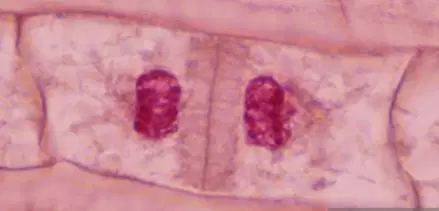
The diagram displays a single parent plant cell undergoing mitosis to become two daughter plant cells. What is the name of the line being created in the middle of the dividing cells?
The cell membrane
The cell wall
The cytoplasmic barrier
The cell plate
The nuclear membrane


Spindle fibers attach, centrioles line chromosomes in the center of the cell describes:
Prophase
Telophase
Metaphase
Anaphase
Organize these options into the right phase/stage of mitosis.
Chromatin pairs up
Chromosomes line up in the middle
Chromosomes are pulled apart and away
The cell begins to tear
Nuclear membrane dissolves
Nuclear membrane reforms

Centrioles move to the poles


Nuclear membranes form, cell begins to pinch to begin splitting describes:
Prophase
Anaphase
Telophase
Metaphase
If there are 20 chromosomes in the nucleus before mitosis how many will there be in each new daughter cell after cytokinesis?
20
10
40
200

Name the phase
telophase
metaphase
anaphase
prophase
Takes only one parent to reproduce and offspring are different (not-identical)
Takes two parents to reproduce and offspring are identical
Takes one parent to reproduce and offspring are identical
Takes one parent to reproduce and offspring are different (not-identical)
Which phase is being described? Nucleus is visible, DNA is making copies (replicating), Cell is growing, Cell is getting ready to divide.
Interphase
Prophase
Metaphase
Anaphase
Telophase
Which phase is being described? Chromatin organizes and condenses (pairs) into chromosomes. Chromosomes are in the X shape and clearly visible. Nuclear membrane disappears.
Interphase
Prophase
Metaphase
Anaphase
Telophase
Which phase is being described? Two nuclear membranes form. Chromosomes start to unravel. Cytoplasm begins to pinch in as the cell begins to tear into two.
Interphase
Prophase
Metaphase
Anaphase
Telophase
What is being described? Cytoplasm finishes pinching (cutting). Chromosomes finish unraveling. Two new daughter cells are completed.
Cytokinesis
Prophase
Metaphase
Anaphase
Telophase

What process is this?
Cellular Respiration
Photosynthesis
Meiosis
Mitosis
Melting

Pick the correct description for the picture
Teleophase: Chromosomes unwind to form chromatin and the cell starts to TEAR to form TWO new cells.
Anaphase: Chromosomes pull APART/AWAY to ends of the cell.
Metaphase: Chromosomes line up in the MIDDLE
Prophase: The cell PREPARES for cell division as chromosomes PAIR up.
Mitosis is a form of
Sexual Reproduction
Asexual Reproduction
How many parents are needed for asexual reproduction?
4
1
3
2
Organisms produced by asexual reproduction are genetically different from the parent organism.
True
False
Is the genetic information in asexual reproduction identical or different compared to the parent?
Identical
Different
It can't be determined
nuclear membrane and nucleolus disappears at which phase:
metaphase
prophase
anaphase
telophase
Mitosis is a form of
Sexual Reproduction
Asexual Reproduction

Which phase is shown
Interphase
Prophase
Metaphase
Anaphase
Telophase

Which phase is shown
Interphase
Prophase
Metaphase
Anaphase
Telophase

Which phase is shown?
Interphase
Prophase
Metaphase
Anaphase
Telophase

90% of the cells life cycle
Stage where DNA is copied
Interphase
Metaphase
Telophase
Prophase

Select the correct description for the picture
Prophase: The cell PREPARES for cell division as chromosomes PAIR up and the centrioles move to the POLES of the cell.
Metaphase: Chromosomes line up in the MIDDLE
Anaphase: Chromosomes are pull APART/AWAY to ends of the cell.
Teleophase: Chromosomes unwind to form chromatin again and the cell starts to TEAR to form TWO new cells.

What is feature unique to PLANT CELLS will appear during telophase and cytokinesis?
Cleavage Furrow
Cell Plate
Nucleolus
Nuclear Membrane

The parent cell started with 4 chromosomes. How many should each daughter cell have?
4 chromosomes each
2 chromosomes each
8 chromosomes each
one daughter cell will have 1 chromosome and the other will have 3 chromosomes

The diagram displays what type of reproduction?
Sexual Reproduction
Asexual Reproduction
Both Asexual and Sexual Reproduction

Which plant cell number is going through anaphase?
Picture 1
Picture 14
Picture 7
Picture 12
What organelle produces the spindle fibers that are used throughout mitosis?
Cytoplasm
Chloroplast
Centrioles
Cell Membrane
Reorder the images from Interphase to Telophase.


What does DNA replication mean?
dividing (splitting) the cytoplasm
copying (doubling) the organelles
copying (doubling) the chromatin
none of the above

Select the correct description of the picture
Prophase: The cell PREPARES for cell division as chromosomes PAIR up.
Anaphase: Chromosomes pull APART/AWAY to ends of the cell.
Teleophase: Chromosomes unwind to form chromatin and the cell starts to TEAR to form TWO new cells.
Metaphase: Chromosomes line up in the MIDDLE

The uncoiled (unpaired) DNA located in the nucleus during interphase is known as which of the following?
Chromatin
Chromosomes
Centrioles
Spindle Fibers
Cytokinetic Fibers
Identify the correct phase for each of the phases shown.
Telophase
Anaphase
Metaphase
Prophase
Interphase

