Wayground logo

Free Printable Worksheets

Font size

S
M
L
XL
Worksheets

Science 4.5wk Review

Total questions: 55

Worksheet time: 39mins

Name
Class
Date
1.

What is the first step in the scientific method?

a)

draw conclusions

b)

ask a question/make an observation

c)

make a hypothesis

d)

test the experiment

2.

Which happens last in the Scientific Method?

a)

make a hypothesis

b)

ask a question/make an observation

c)

make a plan

d)

draw conclusions

3.

To make observations you use your _______.

a)

senses

b)

feet

c)

smile

d)

experience

4.

Performing a test or experiment allows you to test your ___________.

a)

draw conclusions

b)

hypothesis

c)

senses

d)

battery

5.
Should experiments be repeated over and over to see if the results are the same each time?
a)
yes
b)
no
6.
A series of steps used by scientists to solve a problem or answer a question. 
a)
scientific method
b)
recipe
c)
data collection
d)
metric system
7.
Which of these contains steps in the right order?
a)
Ask a question, state your hypothesis, research, experiment, analyze, make a conclusion
b)
State your hypothesis, ask a question, research, experiment, analyze, make a conclusion
c)
Ask a question, research, state your hypothesis, experiment, analyze, make a conclusion
d)
State your hypothesis, ask a question, research, make a conclusion, experiment, analyze
8.
Who are the three scientists credited with creating the Cell Theory?
a)
Schlieden, Schwann, Virchow
b)
Schindler, Schmeil, Vanderhoot
c)
Schwimmer, Shanazzek, Van Halen
9.
The second part of Cell Theory states: "All living organisms are made up of cells."
a)
True
b)
False
c)
I don't know
d)
If you say so
10.
All cells come from___________ cells.
a)
pregnant
b)
pre-existing
c)
paternal
d)
pin size
11.
The basic unit of life is called a (n)
a)
atom
b)
compound
c)
cell
d)
energy
12.
When observing cells, which of the following pieces of equipment is most appropriate?
a)
Hand lens
b)
Telescope
c)
Petri dish
d)
Microscope
13.
What should you do if you break glass in the lab?
a)
Tell the teacher.
b)
Sweep up the glass.
c)
Pick up the glass with your hands.
d)
Ignore it; the teacher will clean it up when she sees it later.
14.
When should you tie back long hair or baggy clothing?
a)
When working with chemicals
b)
When working with a Bunsen burner
c)
When doing dissections.
d)
Any time you are working in the lab.
15.
I will immediately notify the instructor only about major accidents.
a)
True
b)
False
16.
Horseplay, jokes, and pranks are appropriate in the science classroom at any time.
a)
True
b)
False
17.
Part of lab safety includes reading the lab procedure...
a)
before doing the lab
b)
while doing the lab
c)
after doing the lab
d)
only if you think you really need it
18.
When in the lab...
a)
long sleeves and loose clothing should be rolled up
b)
closed toe shoes should be worn
c)
long hair should be pulled back
d)
all of the above
19.
You are heating a substance in a test tube. Always point the open end of the tube
a)
towards your body
b)
toward your lab partner
c)
towards another classmate
d)
away from all people
20.
You have been injured in the laboratory (cut, burn, etc.). First you should
a)
visit school nurse
b)
text your parent
c)
see a doctor after school
d)
tell teacher immediatly
21.

The proper technique for smelling chemicals is ______________

a)

keeping your nose close to the glassware

b)

wafting

c)

to sniff only a small amount

d)

Trick question; you never are allowed to smell chemicals in class

22.

When moving chemicals during labs, you should;

a)

Move quickly so you can be in the way for the shortest time possible

b)

Walking very slowly

c)

Hold them securely and walk carefully

d)

Yell out "Code One" so that everyone clears a path for you to walk through

23.

Why would you wear goggles in the lab?

a)

to prevent eye strain

b)

to improve your vision

c)

for protection from UV rays

d)

for protection from chemicals, heat, or glassware

24.

Which of the following footwear is best in the laboratory?

a)

sandals

b)

rain boots

c)

closed-toed shoes

d)

heels

25.

When you finish working with chemicals, biological specimens, and other lab substances, always

a)

treat your hands with lotion

b)

wash your hands with soap and water

c)

wipe your hands with a cleansing wipe

d)

dry your hands with a paper towel

26.

You are allowed to enter the chemical storage area any time you need to get an item

a)

true

b)

false

27.
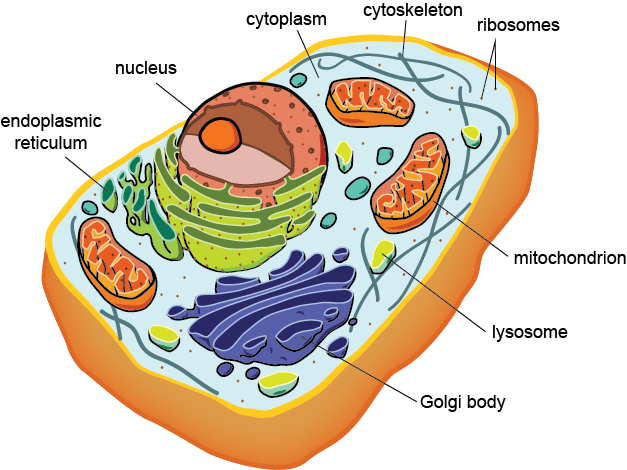
What organelle controls and regulates cellular activity?
a)
Ribosome
b)
Nucleus
c)
Mitochondria
d)
Lysosome 
28.
The major function of ribosomes is to
a)
Make fats
b)
Synthesize protein
c)
Digest protein
d)
Make sugars
29.
Select the statement that best describes the function of the cell wall.
a)
It gives structural support to plant cells.
b)
Its jelly-like fluid surrounds the nucleus and most of the cell’s internal parts.
c)
It contains the cell’s nuclear material. 
d)
It produces food from sunlight. 
30.
What is the name and function of the organelle displayed above?
a)
Mitochondria: breakdown glucose and produce ATP
b)
Chloroplast: converts solar energy into chemical energy
c)
Vacuole: Stores H2O, salt, food
d)
Nucleus: stores genetic information
31.

which of the following transports material within the cell?

a)

Golgi Apparatus

b)

Endoplasmic Reticulum (ER)

c)

Cell Wall

d)

Ribosomes

32.
Which structure would be found in a grass cell but NOT on your cell?
a)
cell wall
b)
nucleus
c)
mitochondria 
d)
vacuoles 
33.
Rough endoplasmic reticulum has ________________ attached to it. 
a)
ribosomes 
b)
chromosomes 
c)
Golgi apparatus 
d)
nucleolus 
34.
The arrow is point to the 
a)
mitochondria 
b)
Cell membrane 
c)
nucleus 
d)
ribosome
35.

The first person to see cells. He was looking at cork and named the cells, cells. They reminded him of the cells monks lived in.

a)

Robert Hooke

b)

Anton van Leeuwenhoek

c)

Theodore Schwann

36.
It is called the "powerhouse" of a cell.

a)
nucleus
b)
mitochondrion
c)
lysososme
d)
ribosome
37.
It is the storage area for water and other substances.
a)
vacuole
b)
lysosome
c)
ribosome
d)
rough ER
38.
It is located outside the cell membrane of plants and some bacteria which serves as support.
a)
cell wall 
b)
choloroplast
c)
smooth ER 
d)
rough ER
39.
It is the  jelly-like fluid interior of the cell
a)
cytoplasm
b)
nucleus
c)
endoplasmic reticulum
d)
golgi bodies
40.
These are  "little organs" that carry out cell functions.
a)
lysosomes
b)
organelles
c)
golgi bodies
d)
mitochondria
41.

Which cell has a cell wall?

a)

Animal Cell

b)

Plant Cell

c)

Both

42.

How many nucleus' are in a plant cell?

a)

1

b)

5

c)

9

d)

3

43.

Which cell has chloroplast?

a)

Plant cell

b)

Animal cell

c)

Both

d)

Neither one of them have chloroplast

44.

What is the cell membrane?

a)

Power House

b)

Its the outer layer of a cell

c)

Large sac that holds food, water, and waste

d)

Jelly like substance

45.
During this step of the scientific method, a scientist would gather background information. 
a)
Hypothesis
b)
Research
c)
Observation
d)
Experiment 
46.

What is the idea that life can arise from non-living material?

a)

Spontaneous Generation

b)

evolution

47.
Which of the following statements is not part of the cell theory?
a)
Cells are the basic unit of structure and function in all living things.
b)
All cells are produced from other cells.
c)
Only animal cells are composed of cells.
d)
All living things are composed of cells.
48.
Which scientist did NOT contribute to the cell theory?
a)
Anton Van Leeuwenhoek
b)

Robert Hooke
c)
Albert Einstein 
d)

Matthias Schleiden
49.
"All animals are made of cells". This fact was discovered by...
a)
Matthias Schleiden
b)
Theodor Schwann
c)
Robert Hooke
d)
Rudolf Virchow
50.
All plants are made of cells.  This was discovered by....
a)
Matthias Schleiden
b)
Rudolf Virchow
c)
Robert Hooke
d)
Aristotle
51.

For generations, people believed in "spontaneous generation." Francesco Redi was the first to disprove this idea. Spontaneous generation is the idea that . . .

a)

..... all living things are made of cells

b)

... all cells come from other cells.

c)

living things could "generate" from non-living matter.

d)

cells are the basic unit of structure and function

52.

There are more than two scientists who contributed to the cell theory

a)

True

b)

False

53.

_____________ is an explanation or model made of predictions that can be tested by experiments.

a)

Theory

b)

calculation

54.

Unlike animal cells, plant cells contain

a)

mitochondria.

b)

few nuclear pores in their nucleus.

c)

a large vacuole for water storage.

d)

centrioles.

55.

Which order of organization agrees with the cell theory?

a)

tissue --> cell --> organ --> organism

b)

cell --> tissue --> organ system --> organism

c)

organ --> cell --> tissue --> organism

d)

tissue --> organ --> cell --> organism