
 Worksheets
Chp 2 Matter practice test
Total questions: 65
Worksheet time: 38mins
____ is the amount of matter in an object.
Mass
Volume
Weight
Density
One unit to measure mass is
g/mL
grams (g)
milliliters (mL)
Centimeters (cm)
____ is the amount of space an object takes up.
Mass
Volume
Weight
Density
One unit to measure volume is
g/mL
grams (g)
milliliters (mL)
Centimeters (cm)
One tool to measure volume is:
Graduated Cylinder
Thermometer
Triple Beam Balance
What is a type of mixture is NOT evenly mixed and different parts can easily be seen (Ex. Vegetable soup)?
Heterogeneous mixture
Homogeneous mixture
Solution
Colloid

This picture represents:
Element
Compound
Mixture of Elements
Mixture of Compounds
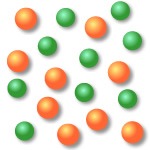
This picture best represents which of the following?
element
compound
Homogeneous mixture
Heterogeneous mixture
If you change a substance into a new substance with new and different properties than the starting substances.
Partial Change
Physical Change
Chemical Change
Freezing
Changing the phase, size or shape of something....
Chemical change
Physical Change
Suspension
Colloid
Matter can be classified as either a __________ or a _____________.
Element or a Compound
Compound or a Solid
Pure Substance or a Mixture
Mixture or a Solid
Matter made up of one kind of atom is called a ___________.
Element
Mixture
Compound
Elements and Compounds are classified as _______.
Heterogeneous mixtures
Homogeneous mixtures
Pure substances
Unpure substances
__________ are substances that are combined in any proportion.
Pure Substances
Compounds
Mixtures
X is a substance made of only one type of atom. What type of matter is this?
homogeneous mixture
compound
element
heterogeneous mixture
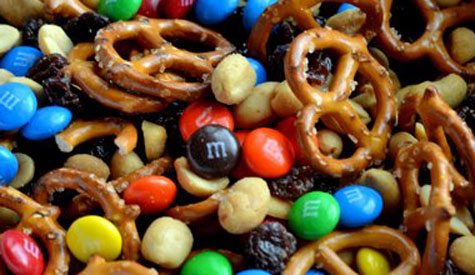
What type of mixture is this?
homogenous mixture
chemical
heterogeneous mixture
solid mix
A pure substance containing two or more types of elements that are chemically combined is called?
Mixture
Element
Compound
Solution
A mixture that is uniformly mixed is called?
Element
Compound
Homogeneous
Heterogenous

Physical change or chemical change?
Chemical
Physical

Physical change or Chemical change?
Physical
Chemical
Which of these show chemical formulas for compounds? Choose ALL that apply!
Water (H2O)
Table salt (NaCl)
Oxygen (O2)
Glucose (C6H12O6)
Which of these is not a chemical symbol of an element?
Water (H2O)
Copper (Cu)
Carbon (C)
Iron (Fe)
What is the smallest unit of an element that retains the chemical properties of that element?
Electron
Neutron
Molecule
Atom

Which of these samples shown best represents an mixture?
A
B
C
D
Which of these samples shown best represents a compound?
A
B
C
D

What is the name of this metric tool?
Triple Beam Balance
Graduated Cylinder
Massometer
Triple beam balances measure ________________.
Volume
Length
Mass

What is the volume of this prism?
18 cubic cm
6 cubic cm
9 cubic cm
The method used to find the volume of an irregular solid is called -
volume finding method
we cannot measure it only
Fluid displacement method
graph paper method
What is the formula for density?
Weight/volume
Energy/time
Volume/mass
Mass/volume
When measuring the mass of an elephant it is best to use:
g
nL
ng
kg
Which of the following is not a unit of volume?
L
mL
cm3
cm2
A graduated cylinder is used to measure the volume of what?
plasma
liquid
gas
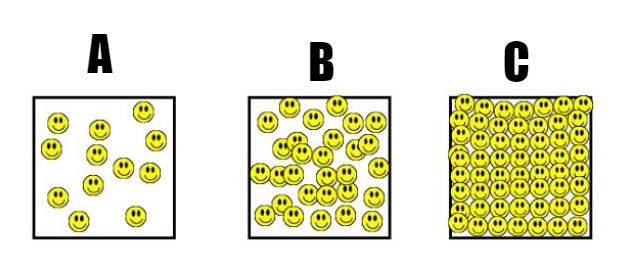
Which box shows the particles of an object that is the MOST DENSE?
A
B
C
they are all the same
If an object is more dense than water, what will it do when placed in water?
it will disappear
it will sink
it will float
it will break apart
Which unit is a unit of density?
cm
cm3
g
g/cm3

The tool pictured here is...
a buret
an erlenmeyer flask
a graduated cylinder
a beaker
The unit for volume is
grams
milliliters (mL)
Newton
cm
What is the density of water?
34 g/mL
1 g/mL
29 g/mL
6 g/mL
Physical Properties are
chemical changes
are properties that can be observed without changing the matter's identity
are properties that can be observed that change the matter into new matter with new properties
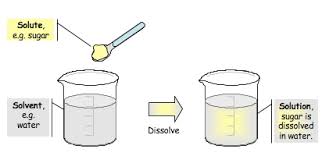
The ability of sugar to dissolve in water is called
malleability
Density
State
solubility
What is the SI unit of weight?
kg
grams
N
m3kg
Weight is the measure of the force of ______ on an object.
Density
Mass
Matter
Gravity
Velocity
6) Which measurement would be different if you were on the Moon versus on Earth?
Mass
Weight
Which of the following is a colloid?
Milk
salt water
Italian salad dressing
air
Which of the following is a solution?
Snow globe
Paint
salt water
fog
What is a mixture containing small, undissolved particles that do not settle out over time (Ex. Fog)?
Solution
Suspension
Colloid
Compound
What type of mixture separates upon standing?
Solution
Alloy
Colloid
Suspension

The beaker on the left would be a (both have been recently stirred)
Solution
Suspension
Colloid
Impossible to tell
Solutions are
Homogenous
Heterogenous
A snow globe would be an example of a __________________.
colloid
solution
suspension
In a ______________, one substance is dissolved in another substance.
solution
suspension
colloid

Mass and volume are both examples of
Physical Properties
Chemical Properties
Flammability and Reactivity are both examples of
Physical Properties
Chemical Properties

What type of matter is shown in this particle diagram?
Element
Compound
Mixture of Elements
Mixture of Compounds
Mixture of Elements and Compounds

What type of matter is shown in this particle diagram?
Element
Compound
Mixture of Elements
Mixture of Compounds
Mixture of Elements and Compounds

What type of matter is shown in this particle diagram?
Element
Compound
Mixture of Elements
Mixture of Compounds
Mixture of Elements and Compounds
Which particle diagram can be classified as a compound?


Which one of the following statements about compounds is correct?
The properties of a compound are the same as the properties of the elements of which it is made up.
At least one of the elements in a mixture must be a gas.
It is easy to separate a compound into the elements that it is made from.
The elements in a compound are always present in the same ratio.

Of the four boxes shown, which one represents a model of elements only?
A and C
A, C and D
B and D
B and C
A mixture that is uniformly mixed is called?
Element
Compound
Homogeneous
Heterogenous
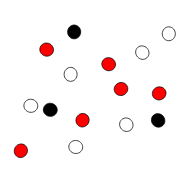

What type of matter is shown in this particle diagram?
Element
Compound
Mixture of Elements
Mixture of Compounds
Mixture of Elements and Compounds

What does this illustrate
Elements
Compunds
Mixture of Elements and Compunds
Mixture of Compounds

