wayground logo

Free Printable Worksheets

NEW

Font size

S
M
L
XL
Worksheets

Weather

Total questions: 60

Worksheet time: 44mins

Name
Class
Date
1.
Humidity is the...
a)
Amount of Water Vapor in the Air
b)
Amount of Wind in the Air
c)
Amount of Precipitation in the Air
d)
Amount of Pressure in the Air
2.

Because the earth is spinning on its axis, the global winds appear to curve. This is known as the __________ ________.

a)

Coriolis Effect

b)

Greenhouse Effect

c)

Cumulus Effect

d)

Stratus Effect

3.
What measures temperature?
a)
barometer
b)
anemometer
c)
thermometer
d)
psychrometer
4.
Clouds form when...
a)
liquid water is heated and evaporates to become water vapor in the atmosphere.
b)
water vapor in the atmosphere cools and condenses becoming water droplets in the atmosphere
c)
water droplets float upwards and gather together in the atmosphere to form a cloud.
5.
During which part of the water cycle does a cloud form?
a)
Evaporation
b)
Precipitation
c)
condensation
d)
Run off
6.
What is going on with the atmosphere at any particular time.
a)
Weather
b)
Climate
7.
Daily temperature, daily rainfall, daily amount of sunshine
a)
Weather
b)
Climate
8.
The tropical rainforest has experienced 50 to 260 inches of rainfall annually for the last  few decades.
a)
Weather
b)
Climate
9.

Right now the Southern Hemisphere is tilted away from the sun, so Australia experiences winter.

a)

Weather

b)

Climate

10.
The condition of the atmosphere, such as temperature, cloud cover, wind speed and rainfall
a)
climate
b)
weather
c)
trend
d)
season
11.
Rain, snow sleet, or hail that falls from the clouds in the sky
a)
humidity
b)
liquid
c)
precipitation
d)
weather
12.
Average weather conditions of a region year after year
a)
weather
b)
season
c)
cold front
d)
climate
13.
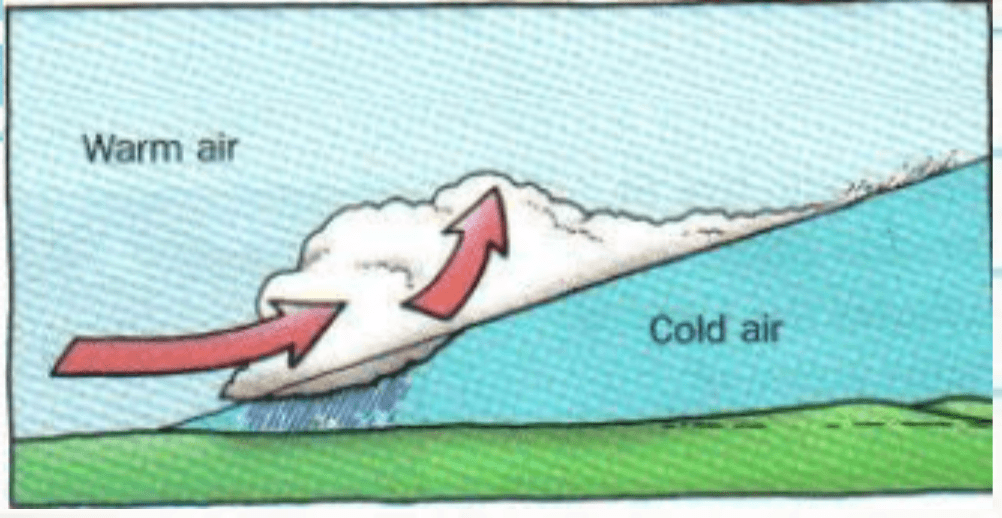
The location where warm air mass is replacing a cooler air mass
a)
cold front
b)
warm front
c)
icy front
d)
storm front
14.
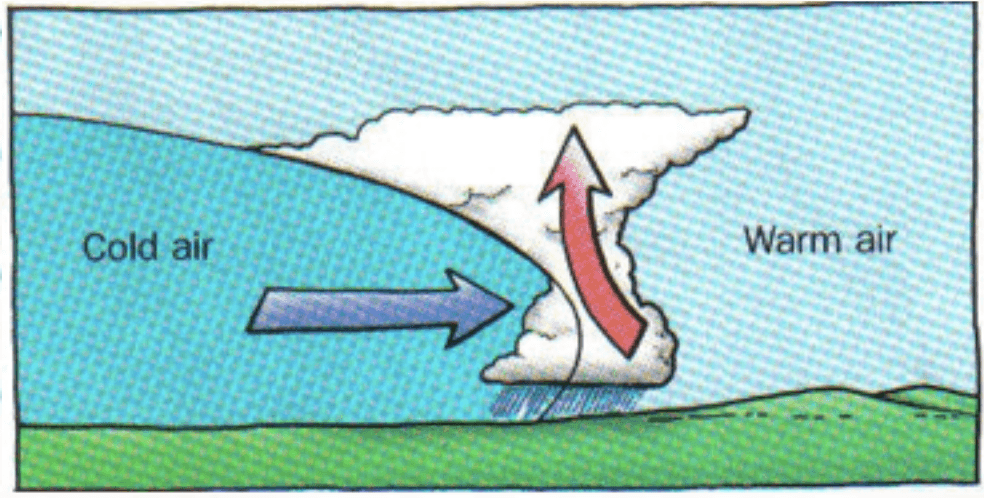
The location where cold air mass is replacing a warm air mass
a)
storm front
b)
hot front
c)
warm front
d)
cold front
15.
What does the rotation of the earth cause us to experience?
a)
seasons
b)
year
c)
day & night
d)
eclipse
16.
When the Northern Hemisphere leans toward the sun, the northern part gets -
a)
more sunlight
b)
less sunlight
c)
to be winter
d)
cooler
17.
What happens when the area in which you live tilts away from the sun?
a)
It is summer.
b)
It is spring.
c)
It is winter.
d)
It is fall.
18.

If it's ____ in the Northern hemisphere, then it's summer in the Southern hemisphere.

a)

spring

b)

summer

c)

fall

d)

winter

19.
What season is letter A in the northern hemisphere?
a)
Winter
b)
Summer
c)
Spring
d)
Fall
20.
Water from rain or snow that flows over the surface of the land into streams, rivers, and lakes is called...
a)
accumulation
b)
runoff
c)
ground water
d)
surface water
21.
The process by which plants release water through the pores in their leaves is called...
a)
accumulation
b)
dormancy 
c)
photosynthesis 
d)
transpiration
22.
The energy that drives the water cycle comes from the...
a)
Sun
b)
Moon
c)
Clouds
23.
Surface currents are a result of
a)
Global Wind Patterns
b)
Earth's Rotation
c)
Density
d)
All of the above
24.
Deep Ocean currents are a result of
a)
Global Wind Patterns
b)
Earth's Rotation
c)
Density
d)
All of the above
25.

Warm ocean currents generally come from

a)

The North Pole

b)

The South Pole

c)

The Equator

d)

Both Poles

26.

Cold ocean currents generally come from

a)

The North Pole

b)

The South Pole

c)

The Equator

d)

Both Poles

27.
Ocean currents have an affect on which two things
a)
climate and weather
b)
temperature and density
c)
land and sea
d)
equator and poles
28.
What process brings the deep cold ocean currents up to the surface?
a)
Conduction
b)
Global Wind Patterns
c)
Convection Currents
d)
Temperature and salinity
29.
Why are surface currents at the surface of the ocean?
a)
colder temperature
b)
colder temperature & more salinty
c)
warmer temperature & less salinty
d)
less salinty
30.
As you go to the top of a mountain, what happens to temperature?
a)
Nothing
b)
It increases
c)
It decreases
d)
It goes up and down
31.
The sun’s rays are least direct __________.
a)
near the poles.      
b)
in July.
c)
near the equator.
d)
far from the ocean.
32.
Large bodies of water affect climate of the land next to them because
a)
water heats up and cools more slowly than land
b)
water heats up and cools faster than land
c)
water and land cool at the same time
d)
water and land heat at the same rate
33.
What makes global winds curve rather than move in straight lines?
a)
the spinning of Earth
b)
changes in air pressure
c)
changes in temperature
d)
differences in latitudes
34.
The gradual increase in the temperature of the atmosphere is known as ___________________.
a)
sunspots
b)
global warming
c)
ice ages
d)
arid
35.

What process absorbs energy from the sun and hold heat close to Earth?

a)

Hurricanes

b)

Ozone

c)

Greenhouse Effect

d)

Air Pressure

36.
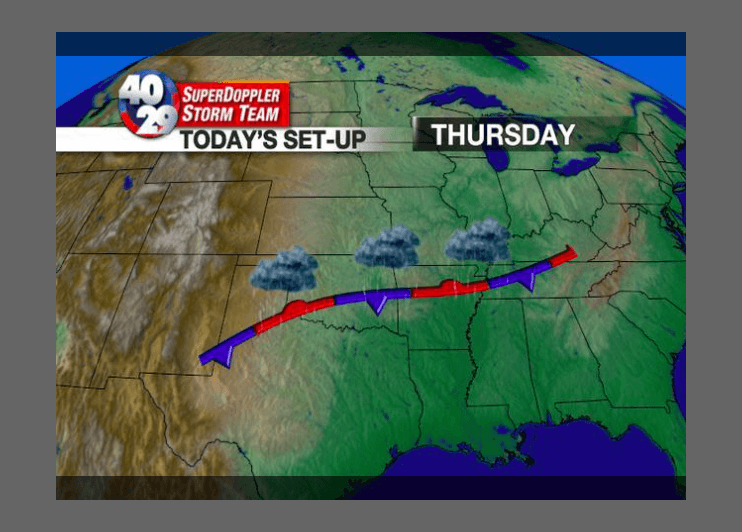
Which type of front can be seen here?
a)
cold front
b)
occluded front
c)
stationary front
d)
warm front
37.
On weather maps, there are lines with tiny triangles on one side. This represents --
a)
cold air moving in the direction the triangles point
b)
cold air moving opposite the direction the triangles point
c)
warm air moving in the direction the triangles point
d)
warm air moving opposite the direction the triangles point
38.

A ________________ is a scientist who studies the atmosphere to predict and understand earth's weather.

a)

biologist

b)

meteorologist

c)

opthamologist

d)

geologist

39.
Which front is located near San Diego?
a)
cold front
b)
warm front
c)
occluded front
d)
stationary front
40.
a)

cold

b)

stationary

c)

warm

d)

occluded

41.
a)

cold front

b)

warm front

c)

high pressure

d)

low pressure

42.
What type of front is represented on this map?
a)
cold front moving North
b)
cold front moving South
c)
warm front moving South
d)
occluded front
43.

During a cold front you are likely to experience...

a)

Thunderstorm

b)

Light drizzle

c)

Sunny Weather

44.

A warm front...

a)

replaces warm air with cool air

b)

replaces cool air with warm air

45.

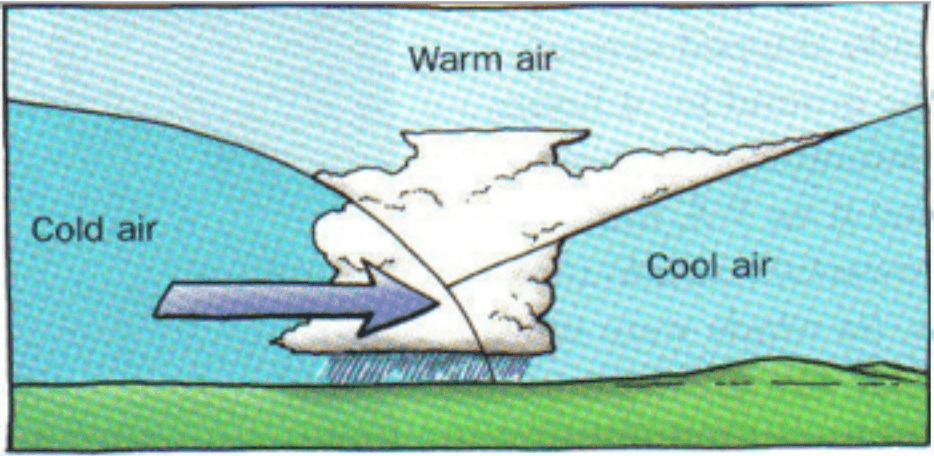
Name that front.

a)

Cold Front

b)

Warm Front

c)

Stationary Front

d)

Occluded Front

46.

Brings some clouds and gentle rains.

a)

Cold Front

b)

Warm Front

c)

Stationary Front

d)

Occluded Front

47.

Cold dense air slides underneath warm air. The warm air is forced up, cools, and condenses.

a)

Cold Front

b)

Warm Front

c)

Stationary Front

d)

Occluded Front

48.

Name that front.

a)

Cold Front

b)

Warm Front

c)

Stationary Front

d)

Occluded Front

49.

What type of weather will you see along a cold front?

a)

Thunderstorms

b)

Sunny skies

c)

Gentle rain

d)

No weather

50.

Name that symbol.

a)

Cold Front

b)

Warm Front

c)

Stationary Front

d)

Occluded Front

51.

Name that front.

a)

Cold Front

b)

Warm Front

c)

Stationary Front

d)

Occluded Front

52.

Temperature drops quickly. Strong winds, heavy precipitation.

a)

Cold Front

b)

Warm Front

c)

Stationary Front

d)

Occluded Front

53.
A warmer world is least likely to result in
a)
decreased food production
b)
reductions in biodiversity
c)
a rise in sea level
d)
more moderate weather
54.
In a warmer world, we would expect more
a)
droughts
b)
hurricanes
c)
desert expansions
d)
all of these
55.
The term "greenhouse effect" describes
a)
occupational diseases of florists
b)
the trapping of heat energy in the troposphere by certain gaseous molecules
c)
the trapping of heat energy in the stratosphere by nitrogen
d)
efforts by the White House to support environmental legislation
56.
Things you can do to help decrease global warming include:
a)
Eat more ice cream.
b)
Keep your freezer door open.
c)
Keep your air conditioner on high.
d)
Turn off your lights when you’re not using them.
57.

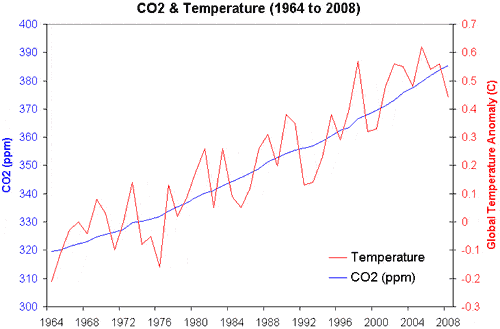
The graph below shows CO2 emissions and temperatures from 1909 to 1949. What conclusion is best supported by the graph?

a)

There is no relationship between carbon dioxide concentrations and temperatures

b)

As carbon dioxide concentrations increase, temperatures increase

c)

As carbon dioxide concentrations increase, temperatures decrease

d)

As carbon dioxide concentrations decrease, temperatures increase

58.

Which of these is NOT a greenhouse gas?

a)

Carbon Dioxide

b)

Nitrous Oxide

c)

Oxygen Gas

d)

Methane

59.

Carbon Dioxide, CO2, comes from

a)

Burning fossil fuels

b)

Cold water

c)

Animal manure

d)

Plastic

60.

Some ways to slow Global Warming are

a)

Take lots of airplane trips

b)

Making your bed and cleaning your room.

c)

Buying food and items from far away (other countries)

d)

Riding your bike, recycling, save energy, use less water