
 Worksheets
Investigating Genetics
Total questions: 57
Worksheet time: 57mins
Genes are located on an organism’s -
ribosomes.
vacuoles.
lysosomes.
chromosomes.
Inherited traits are governed by–
digestive enzymes
cell products
blood cells
genetic material

The table lists traits and whether they are recessive or not for two parents. Based on the data table, if the parents reproduce and create an offspring, the offspring will -
definitely have red hair and most likely have brown eyes.
most likely have brown hair and definitely not have blue eyes.
definitely have brown hair and definitely have blue eyes.
most likely have red hair and maybe have blue eyes.
Chromosomes are best known as units of an organism’s -
dietary intake.
genetic make-up.
local habitat.
survival instincts.
An organism inherits its genetic material from its -
offspring.
food source.
parents.
environment.
In which organelle are chromosomes located?
Nucleus
Cell wall
Lysosome
Vacuole
What is heredity?
The production of protein for an organism’s energy needs.
The passing of genetic material from parent to offspring.
The removal of waste from an organism’s cells.
The relaying information between parts of an organism.
In humans, the gene for brown eyes is dominant over the gene for blue eyes, which is recessive. If two blue-eyed parents have eight children, how many of their children will have blue eyes?
0
2
8
1
If both parents have the recessive traits, the offspring will
also have the recessive trait
will still have the dominant trait
If one parent has the dominant trait, but the other carries the recessive trait
the offspring will most likely have the dominant trait still.
the offspring are guaranteed to have the recessive trait.
Recessive genes show up when
there is an absence of dominant genes for the same trait
never
always
How frequently are dominant traits expressed if the organism has them?
Always
Never
Sometimes
How frequently are recessive traits expressed if the organism has them?
Always
Sometimes
Never
Asexually produced offspring will be
genetically uniform
completely different than its parent
Sexually reproduced organisms
are identical
show more variation
sexually reproduced offspring
are identical to the mother
are identical to the father
are genes that are uniquely combined from both parents
are identical to other offspring
"T" is dominant, "t" is recessive. If an organism has the genes "Tt."
Which will trait will result?
"T" Dominant
"t" Recessive
"G" is dominant, "g" is recessive. If an organism has the genes "gg."
Which will trait will result?
"G" dominant
"g" recessive
What should you use to predict the traits of offspring when you know the genes of two parents?
a graph
a flow chart
a data table
a Punnett square
Scientists in Bikini bottom are investigating the genetic makeup of the organisms in their community. Select all of the genotypes below that are homozygous dominant
Dd
ff
BB
tT
TT
Scientists in Bikini bottom are investigating the genetic makeup of the organisms in their community. Select all of the genotypes below that are heterozygous.
TT
Bb
DD
fF
tt
Scientists in Bikini bottom are investigating the genetic makeup of the organisms in their community. Select all of the genotypes below that are homozygous recessive
bb
dd
BB
tT
tt


There are two types of reproduction :
semisexual reproduction
asexual reproduction
bisexual reproduction
sexual reproduction
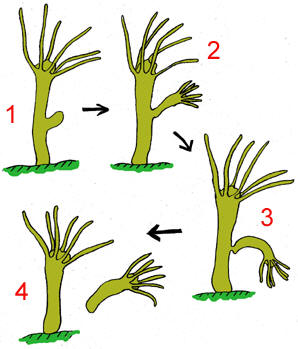
When an offspring grows off from the body of a parent organism it is called __________________.
budding
fission
fragmentation
sporulation
What are some advantages of asexual reproduction are: (select all that apply - there are 3)
it only requires one organism
it takes less energy than sexual reproduction
offspring are already well-adapted for the environment
there is a lot of genetic variety
Some advantages of sexual reproduction include: (select all that apply - there are 3)
genetic variation
improves chances of adapting to the environment
helps species survive catastrophes
it doesn't take as much energy as asexual reproduction
Male and female reproductive cells are collectively known as:
spores
pollen
gametes
offspring
Genetically identical offspring are _____________ the parent organism.
opposite of
clones of
superior to
inferior to
____________________ occurs when a male gamete (sperm) combines with a female gamete (egg).
sporulation
fertilization
fission
regeneration
How many parents are required for sexual reproduction?
0
1
2
3

Asexual reproduction is associated with what type of cell division?
Mitosis
Meiosis

What is the type of cell division associated with sexual reproduction?
Mitosis
Meiosis
A parent cell breaks into pieces and each piece becomes a new offspring.
Binary Fission
Budding
Fragmentation
Vegetative Reproductions

What type of asexual reproduction is taking place?
Binary Fission
Budding
Fragmentation
Regeneration
Vegetative Reproduction
An organism that has been reproduced by asexual means receives ______________ of its chromosomes from its one parent.
3
25%
50%
100%
In asexual reproduction, all of the offspring are:
Physically Identical
Genetically Identical
Physically and Genetically Identical
Not Identical
An organism that has been reproduced by sexual reproduction received ____________ of its chromosomes from the male parent.
4
25%
50%
100%

These are long strands of DNA in the nucleus that controls the traits of an organism.
Gene
Allele
Chromosomes
a characteristic that distinguishes one organism from another.
Trait
Facial Recognition
Genotype
DNA
a section of DNA on a chromosome that has genetic info for 1 trait
Gene
DNA
Chromosome
Meosis
describes an organisms observable set of traits
phenotype
genotype
notmytype
appetite
describes an organisms complete set of genes
genotype
mutation
fission
genes
a change in the DNA code of the gene
mutation
adaptation
constellation
hibernation
reproduction in which the genetic materials from 2 different parent cells combine to produce offspring.
Asexual Reproduction
Sexual Reproduction
Reproduction
Fission
an egg cell and a sperm cell joined together
fission
fertilization
meosis
osmosis
pairs of chromosomes that have genes for the same traits arranged in the same order.
Homologous Chromosomes
Chromosomes
Mutation
Fission
one diploid cell divides and makes 4 haploid sex cells
meosis
mitosis
fission
mutation
Reproduction done with one parent without meiosis and fertilization
Asexual Reproduction
Genotype
Phenotype
Trait
cell division in prokaryotes that forms 2 genetically identical cells.
Fission
Mutation
Meiosis
Trait
Genetic information in a cell
DNA
RNA
CNA
DMV
the passing on of physical or mental characteristics genetically from on generation to another
heredity
dna
traits
chromosomes

