

wayground logo

Free Printable Worksheets

Font size

S
M
L
XL
Worksheets

Nature of Science

Total questions: 55

Worksheet time: 4hrs 33mins

Name
Class
Date
1.
Justin blows his nose, but mucus seems to leak through the tissue.  He decides to test which tissue holds up the best while sneezing.  What is the independent variable?
a)
sneezing
b)
Justin
c)
amount of tissue
d)
type of tissue
2.
Mr. McNeice wanted to know if different types of music affected people's heart rates, so he played different music and checked their pulses.  What is the dependent variable?
a)
type of music
b)
heart rate
c)
how long they listend to music
d)
Mr. McNeice
3.
This is the outcome of the experiment. We get data and results from this.
a)
Independent Variable
b)
Dependent Variable
c)
Control
d)
Constant
4.
How many independent variables should be tested at a time in a scientific investigation?
a)
none
b)
one
c)
two
d)
three
5.
Which is the dependent variable in Amelia's experiment?
a)
the number of bean plants in each group 
b)
the amount of water given daily to each plant 
c)
the height of each bean plant 
d)
the amount of fertilizer given to each group of bean plants
6.
The variable that is changed on purpose is: 
a)
Control
b)
Dependent
c)
Independent
d)
Outcome
7.
When experimenting with the growth of a plant, a scientist uses three plants, two different fertilizers, equal light, and equal water. What type of variable is the water?
a)
Dependent
b)
Independent
c)
Control
d)
Outcome
8.
Which of the following might lead to the changing of a scientific idea?
a)
A scientist describes an experiment to a group of students
b)
A scientist gets the same results when repeating an experiment a second time
c)
a scientist gets results that do not fit a current idea and other scientists find his results are valid
d)
a scientist has to redo her experiment because she finds the correct procedure was not followed
9.
During a scientific investigation which step will a scientist likely perform first?
a)
form a conclusion
b)
experiment
c)
define the problem
10.
I want to see how the amount of water affects plant growth.  What is the independent variable?
a)
amount of water
b)
plant growth
c)
type of plant
d)
soil type
11.
A testable idea or explanation that leads to a scientific investigation is called (can be stated as an if/ then statement)
a)
conclusion
b)
experiment
c)
hypothesis
12.
The variable that stays the same
a)
independent
b)
dependent
c)
control
13.
All the measurements and data scientists gather in support of a scientific explanation
a)
hypothesis
b)
valid
c)
invalid
d)
empirical evidence
14.
Sometimes scientist imitate something that is too big or too small to work with by creating a(n)
a)
experiment
b)
data station
c)
model
15.
When forming a conclusion you should
a)
Prove or disprove your hypothesis
b)
Always confirm your hypothesis
c)
State it as an if/ then statement
16.
How are theory and hypothesis alike?
a)
Both are completed by experts.
b)
Neither of them can be revised.
c)
They attempt to explain natural phenomenon.
d)
They both describe an event in nature.
17.
Something that is always true and is expected to happen every time is called a _____
a)
conclusion
b)
hypothesis
c)
scientific theory
d)
scientific law
18.
A well-tested explanation for a set of observations is called a ____
a)
scientific law
b)
scientific theory
c)
observation
d)
metaphor
19.
Sometimes scientist imitate something that is too big or too small to work with by creating a(n)
a)
experiment
b)
data station
c)
model
20.

What is the systematic study of the natural world, events and conditions?

a)

Science

b)

Pseudoscience

c)

Math

d)

Psychology

21.
Empirical evidence is__________________.
a)
Data
b)
Opinion
22.

Why would a scientist run an experiment with several trials instead of a single trial?

a)

Repetition increases the accuracy of the results

b)

Repetition increases the sample size

c)

Replication lets the experimenter change variables

d)

Replication lets the the experimenter change the procedure

23.
A possible explanation to a problem that has not yet been tested. 
a)
data
b)
theory
c)
hypothesis
d)
fact
24.

Which list is in the correct order that a scientist might follow during an experiment?

a)

Collect Data -> Analyze Data ->Conclude

b)

Collect Data -> Form Hypothesis -> Create a Question

c)

Form a Procedure -> Ask a question-> Form an opinion

d)

Analyze Data -> Run an experiment -> Form a Procedure

25.

Which phrase best describes why a scientist would modify an idea

a)

They wanted to prove another scientist wrong

b)

They proposed a Law

c)

Scientist had to much information to look at

d)

Scientist gained new data and then debated the change

26.

What does it mean to replicate

a)

Copy another person's answers down

b)

Complete repeated trials of an experiment to test the authentication of data

c)

performing another scientist's study; following the same procedures

d)

Collect data and put it in a chart

27.

What does it mean to go through repetition?

a)

To complete many trials over and over to authenticate data

b)

To change the variables and retest

c)

To copy another scientist's answers

d)

To perform another scientist's study to check the procedure and data

28.

What is the difference between an independent and a dependent variable?

a)

The dependent variable does not change while the independent variable does

b)

The dependent variable does not change while the independent variable does not change

c)

The dependent variable is the test variable and the independent is the outcome variable

d)

The dependent variable changes based on the independent variable.

29.

What could change a scientific idea?

a)

technology is used to teach a specific concept

b)

two scientist replicating the same experiment under the same conditions gain different results

c)

New evidence doesn't support a theory, other scientist agree with the new finding

d)

An experiment is found out to have contaminated variables.
30.
On which axis would you place the independent variable?
a)
X
b)
Y
c)
Z
31.
On which axis would you place the dependent variable?
a)
X
b)
Y
c)
Z
32.
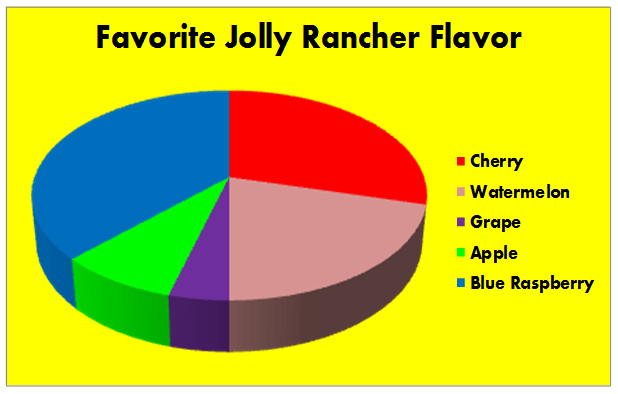
According to this graph, what is the most popular flavor of Jolly Rancher?
a)
Cherry
b)
Grape 
c)
Blue Rasberry
d)
Watermelon
33.
What percent of people chose gummy bears as their favorite candy? 
a)
25%
b)
15%
c)
30%
d)
None of these
34.

Researchers were studying Disney employees and how they traveled to work. They collected their findings and graphed the data. Which question could the graph be used to answer?

a)

What is the number of cars owned by Disney employees?

b)

How many Disney employees can ride a bike?

c)

How many more Disney employees take the bus than walk to work?

d)

Ho many Disney employees ride with another person to get to work?

35.

Samantha runs an experiment and collects data on how far a ball travels. She runs four trials and the last one is drastically different from the first three. How could she improve the accuracy of the investigation?

a)

Get rid of the data that is different

b)

average the data from each trial together

c)

do more trials

d)

try a different ball

36.

Which item might be used to record the measurements of height, and weight for each student in a class?

a)

A camera

b)

sketch

c)

graph

d)

data table

37.
A set of principles that explains and predicts a phenomena is called a _____. 
a)
scientific law
b)
scientific method
c)
scientific theory
d)
scientific instructor
38.
What is a theory?
a)
Describes what happens
b)
Explains a process
39.
What is a law?
a)
Describes what happens
b)
Explains a process
40.

Theory or law? The cell _________ of living things: living things are made of cells, which explains how things grow and live.

a)

Theory

b)

Law

41.

Theory or Law? Kepler's ______ of Planetary Motion: how planets orbit the sun. Shows what happens with planets.

a)

Theory

b)

Law

42.

Theory or Law? Tectonic ________ of Geology: the surface of the earth is made of tectonic plates, which move slowly. Explains why mountains are formed, earthquakes happen, etc.

a)

Theory

b)

Law

43.

Theory or Law? Newton's first ______ of Motion: Objects will stay in motion unless stopped. Shows what happens with moving objects.

a)

Theory

b)

Law

44.

Theory or law: Atomic _____ of matter: all matter is made up of atoms. Explains why matter behaves a certain way.

a)

Theory

b)

Law

45.

Can be expressed by a mathematical equation

a)

Law

b)

Theory

c)

Both

46.
When a another scientist does someone's experiment to see if the results are valid?
a)
repetition
b)
replication
c)
experimental method
d)
controlled variable
47.
Scientists frequently repeat the experiments of others scientists. Why is this important in science?
a)
Scientists often ask each other for help in performing experiments.
b)
Replication of experiments helps to confirm and verify results.
c)
Scientists frequently perform other scientists’ experiments in order to practice their technique.
d)
Repeating experiments is an effective way to make sure a laboratory is in optimal condition.
48.
Caira reads in a science journal that replication and repetiton are so important, but she did not understand the  difference between them. Which of the following best explains the two terms?
a)
Repetition is when a scientist repeats an experiment; replication is when a scientist conducts an experiment on genetic material.
b)
Repetition is when a scientist does the same experiment a number of times; replication is when other scientists reproduce a scientist’s experiment.
c)
Repetition is when a scientist publishes in more than one scientific periodical; replication is when another scientist reproduces another scientist’s results.
d)
Repetition is when a scientist commits an error in an experiment the first time and must repeat it; replication is when a scientist repeats an experiment to make sure it is valid.
49.
Dr. Smith has been reading about another scientist’s research in a physics journal. He plans to do these experiments himself and see if he gets the same result.
a)
repetition
b)
replication
50.
Josue goes to Silver River each week for 4 weeks and collects 5 samples of water to test the pH.
a)
repetition
b)
replication
51.
An environmental group contacts Nina to get her procedures so that they can check her results.
a)
repetition
b)
replication
52.
Kevin was mixing a batch of glue and borax solution to make silly putty and discovered a new substance that glows in the dark. He gave Ja'nay his specific amounts of ingredients and the steps of his procedure. He asked Ja'nay to try the experiment to see if she gets the same results.
a)
repetition
b)
replication
53.
Paco's daughter will be participating in an upcoming dance recital. She will require a different costume for each dance she plans to performs.
c = the number of costumes Paco's daughter will require
d = the number of dances Paco's daughter plans to perform

Which of the variables is independent?
a)
c
b)
d
54.
An experiment is performed on plants to see how different liquids affect plant growth. Each plant in the experiment is given a different liquid; water, apple juice, or milk. Each plant has the same amount of soil, sunlight, and listens to the same music. In this investigation, the independent variable is ...
a)
The type of plant
b)
The amount of sunlight
c)
The type of music
d)
The type of liquid
55.
Kreedence wants to know if birds prefer to eat in one place over another. She makes three feeders out of 2-liter bottles and paints all of them red. She fills each of the feeders with the same amount of mixed birdseed, and plans to keep the feeders out for 10 days before measuring how much seed is eaten from each feeder. She puts each of the feeders in her back yard: one feeder in a large dead tree, another feeder she sits on the dog house, and the last she sits in a small bushy tree.
What is the dependent variable?
a)
Length of the birdfeeders
b)
Amount of time feeders are outside
c)
Amount of seed eaten
d)
Location the feeders are put in.
